Classes in Blackmoor, or, how to run a class system and abandon it at the same time 

So in Blackmoor, the pre-D&D attempt at a role playing game, we run into what I think is the best attitude to how to run a campaign and why I dislike so many modern RPGs. So with nothing to turn to, because he was doing something entirely new, Arneson grabbed a copy of the war game “Chainmail” and gave the three most interesting military units in the game to his players: the Hero, the Seer, and the Elf. 

The Hero is a basic ground unit that ranges from Light Footmen to Heavy Horse (all units in the Chainmail game) depending on the gear they can buy. Really, it is 6 different units that all follow similar rules. Basically, they can make themselves a higher point value unit by finding gear or looting dungeons to buy gear. They have 4 unique features: 

  • No morale checks (a war game mechanic) 
  • Gain +1 to all melee attacks 
  • The biggest and most powerful bonus of all: 4hp!… which in a game where everything has 1hp is actually a really big deal. All 4 points of damage had to be dealt in the same round. 
  • If a Dragon is flying overhead and you have a bow, instantly kill the Dragon on a hit of 10 on 2d6 assuming you are a “Ranger” and you are using enchanter arrows. 

There is also an upgraded unit called a Superhero. 

  • Force a morale check when you charge at an enemy formation
  • Upgrade that health to 8hp
  • Dragon killing with a bow on a 7. 

The Seer is the lowest form of Wizard. They had a strong default spell list right out of the gate. 

  • Invisibility on Self. This is a turn to turn ability so it is actively using their magic. 
  • Fireball… which used the math of a Catapult 
  • Lightning Bolt… which used the math of a Heavy Field Gun (i.e. a Cannon) 
  • Immune to normal arrows and they got a saving throw to prevent fireball or lightning bolt against them. Think of this as the shield spell and an automatic Counter Spell against spells they know. 

In addition to these things they also got a single spell of their choice. As they improved, they learned more spells and increased their odds with Counter Spell and Shield. They had two health and the defensive stats of heavy infantry which is solid. 

Arneson also made a few Elves. These elves were less Tolkien and more Kibbler or Santa style and are always talked about in the same breath as fairies. These were upgraded archers from chainmail with some bonus features like the Dragon-kill archery, invisibility, and bonus dice when rolling against Orc or Goblins (similar to 5e’s advantage system). They also got to ignore some of the rules about combining movement with archery as well as splitting movement. So they aren’t faster in a run, just less restrictions on movement overall. 

Now while Arneson was happy with a bunch of Heroes running around in his world, he still wanted Seers and Elves to be somewhat rare in his world… so he just did not make that many character sheets for them. Later on DMs and game designers would try to control for this rarity with stat requirements as a way to control access… but if you are the DM, yea, you can just control for that directly. 

As people started to play the campaign… things started to change based on what his players did, what players wanted, and what challenges they faced. 

First, built into Chainmail is a trade-off between protection and movement speed. Higher protection, slower movement (from 12” to 9” to 6”). Movement paired with a charge mechanic from the base chainmail game. 

The obvious way to play was to buy nicer armor and weapons as you looted the dungeon, so most players moved along this default “Peasant to Knight” style of play. Most players did this while hiring soldiers and building castles along the way. 

However a few mechanics stopped this from being universal. If in melee, you can give up your movement to attack a second time. Charge was also a solid tactic the people wanted to use whenever possible. Both of these made some players favor movement over armor. Thus, some Heroes preferred the speedy, so a more “Barbarian” style of play developed, ignoring the armor aspect of character development for the speed. 

Other players liked to have ranged weapons. Ranged weapons only fired once per turn and had specific movement limitations added. From here you can see the emerging mix of heavily armored knights with swords, lightly armored archers who quickly redeploy as far away as they could, and speedy barbarians who mix it up with both sword, bow, and charging into combat. This is NOT a Knight Class, Ranger Class, and Barbarian Class since it is all within the same system… but they did use those terms to describe who their characters were, not what their character was. And of course which of these options was the best also depended on if you had picked up a magic sword, enchanted arrows, or magical set of armor. This was all the default Hero and the root of the multifaceted Fighter we have today. 

One of the first big enemies in the campaign was a Vampire named “Sir Fang”. He was actually not played by Arneson, but instead played by another player and played by correspondence since they could not be at the table often. Some of the players were talking about how they could defeat him. They started to research vampires at the local church and discovered that yes, the vampire was weak to all traditional anti-vampire things. Then one of the players pitched an idea “Hey, can my Hero join the priesthood so I can make holy water?” Arneson loved this idea but wanted to keep the game balanced. So he gave the best answer any DM can give “Yes, but at a cost.” Two of the Heroes now class changed to Clerics. All of the magic weapons in the game were bows or swords, so they gave up bows and swords, thus limiting themselves to hammer, but they gained holy water and Turn Undead. They were now Van Helsing like characters.

As the campaign moved on, Sir Fang started to try to turn people into vampires. “The Wounds” was an euphemism for the pair of neck holes when a vampire had bitten into your neck. Wounded people had a chance to “turn” periodically, thus creating a moment like in a zombie movie when someone is bitten and the others have to decide to save their friend or kill them. One of the Clerics started to research how to cure people of vampyrism while the other Cleric went on a quest to find that knowledge. In the end, they put what they learned together and gained the origin of “Cure Wounds”. In modern D&D this would be a restoration spell with a percentage chance of failure, not a heal. This is a war game at its heart, you are either fully alive or fully dead, so there is no healing. 

The next set of upgrades were to the game’s Seers/Wizards. Those players were just a bit underpowered. Arneson did not change the class, he just patched each character in a different way. One of them got a temperamental baby dragon. Most of the time, it was a bonus but not always. … and yes, this right here, this is the best way to patch a character. Not a +1 or +2 or weak to X damage type, but a temperamental baby dragon. 

Another of these patches was the “Super Berries”. These were limited, grew on only one tree, and would rot after a while. The Wizard could eat them to cast a more powerful version of their spells. Basically, this is the 5e Sorcerer’s Empowered Spell or upcasting a spell but with a limited number of usages. That is right, Sorcery Points are actually older in D&D than spell slots. Blackmoor was played on Arenson’s ping-pong table and they used brightly colored ping-pong balls to track the Super Berries. Using a Super Berry also gave the player the chance to chuck the ping pong ball at the DM’s head, an underutilized mechanic in modern D&D to be sure. 

And finally we have… the unique ones. There are two characters that are often brought up as classes. They were never classes, just the result of one-off things in the game. The first is the Sage… which may be one of the most unlucky characters in the history of the game. They were a Hero and had built up a bit of an army. They studied tactical and siege weapons. They were meant to be a great and powerful warlord… until they were turned into a basilisk. One of the other magic users tried to develop spells to reverse the effects… but instead just kept polymorphing them into other random things. Every few sessions he would get transformed into something else odd, everyone would laugh about it, and then move on with the player using a set of monster stats for just a session or two. Finally in one session he got polymorphed into a female elf seer and he said “good enough” and that character became “The Sage.” Basically Arenson agreed to another “Yes, but at a cost” deal similar as he did with the Clerics. The Sage kept all his weapons, soldiers, and siege knowledge but would physically play those as a Seer. He-now-she, would give up damaging spells like Fireball and Lightning Bolt but keep spells like Shield, Invisibility, and Counterspell. She then gained some curses to cast on others. This odd character was a mix of war scholar and support caster is a class total unique to their story in game, with many of the curses match his previous forms. 

The second was “The Merchant” who was actually a bad guy like Sir Fang. No, this was not a player running a shop like a NPC. It was a mafia don and it was one of the players doing it. They were forming a cabal to raise pricing at all the shops and the tavern with the difference in price going to “The Merchant” who soon became the richest player until the other players were tired of being taxed and figured out who was doing it. That required the players to break up the mafia in game and thus defeat the Merchant. So, at the start PvP was enabled but it was done via economics. 

Much in the same way we got the Blue Rider, the Flying Bishop, and the Paladin. The Blue Rider had a blue-flame sword (nice), a mechanical horse named bill which ran on lamp oil (neat), and a set of blue platemail which was really strong (and he was clearly trapped in it, causing him great pain and slowly killing him, oh God!). The Flying Bishop was one of the two clerics but with a magic cloak that let him fly some-what, really it was more like jumping really well. So he dropped the hammer, got a pair of metal boots, and started to do kung-fu kicks. The Paladin was just one of the more honorable Heroes who had done some quests for the King, had a nice sword, and always answered the call to patrol the roads. 

So let’s review: 

Start of Campaign 

  1. Hero 
  2. Seer (limited number)  
  3. Elves (limited number) 

End of Campaign 

  1. Heroes with a side of Knight 
  2. Heroes with a side of Ragner 
  3. Heroes with a side of Barbarian 
  4. Seer but with Baby Dragon 
  5. Seer but with Super Berries
  6. Elves  
  7. Hero into Cleric 
  8. Hero into Cleric into Monk 
  9. Sage 
  10. The Merchant 
  11. The Blue Rider 
  12. The Paladin 

… and to me, this is the way to run a campaign. Give players the minimum they need to get started. Players should get their powers from the world, not the Handbook, so the more you give them upfront the less choices they have as they play. This makes large lists of starting character options a bad thing. Those ideas are great, but they belong in the world and not a starting character’s sheet. At the same time, the DM should not limit how a player wants to develop their character. They should allow for a “Yes, but at a cost” style of character development in game. How your character changes and improves should be a response to what happens in the game, not a build you got off of Reddit.

This is part of my beef with many tabletop games. We have moved character development from the story to the prologue. Let’s put the character back into the story.
Will the Democrats learn this time or repeat their 2016 mindset?

So to fully understand this article you will need to first read this: https://www.natesilver.net/p/24-reasons-that-trump-could-win. Nate Silver is still the best pollster America has. He is a liberal. These are his words on why his party may lose. Published 2½ weeks before they did lose. I would roughly divide these 24 reasons into 3 groups:

  1. Situational issues specific to this election or Harris in particular
  2. Running as an incumbent and people’s reflection on the result on the current administration
  3. Fundamental party issues

So before we dive into this, let’s start with point 0. If you are on the Left and this result is “unbelievable” or “I just can’t understand it” then you do not have any of the problems listed by Nate. You have a reality problem. That is not a take down nor is it an insult, it is a technically correct analysis on the range of information you are allowing in. Trump and Harris have been tied for 3½ months in the polls. If two people are tied, then it is not a surprise when either one of them wins. You should have seen this coming, or at least admitted that there was a notable possibility of it. Feeling bad for a loss, that is human and you have my sympathy. Doubly so for those who have worked hard on campaigns only to lose. Not being able to contemplate how a loss is possible even when it is widely reported on and has been widely reported on for months? That is an unwillingness to accept information you don’t like.

It is ok to be wrong. Use it to get stronger. 

So Nate’s 24 points break down into 3 big blocks of ideas: 

  1. 10 points specific to this election or Harris

  2. 7 points specific to how the Biden Administration ran things, or more precisely how well some of their policies worked

  3. 7 points about the Democratic party at large and where they fit in and aligns with the general US population

The first 10 we get to ignore. Those will not be an issue for Democrats in the next election cycle. If you want to scapegoat while refusing to get better, that is your list. Please don’t do that.

The next 7 are policy lessons that should be reviewed. CNN calls out Harris (https://www.cnn.com/2024/11/06/politics/harris-campaign-went-wrong/index.html) for struggling to answer the question “What would you do differently?”. That is a scapegoat. The problem is not how she answered her question but that many choices made collectively by Democrats over the last few years did not end up well. That means the party needs to reflect on those and make actual policy changes. A political party losing an election because they made bad decisions is the sign of a healthy democracy. Given the role of inflation in this election and the way Democrats treated Joe Manchin and economists who warned them on over spending, this black eye is earned.

Look, policy is hard. The history of public policy is filled with stories of unintended consequences. Some ideas are “broadly good ideas” but don’t work at a specific time or in a specific situation. That is a nuance that policy makers need to understand and always strive to get better at. Their desires for an idea do not outweigh the realities on the ground. Some level of moderation, timing, or situational adjustment are needed. Yes, still do the idea most of the time, just not all of the time if the situation does not match. Polarization makes this worse because what was a “broadly good idea” now gets turned into a political litmus test as if an edict from God. If you want to make minor modifications to it instead of bowing to it as an immutable truth then you are “not a real Democrat”. And that is the problem. When ideals and reality don’t agree, the side that votes against reality will quickly find reality voting against them in the next election. And that is the sign of a healthy democracy.

The final 7 issues are about the party at large… and almost all of them were said in 2016. Part of what happened here and has been happening is the Democrats were so busy hating Trump at the start of 2017, they just never reflected on their weaknesses and they elevated their most unlikable voices. You know, the exact same trick Karl Rove pulled during the Bush Administration. This is not hard to figure out. Open up the Democratic platform on one screen. Open up the Gallup poll on the other screen. Compare them and when 60%+ of the country disagrees with your position, that is where you need to moderate, not dig in.

Previously, the Democrats were slowly and steadily losing both the Labor vote and the minority vote. With the new male/female split among those in their 20’s, they may be losing the youth vote too. Now let me be clear: when I say “losing” what I mean is losing their advantage, i.e. they are now splitting the vote with Republicans instead of it being a source of surplus votes, i.e. part of their “Big Tent”. Latinos and the Asian voter were already becoming more diverse in their political views. We will have to wait and see the final polling numbers, but the number I am most curious to see is the ratio on how black men voted.

Either way, all of this adds up to the fact that the Democratic party is no longer the “Big Tent” party it once was. It is a medium tent party at best, and a medium tent party is just not good enough to win an election, not even against candidates as flawed as Donald Trump. For Democrats to win, they need to enlarge their tent again. That will take compromise on some issues, reprioritization on other issues, and flat out recanting some very unpopular ones. Those are going to be hard conversations for the party, but they are hard conversations that are long overdue. It is time for the Democrats to trade some tiny voting blocks in deep blue states to regain a footing in some much larger voting blocks in swing states.

… and you don’t have time to spare. As I am writing this the Senate is clearly going red and while the House is still in play… it is steadily filling up red as well. The Left needs to get strong if they want to divide power and block the worst of Trump in the second half. And that is the line. It is not “do I like this new policy position”, no the line is “does this position help win in the next election?”. That is the question that should have been asked in 2016 when Hilary lost. It should have been asked in 2020 when Biden won but with the thinnest of margins. The quality of character between Biden and Trump is massive, the margins should not have been that small. And now in 2024 the Democratic Party has once again being given the chance to take a fearless moral inventory of itself in the light of popular opinion.

I hope the Left learns. America needs it to.

The ground work for my next campaign

So for my next campaign I am working on something both more in the west marches style and something in the Sword and Sorcery vein. The issue with the latter is most RPGs are written with high fantasy in mind. So I have been working on a simple system that best matches the Sword and Sorcery style and also leans into the west marches ideas. 

I have a few overarching goals 

  • Warrior types should have a risk and reward play style. Brave heroes require brave players.
  • Warrior types should be given bonuses for cunning plays. Cunning heroes require players with good ideas and who have figured out the enemies. 
  • This should feel gritty but require minimal paperwork and complexity 
  • Ways to handle the flavor character types: the trickster, the hunter, the beastmaster, etc. but require minimal paperwork and complexity. These are flavors of warriors, not fully their own thing. 
  • Capture the parallel duality of magic and civilization
    • Magic should feel chaotic and corrupting but also powerful and strategic; spells should have an effect and a possible cost that reflects that effect; there is an element of corruption to magics, an element of darkness 
    • Civilization should feel chaotic and corrupting but also powerful and strategic, i.e. an Army; being in a civilization should have advantages and also drawbacks, risks, or complications; there is an element of corruption to civilization, an element of darkness 
  • Each character should have lots of small upgrade options within each class. I don’t want big leveling moments or lots of heavily delineated classes but instead lots of small bonuses. I would rather have a spectrum of Barbarians than multiple warrior classes. I would rather have a spectrum of Sorcerers than multiple magic classes. 

Here is my attempt to answer those goals 

Core mechanics 

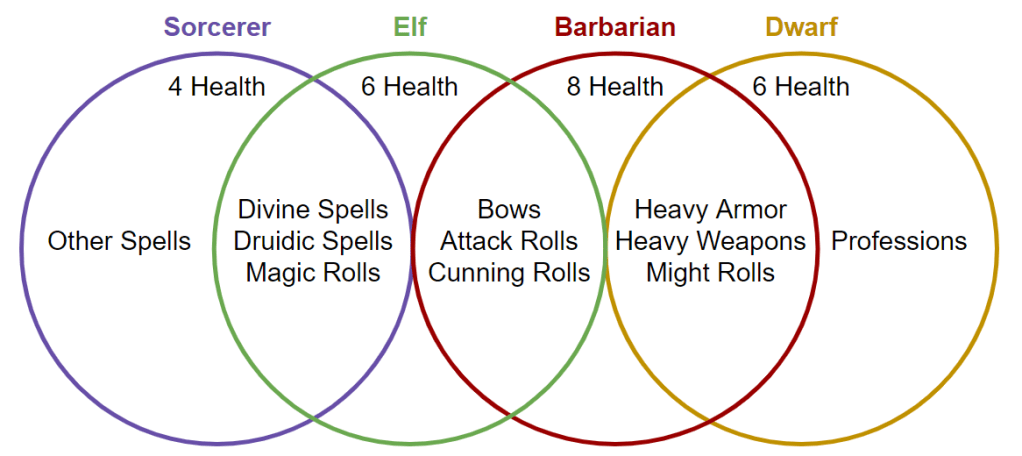
You will pick 1 of 4 classes: Barbarian, Sorcerer, Elf, and Dwarf. You start with 3 “downtimes” to spend how you like. 

  • Characters gain upgrades from “downtime” which happens every 4 sessions. Spending downtime is how people upgrade their character from a pool of options specific to their class. They can also spend loot to buy helpful things.
  • Everything in this game is a d20, sometimes with advantage, and rarely with disadvantage 
  • The action economy is generally one movement and one action. 
  • Reactions: this allows you to take an action even if it is not on your turn. This is reserved for some spells, blocking with a shield, and specific maneuvers. If you use a reaction then you have to give up either your action or movement on your next turn.

The 3 part combat system 

  • This game does NOT use modifiers added to a d20 roll. Instead, you will gain charges of advantage in places where you would normally gain +1 bonuses in other systems. You can use multiple charges in a single action if you like. 
  • Pushing the action economy: You can take extra movements or actions on your turn but for each additional action/movement you make increases the DC. While pushing, failure to succeed any part ends your turn and you fall prone, giving others advantage against you. This allows for a blaze of glory or falling on your face right out of the door. DC starts at 11 and increases by +3 for each additional task. 
  • Attack vs. Called Shot: Attack is generally the more powerful option, but Called Shot allows players to engage a more roleplay style choice by trying to engage enemies in their weak spots. It is riskier but offers more rewards if you read the situation correctly. This is NOT a universal set of trip/blind/grapple mechanics driven by the players but a set of enemy specific weaknesses driven by the narrative.

Note that all three of these ideas flow together. You can use multiple charges of advantage on your turn to increase your odds of successfully pulling off multiple called shots in a single turn with a whirlwind of attacks. Of course doing all of that will blow through a lot of resources and put you at risk. Or you can use charges sparingly and be that fighter that is steadily ripping through enemies.

Magic 

  • Spells Casting: each spell has a DC, generally a DC 11. If you roll over, the spell happens as written. If you roll under then nothing happens and you forget the spell temporarily. The divine/druidic spells have no negative consequence. All other spells can have a negative consequence on a low roll, normally just a 1. 
  • Not all spells are equal. More powerful spells will have a higher DC and greater negative consequences but also are way more powerful.
  • Note: spells work just like attacks and you can use them within the “3 part combat system” with magic rolls replacing weapon rolls.
  • spells are less in the vein of magic missile and lean more to rituals or riskier combat abilities. Think less tactical and more strategic.
  • Spells are… odd. Some have extra features that are discoverable. So as an example: you may have two copies of Cure Wounds and then two more copies that can be reversed into Inflict Wounds and a fifth copy which is Curing Words that works at range. Inflict Wounds and Curing Words heal like Cure Wounds but have a second option and higher DC.

Where to spend your down time

  • There are 4 stats: Might, Magic, Cunning, and Weapons. A bonus in each is just another charge of advantage.
    • Might: athletics, strength, endurance, movement (including pushing)
    • Magic: casting spells and understanding magical effects 
    • Cunning: stealth, thievery, traps, lying, wilderness survival, and general trickery 
    • Weapons: melee and bow 
  • Those with magic can copy a spell they already know, learn a spell from a scroll, make a scroll of a spell they know, or combine magic fragments to create a random spell
  • Dwarves gain a bonus down time which can only be used on professions. This allows dwarves to craft stuff or access new professions.
  • This is not a complete list. As you play the game and discover things, more options will become available. As you build up the town and additional outposts, more options will become available. Some in game events may also open up additional options as well.

Recovery while adventuring

  • In town, regain any mix of 10 from charges of advantage to spells to health. Most of the time you will not be in town.
  • In the field, regain any 3 from charges of advantage to spells to health. Some spells or dwarven crafts may increase this.

A pair of string quartet pieces

Today I brings you a pair of short string quartet pieces. One was written awhile ago but I was finally able to recover the mp3 file. Forgive the sound quality. This is not a really instruments and there are no dynamic controls. Lots of the little nuances or larger dynamic shifts are missing from the recordings.

This second one came to me over the weekend and I knocked it out in a few hours.

An update on Star Chaser… and a bit more

So lots of changes, some rewrites, and finally a big update

I think the result of the last patch went well. The game moved forward better and I am being more direct about the underlying mechanics behind the game, which helps clarify some of the math for players. Originally there were 4 tiers of power with the 3rd and 4th tiers having 1 and then 2 drawbacks. My players universally did not engage with the two drawback options after many repeat offerings, so easy enough to remove. 

Over the last year, I have had two players engage with the magic relic system. Neither really followed through with it but for reasons outside the game mechanics. This means I have an entire subsystem that is mostly untested. Good news: one of my players has made a new character that leans hard into the relic system so we will finally see how that plays out. 

I have been testing the larger mech and armor side of the game and overall… I am just not happy with it. Originally I was using BattleTech as a starting point and simplifying the mechanics again and again until it was quick and simple to learn/play. BattleTech is built around 5 types of weapons for a total of ~31 different weapons. I cut it down to 8. I then assigned those weapons to a few frames to add a feel of mech battle to the game. 

The rough design was: 

  • Missiles were the best damage but had limited ammo and some hard counters to them 
  • Cannons were ok damage and as a bonus there are no counter measures to them
  • Some of the hard counters to missiles had secondary usages 

Missiles ended up being overly powerful. Not in terms of damage but in terms of decision making. If you could fire a missile, you should fire a mission regardless of what the other options are. The other weapons were just not as engaging as they should have been. The EW and other anti-missiles systems were ok, not great but also not bad. 

In the last 2 weeks I have done a bit of redesign on it. I have spent some time with Lancer. Great set of ideas, really messy game. This is one of those games that is filled to the brim with great ideas but due to complexity, and a poorly organized players handbook, it ends up being far less than the sum of its parts. That said, there are some really simple and easy to administer ideas that I think can be patched over. This should give players more fun lateral options. I also like how Lancer handles both their action economy as well as their heat system, which they do far better than BattleTech does. 

This redesign has reduced the pool of mechs to 7, 3 are the traditional good-better-best mix and then 4 niche mechs are added in. I was also using “pods” to hold 1 big weapon or a mix of small weapons. Then there were rules for constructing those mixed pods, the idea being to bring in all those infantry weapons they were collecting along the way. That may be too messy. I am instead making this less fluid with large slots which can hold predetermined pieces or systems where systems grant some of those unique flavor abilities. This allows me to realign to a new mech specific action economy: 

  1. Move and Full Action (read, larger weapons and missiles) 
  2. Move and 2 Quick Actions (read, smaller weapons and systems) 
  3. Overdrive: Move, 3 Quick Actions, gain 1 Heat (Overdriving boosts some systems) 
  4. Shed Heat, this is automatically triggered at 3 Heat 

Here the quick actions are some of the smaller weapons and systems. With missiles being the problem child, this provides a boost to the non-missiles weapons but with a controllable  drawback. I also wanted to provide two very different styles of play here, the first being the slow lumbering mech firing powerful weapons but in a style that is simple to play and adjudicate. The second is a multi-step comboing of actions with some push your luck elements thrown in. I might end up folding action 2 and action 3 together based on play testing.

All of these ideas still need a lot of testing, once again the mech level of the game needs to be able to move fluidly with the infantry level and the star-fighter level as well as be its own system with dynamic play. I do like that idea of giving different levels of play different action economies to make them feel different.

RPG Chaser

And while all of that is great, it is not the big news. I have put together the core rules for “RPG Chaser”. A system designed for DM’s who want to build their own worlds and their own systems. I see this as the front 80% of whatever custom system a DM wants to build. This doc will be free and released with multiple campaign settings included in it. This includes Star Chaser for sci-fi, Steam Chaser for steampunk, Cyber Chaser for cyberpunk (this is actually my original burning light setting) and Bullet Chaser for a post-apocalypse campaign, be it more zombie or more Fallout. I have few other settings I may or may not include. These settings are not “the correct way to play” a genre but example of how you could do it.

Back in my Alpha Test part 3 post… 4 years ago, I talk about having a system where DMs can bring in different themes to match their worlds. RPG Chaser is a more granular version of that. I recognized that my attempts to define themes was actually super limiting. Instead I am now focused on letting DMs create their own themes and I am fleshing out the rules and long lists of examples that DMs can leverage as building blocks to make whatever kind of world or game they want to run.

A book review and reexamination of history

So I just finished reading The Fall of the Rome Empire by Michael Grant, find it here: https://www.amazon.com/Fall-Roman-Empire-Michael-Grant/dp/0684829568

Great book and some really solid historical research. There are a couple of overarching ideas that I think go unchallenged when people talk on this topic and this book does a great job diving into those details and making those corrections. 

The east did not fall 

This is the biggest issue with this topic and I think one that gets overlooked in pop history. While we call the east roman empire the Byzantines, they did not. They called themselves Roman. And… yea, they really were roman. They had roman law, followed roman traditions, and provided support (often, not always) to the western empire. The Eastern Roman held on until the 15th century, although decline slowly started in the 11th century. Still, that is a much longer time than the 5th century fall of the west. 

Why does this matter? Because there are many, many narratives about why the western roman empire fell but many of those stories would also equally describe the east. So why didn’t the east fall? This is the problem with a lot of pop history on the subject and it can be a great slice of applied social science. Whenever someone says “the roman empire fell because of X, so we should stop doing that too” go and see if the eastern roman empire was doing it as well. If they were, then that didn’t cause the fall. One of the important ideas in science is to have falsifiable theories, i.e., theories that can be disproven. History has given us a great A/B test for those ideas. 

The west did not fall… it was conquered

This is another key idea. Normally when people talk about the fall of the roman empire they begin to look for internal problems or cultural issues… but Rome was conquered by an external party. Repeatedly. Maybe Rome was good but the Germanic tribes were just better? I think we still carry a bit of this anti-barbarian bias in our analysis but the fact of the matter is the various Germanic tribes built large, complex, and very capable military forces. That is not just “bravery” and strength from “hard living” or other nonsense ideas assigned to “barbarians” but that the Germanic tribes in particular had well practiced strategic adaptation by chieftains, reliable social structures, and a sizable iron industry. 

The highly localized structure of the Germanic Tribes made low level chieftains well practiced diplomats as they could not just ask a higher power but had to build coalitions at the local level. Adapting a specific tribe to a military niche or a flexible alliance were common. While Romans had their famous standardized legions, Germanic tribes often called up much larger forces with more mixed units. Within those masses would be smaller, more professional forces of specific types to counter specific military problems. 

As small independent tribes, these groups may side with one roman faction or another at different times. This well practiced political flexibility of leadership and variability of unit types often placed them as king makers at key points in time. They then leveraged that power into more land, more resources, and placed themselves into yet another, more powerful, king maker position. This was supported by a local iron industry that was both widespread and far larger than expected. For decades now archaeologists keep finding more and larger ancient iron forges from this era. This means Rome’s normal technological advantage was not there. 

The hard truth is… the Romans got out played while maintaining a high quality force. Even if many of Rome’s internal issues were addressed and more unity was in place, those Germanic tribes would still be at the gate, well armed, and in larger numbers. Any weakness in the passing of the crown, which was common in Rome, was aggressively exploited by the less formal Germanic chieftains who played those games with each other at all times. 

When they weren’t engaged in king making, they were ambushing Roman forces and making Rome fight not as their larger, complex but capable military, but as small units against smaller units where artillery or logistical advantage were not really a factor. As an ally, they were uniquely capable of eroding Rome from the inside. As an enemy, they were uniquely capable of eroding Rome from the outside. And because there were so many factions within the Germanic tribes, Rome was never fully sure which they were dealing with. This caused distrust, which undid Rome’s great power: their ability to integrate new peoples. The disunified Germanic tribes did not transition to Roman. 

A shift in cities 

It is also important to note the shifts that had already happened within the Roman Empire. Rome had already moved from being the king of cities to a 2nd or 3rd tier city below places like Constantinople, Alexandria, Corinth, and yes, even Carthage. These had grown to be larger and more important cities within the empire and seen as the choice governor appointments over places like Hispania or Gaul. 

Did Rome fall… or did Rome just move elsewhere? Both are true, but I think the latter makes more sense and is a far more honest reflection of the changes that had already happened. Much like the loss of Normandy did not end the English crown, being Roman no longer required Rome itself. And while no one was happy with Rome getting (partially) sacked, it was better that it happened to Rome than some of the other cities in the Empire. 

So let’s talk about that “(partially) sacked” part. The city and nearby estates were sacked, the Germanic tribes are partially-kind-of-mostly christian at this point. They did not sack the Vatican. There were sacred lines they did not cross. That line used to be the Rubicon, now it was the faith. While there was a shift between cities, there was also a shift away from government into faith. The church was becoming more important than the state, and while the state fell the church did not. At the time, this was generally seen as a good trade. Better to lose a 3rd rate but historic city and the riches within than lose the faith that binds us all together. 

Why we talk about imperial overstretch wrong today 

So this is the one that took me by surprise. Most references to imperial overstretch completely misunderstand that argument. Today, the argument is generally used by the left to point out the problems with having too large a military and getting yourself drawn into too many global conflicts.

But that is not actually the argument. The argument is that having a too large military causes a high tax burden and the high tax burden angers the people at all levels of society. Society then rewrites itself to push off the tax burden on to the other parts of society. This creates disunity by completely drowning one part of society in taxes, completely destroying it in the process so the burden falls on the next part, destroying it, and so on and so forth. At its core, this is not a liberal anti-military argument, it is a conservative anti-tax argument. 

The failure of local government 

And that tax burden was a real issue. Specifically in the roman case there was a class of people called curiales which acted as the local city council. They oversaw local laws, were responsible for local taxes, and governed the area as an inherited title. Early in the empire this was a good position to hold but as time went on it became the worst of both worlds. These local city councils were personally liable for taxes not collected. For most of the empire’s history, they always collected “extra tax” which they kept and were able to do so without angering too many people.. mostly. Now, they struggled to collect enough taxes. This forced the local government to be more and more heavy handed with the lower classes to raise taxes, it meant the higher nobility senators quickly wrote laws removing themselves from these titles, and there are many cases of lesser noble families bankrupting themselves due to having to pay the taxes from their own coffers year after year. 

As time went on, the emperor had to create new laws limiting the travel of Curiales, punishment for those who aided Curiales from flee from their inherited noble rank, and in 365 AD, Emperor Valen wrote an edict forbidding judges and city councils from granting the title of Curiales as punishments for criminal acts. Just imagine a government position so screwed up, that instead of running for the office to get the job, you got the job because you got in a bar fight and committed assault, and then the emperor steps in and says “no, that is too cruel a punishment for assault, just send him to the gladiatorial pits instead. That will only end his life, not that of all of his descendants”. 

How do you trust that Curiales to survey your land? To record your trades or legal proceedings? To entrust them with your children when they reach age for military training? During a trial? The roman countryside was built around these offices and they had completely fallen apart as a means of government. This is what bound the bulk of the countryside and estate to the city network that was the Roman Empire. 

Dropping out of society 

The Curiales were not the only people dropping out of the empire. Civic duty had collapsed, but like the Curiales each of those collapses was very specific and hard to find a good alternative for. The empire used to attract new soldiers with promises of land… but they ran out of land. Getting local titles seemed like a double edge sword so that could not be leveraged either. The edges of the empire were now either ocean, desert, or Germanic tribes so filling in gaps by recruiting outside the empire did not work any more. 

Social developments were also making this harder. Christian monks and scholarly orders had started to pop up. Many of these ran for the hills to get away from the sin of roman cities, thus removing many of the most educated people of the time from society. Small factions developed all along Christianity… but not in a splintering way. Each was independent, disconnected, and kept to themselves. They were friendly to each other, letters were exchanged and often monks would visit each other, but as a whole they left everyone else alone and were left alone. They did not challenge the authority of the Pope in Rome so the church did not really push back against them, even if they were a bit outside doctrine. 

The big take-away 

The final result of this book was great. A lot of the little fissures in roman society became even more clear while at the same time it never looked past the fundamental historical truths that it was taken down by a capable outside opponent and the east did not fall due to similar internal issues. It showed that at the end of the day, the western roman empire kind of just didn’t have much to offer its citizens anymore, or maybe what it had to offer was more toxic than beneficial. The things that bound the empire together stopped working and where simply never replaced, fixed, or improved upon. Maybe there are paths that could have saved them… but those are few and hard to see. 

Why defense analysts should abandon the “near peer” concept

The term “near peer competitor” is used constantly inside the beltway. It is the official code word in military and diplomatic circles for Russia and China. It is a theoretical idea for an enemy… that just happens to look exactly like Russia and China.

And near peer competitor is the justification of all kinds of defense spending. Want a new air superiority fighter? Make a reference to an unproven prototype with over hyped abilities. What more heavy tanks? Point at whatever armor is their newest model. Want a new piece of tech? Claim it is the wonder weapon to defeat some niche, low volume capability the other side has. Want to reorganize part of the Army? We need full scale penetration divisions to defeat the Russians! 

This has been the core of military dogma since the early days of the cold war. But does it hold up? Let’s take a minute to talk about what we are seeing happening, and not happening, in both Russia and China. 

Russia

How the mighty have fallen. Russia, the USSR before it, has been our traditional boogie man. That fear is broken, maybe more that it should be, but they are still seen as a shadow of their former self… unless you need funding for a new weapon. So without getting super deep into the Ukrainian conflict, what is the strength and capacity of the Russia military and are they really a near-peer? 

So first off, let’s address the elephant in the room. Right now the Russian Army is too much metal and not enough manpower. America has active units, where all people and gear are active, and reserve units, where all people and gear are reserved and are all called up at once as a group. Most western militarizes run this way. Ex-soviet militarizes do not. They intermix their regulars with whatever mix of conscripts, reserves, militia, etc. they leverage to fill out their forces. 

This is part of what got Russia in trouble in Ukraine. They had units built around having lots of infantry, lots of artillery, and a bit of everything else in them. Overall, a solid modern force structure. They were 60% regulars and 40% conscripts… on paper. In reality the conscript side was only half full. So when commanders were to get ready to invade, they had to figure out which parts of their force to undermanned since they were only at 80% strength. Then when it became time to actually go in, debate about the conscripts flared up, and Putin said to leave them behind. That means large, multifaceted units found themselves running at only 60% man power at the start of a war. 

Lower level commanders couldn’t under man a full spectrum capability at that point, they had to outright cut capacity and everyone did so in different ways. This is why some Russian units lacked infantry but others didn’t. Why some lacked anti-air, but others didn’t. Why some lacked trucks and logistics, but others didn’t. Those who lacked infantry for screening got hit with anti-tank missiles. Those who lacked anti-air (which was top of the line) explains why Ukraine (using old jets) still has an air force. Those who lacked logistics just ran out of gas while other forces traveled farther while maneuvering. This is also why Ukraine was able to capture some high end Russian equipment without a fight. It was left unmanned because commanders had more vehicles than drivers.

Russia still has a quality military. What they lack in a quantity military. They have confused large armor reserves and potential conscript numbers with actual military forces. When they put all their pieces together and do small deployments they actually do a really solid job. We have watched that for years in Syria. We see elements of advanced missile and air forces, just not a large scale and consistently sustainable one. Russia is very capable at small wars, just not at scale.

So does the US Air Force need a 6th generation air force to go toe to toe with the air power that is ineffective in Ukraine? No. Do we need a new fleet of 200 destroyers to go up against the Russian Navy when we now know that the Blacksea Flagship, Moskva, was in such bad shape that they sent it out with 2 of 3 anti-missile systems non-functional and the 3rd only partially functional. No, let’s hold off on ordering the new ships. Do we need to rescale and reorganize all of our army units to form high end penetration divisions specifically to counter the Russia armor because, surely there is no way some shoulder fire missiles, counter strikes on their limited logistical vehicles, and just poor maintenance will undo the great Russian armor push, right? Yea, we can pass on the reorg. 

There is a real chance Russia will rebuild itself over the winter and maybe that new force will be worth worrying over? Possible, but very, very difficult as alot of the trainers and other support forces were already deployed directly in combat. What we see now from Russia is well within America’s capacity as long as we remain prepositioned and ready. 

UPDATE: Russia’s February offenses have already started and, mostly, failed. Specifically 2 of 3 attacks were repelled and Bakmut continues to be a Pyrrhic victory in the making. 

But that is ok, because we now have a new boogie man. An up and coming boogie man. A lean-mean production machine boogie man coming after our buddies Taiwan, Japan, and Australia. And unlike Russia, they are still communist. So let’s talk about the new Soviet Union: … 

China

… or are they? Stalin and Xi are very different rulers with very different goals, very different countries, very different resources to leverage, very different domestic issues, and facing very different international problems. 

At its heights, the Soviet Union was spending around 24% of GDP on the military. That is how they kept pace with the West. They were 1/12 the size so they spent 12 times as much. China has spent a massive amount on a military build up so that must mean they are doing the same thing right? Well… no. China spends about 6% of GDP on the military. That has held steady since the 80’s. What has changed is not the slice, but the size of the pie. As China’s economy has massively grown, so has its military spending but on pace with other parts of China. Yes, Xi wants to modernize the Chinese military, but he also wants to modernize the Chinese education system and China’s scientific community. There are massive infrastructure projects modernizing China’s infrastructure in power, rail, and water. There are projects to modernize China’s space program, modernize China’s social safety net in rural areas, and modernize and regulate both social media and other digital platforms. Xi wants to modernize as much as he can… including the military. 

A few centuries ago, Prussia was described as not a state with an army but an army with a state. The Soviet Union wasn’t far from that idea, but China is. China is not driven by their military, they are driven by their need for economic growth. The thing at the center of Chinese diplomatic affairs, the thing that keeps unrest down, and the thing that moves the nation forward in the eyes of the Chinese people is their economy, not their military. The military is at best a plan B or even a plan C given how China is leveraging their investments to make indebted client states.

So we should just ignore China’s military reforms then? Actually I think we need to do the opposite. I think we need to understand them without over simplifying them. I think we need to figure out what they are transitioning to and where they can or may use those capabilities down the road.  Only then can we figure out not just if we need a “near-peer” response but what kinds of near-peer response would fit and which don’t. 

For the second question I am going to propose 6 different possible defense scenarios with China. Some are more likely than others and each has their own quarks to them both in terms of how they will play out, what allies would join in, and what kinds of military assets are needed… and which would be a struggle to use. Those scenarios are: 

  1. Counter-Coup 
  2. Counter-Revolution 
  3. An invasion of Taiwan 
  4. An invasion of Japan 
  5. A joint invitations with North Korea on South Korea
  6. A sustained border conflict with India 
  7. An invasion in South East Asia 
  8. Enforced Sea/Air Dominance in the South Pacific 

Before we talk through these, just keep them in mind as we talk through the changes we are seeing happening in China now. 

So let’s look at just 4 changes: the 96 rifle, tanks, new marine formations, and J-20 fighters. Starting with the QBZ 96 bullpup rifle, this is a very compact rifle design. It is not optimized for full range combat or the rolling hills of Europe like most combat rifles are. Instead, it is one of the smallest silhouettes for a main rifle, making it easier to carry in compact armored vehicles or in tight urban situations. While many Western nations switch from battle rifles to submachine guns in urban settings, the 95 is a compromise design between both. It is also known for its smaller rounds and easier to control kick back. This makes it ideal for poorly trained troops or forces more focused on security, not wide ranging battlefields. It is also the cheapest military rifle in the world right now. This clearly places it in a quantity over quality approach. A skilled marksman and trained soldier would do better with any other battle rifle already in service around the world, but if your limiting factor is guns, not people, then this rifle makes perfect sense. 

So let’s talk tanks. The US has the venerable 55-tons Abrams, the Russia has 46-ton T-90s and the new 58-ton Armadas, Germany and swaths of NATO are using Leopard 2’s at 63-tons, and China… China is focusing on the 33-ton Type-15. 33-tons. Much lighter armor, much smaller gun, and it even carries less ammo. Why? Easier to deploy and requires less fuel… and once again, cheaper to build. This gives the PLA a much lighter footprint than NATO members or Soviet based forces, which would normally lead to heavy losses if they were going head to head against those heavier forces. 

Now I don’t want to present an unbalanced view here to overstate my point. China does have a mix of older, heavier tanks. In fact about 40% of their force is licensed T-54s. You know those old T-62 tanks people are making fun of Russia for using in Ukraine. Well those T-62 were the replacements for the T-54s. China does have a heavier tank called the type-99 which is a mix of reactive armor, long range cannon built around missile-ammo, and a reverse engineered german engine. But even in Chinese doctrine this is seen as not a leading element, but a stand-off element in most cases. It is also a tank design that emphasizes quantity over quality, which make sense for a country trying to leverage their population. Type-99s only make up about 10% of the force. The remaining middle half of the force is some between these two in technology. 

But you know what they are great at? You can drop them from a heavy lift aircraft. Now Taiwan has more than enough SAMs to deal with the easy target that is a heavy lift aircraft, so what is the target for that capacity? Rapid deployment within China. The type 15 can also travel over smaller bridges and more rugged terrain. This is clearly an issue when you look at a map of western China, not Taiwan. It also has its own built in oxygen compressor for very high altitudes and the main cannon, while smaller, has a much larger vertical aim range than most tanks have a need for. This is the ideal tank to take on India over the Himalayas. This is the fastest possible tank for the mountains of south China, deserts of west China, and the second wave of landings in an amphibious operation. This is not a Patton style armor-on-armor option, this is a Hannibal style of heavy forces coming out of places heavy forces should not be able to go. 

The J-20 is China’s new stealth fighter…. all though you have to take that with a grain of salt. Parts of the design were clearly taken from the confirmed theft of F-35 plans and India has already confirmed they can track these without an issue. It is possible that the J-20 have been flying with beacons running or doors open as well as India could just be lying. That said, even if a high powered  ground radar can track the aircraft, there are still situational tactical advantages to having more stealth elements on your plane even if the whole thing is not stealth. 

The real power of the J-20 is two fold: much better range and bigger missile bays. The J-20 is very large for a fighter. It is best to think of it filling a space between a traditional fighter and larger bomb that focuses on missiles. That large size hurts its maneuverability but helps with its flight range due to a much larger fuel capacity. 

That bigger size also allows for a bigger missile bay which also gives China an easier way to catch up on missile tech. Currently, the West has much better missile tech across the board and they have kept missiles down to the traditional sizes, largely because every aircraft wants to grandfather in all of those older specialized missiles made across America and Europe. By giving the J-20 a large bay, China is also upgrading the size of their missiles. This means they carry less of them, but this allows their lower developed but larger missiles to produce results similar to the smaller, more advanced NATO armament.

China runs about 1,900 fighters. Only about 70ish are the new J-20 of 5th generation quality. This is the one everyone likes to talk about but it is in the lowest number in their fleet of aircraft. Another 830 are upper tier 4th generation and are spread between 6 different models made in China, Russia, and upgraded USSR models. These are mostly flanker variants. After that you have 550 J-10s which are a low tier 4th generation fighter which is largely regarded as under performing but was China’s first real attempt to enter into the fighter marketplace. Finally there are about 450 3rd generation fighters still in service. 

China steadily replacing 1960’s aircraft with modern J-20 is a huge improvement, but the balance of the force is still largely 1991 Gulf War in quality and will remain so for at least two decades. This is a great air force for regional point defense and in quantity enough to deal with threats from multiple directions at once. It is a good spearhead for a medium scale invasion. 

These elements, mixed with traditional soviet style equipment, gives us large formations of light units designed around extended ranges or easy of deployment. Now that we have that pinned down, why did China build their forces like that and not like the West or Russia? Let’s walk through those potential operations. 

So the first is the one defense analysts like to talk about the most. And to be fair, this conflict would already have a name: the 4th Taiwan Strait Crisis. Why yes, this would be the 4th one and the previous three happened in 1955, 1958, and 1996. No, this is not new. In my measurement, this is one of two highly likely places for conflict. 

The problem with this analysis is it is the one everyone sees coming so it is the one people on both sides have worked on the most. Expect both sizes to be engaged in counter intelligence and have at least one ace up their sleeve. I can guarantee you China is hiding/over-stating/lying about their offensive capabilities. I can guarantee you Taiwan is hiding/over-stating/lying about their defensive capabilities. If either side is not, then they aren’t doing their job. 

The pendulum in the defense world has swung in favor of defense over offense at the moment. This is something we have seen in Ukraine and something China has peckishly admitted to. 

So lets review those 8 scenarios again

  1. Counter-Coup 
  2. Counter-Revolution 
  3. An invasion of Taiwan 
  4. An invasion of Japan 
  5. A joint invitations with North Korea on South Korea
  6. A sustained border conflict with India 
  7. An invasion in South East Asia 
  8. Enforced Sea/Air Dominance in the South Pacific 

The forces created on the tank and infantry side are ideal for tasks 1 and 2. They are ideal for 2 because given the quantity they can spread them out to control multiple large areas at once. This also makes it ideal for 1 as getting the whole military involved is incredibly difficult. Having no super heavy, super elite force to act at the king maker, any other larger formation of loyal troops can counter a military coup. Raw army size makes 1 harder and harder.

New Marine Forces would help with 3 and 4 as well as the lighter, faster deployable 2nd wave of light tanks. Maintaining that large fleet of older aircraft gives you an artillery alternative until larger guns can be landed on shore. These changes make sense for a proper invasion force… but they are just not at scale yet. They would need 4 to 5 times as many forces of these types. 

5 and 6 actually also make a lot of sense given the upgrades we have seen. China’s forces will still struggle but those force they are up against are also lighter than most so they line up is more favorable than you would expect in Europe. They have some adapted units now that can help with this very specific situations. Number 7 is really a mix of 3-4 combo and the 5-6 combo. This is now a full capability at scale for China. They have this ability (assuming a small land boarder) and are fully a threat. Politically, I don’t know who they would target this way, but they can if they want to. It is unclear is this is a real objective, a political threat, or the just the side effect of other objectives.

8 best explains what we see happening with China’s air force. This shift in planes and missiles make minimal sense in all the other scenarios but it makes scenes as an anti-US Navy option and really only as an anti-US Navy option. 

So what does all of this mean? China’s air force is tasked with dealing with the US Navy and their army is tasked with dealing with low to mid scale local operations with an emphasis on rapid response over difficult terrain types. The response needed for this is a strong counter play in the air to support the US Navy and then either heavy units already in position on the ground or a large, light, flexible rapid response force to match China’s. Anything outside these purview are defense spending programs you should be highly skeptical of. 

The US Air Forces move on B-21 and the US Marines dropping the tanks and doubling down on rotary makes sense in these contexts. Things like the Abrams-X, penetration divisions, or new nuclear subs, less so. 

Oh My Eru Ilúvatar, Rings of Power doesn’t understand Tolkien

Why the stars, the two trees, and the Sun matter

So there is no way to talk about Tolkien without some back story. It comes with the territory. This will be super abbreviated. 

Early on, there were no humans and no sun, just the stars and earliest elves. When Galadriel was born, a faction of the elves was living with the Valar (upper angels and greek gods parallels) and Maiar (lower angels, greek demi-gods, and celtic spirit parallels) in the west under the lights of the two trees. The two trees were a golden tree and a silver tree which shone not just with light, but with the reflection of God’s glory. Yes, it took massive giant world tree-like beings to handle the reflection of God glory and these two trees were it. They gave light to the Valar, Maiar, and the elves. 

An evil Valar attacked the land and killed the golden tree. When he did, instead of it being a victory it was his great loss. With the death of the golden tree, the sun rose for the first time, burning his orcs army by exposing them to its light. This is also the moment that man, children of the sun, first arose. With the coming of the armies of man and the sun to deny them half the day, this evil Valar had doomed himself. This was the power of the golden tree. But the silver tree was equally as powerful. 

As the silver tree was being destroyed, it projected its soul and power into the purest and wisest being it could find… a young elven girl named Galadriel caught its last lights. 

Who is Galadriel… and why she isn’t an angsty teen

And this… this is why we can’t have nice things. 

In the unfinished tales Tolkien said, “From her earliest years she had a marvellous gift of insight into the minds of others, but judged them with mercy and understanding.” And yet, she is a walking nuke. A living reflection of a reflection of the awe and might of God the creator. She has the soul and power of the silver tree living within her. That is why she can turn dark and project power and light. That is why Sauron flees from her, he is fleeing from the awe of God…. And in case you missed it, this is a parallel idea to have Jesus Christ come live in your heart as lord and savior. She is not magical, she is theological. 

She is the answer to the question “what if instead of Jesus, God the Father of the Old Testament lived in your heart”. Galadriel has embedded within her the Awe of God. Despite this, she is still pure of heart and tries to treat people with mercy and understanding. That is her character’s dichotomy, the walking nuke that strives to be a diplomat. When Frodo offered her the Ring, he was pushing the launch codes into the missile, but she had the wisdom to walk away and not follow the order. This was a real concern in Tolkien time and that scene reflects it. 

Galadriel was later described as “the greatest of the Nolder, except Feanor maybe, though she was wiser than him.” Keep in mind, Feanor fought off multiple Balrogs at once while Gandolf tied against a single one. Notice how in the Jackson films, the Wizards always bow to Galadriel and take her council even though they are literal angels. It takes the angels to fully see the God in her, which is why she is so respected by them. The Wizard-Angels are bowing to God through her. 

… and then this happened at Amazon:  

Jerk 1: Hey Boss, how do we write the most powerful and wisest woman in all of fantasy for the small screen? 

Jerk 2: I don’t know bro. Hey you know what is awesome? Swords! Let’s make her good at swords! Oh, and angsty as shit. That’s hot. 

Jerk 1: But how do angst and swords fit into the narrative about how even in death, like Jesus Christ, the trees only return more powerful and how their offshoots in new forms play out across the centuries of Middle Earth history? That the promise of God is kept even in hard times by new means, you know… hope. Or in this case the parallel stories of Galadriel and Gondor, both of the same white tree. 

Jerk 2: Oh, and then we can have her dual wield while fighting humans! 

Jerk 1: But how do angst and swords fit into the narrative about power versus mercy? Isn’t her new angst based personality actually in direct conflict with the core of her characterization is every previous Tolkien work and movie? 

Jerk 2: Oh, and she can be such a badass with swords and so angsty that the King has to send her away because she is a troublemaker. Yea, bad girls are hot right now. 

Jerk 1: But how do angst and swords fit into the narrative about her containing her great power, the power of God itself, while balancing his divine wrath against her desire for mercy and peace. Wouldn’t sword skills be the least of her powers? Wait, isn’t she actually more powerful than the King who is sending her away? 

Jerk 2: Oh, and we can have her fight a shark. No wait, a mega-shark…. 

Jerk 1: But how do angst and swords fit into the narrative of long standing alliances driven by common desires derived from a free people? Isn’t part of the message that if people are truly free then we will desire similar things, because fundamentally we are all the same? That all free people, with matching common desires, will lead to lasting peace? I mean she is the soul of the literal tree that is on Gondor’s crest and in their courtyard in Return of the King despite the fact that they are a very different race of beings? 

Jerk 2:  …Yea… Mega-Shark… 

Jerk 1: … yes sir, I will have it on your desk by Friday. 

Notice that here you have two different kinds of jerks here. Why do I call that out? Because WWGD (What would Galadriel do?). She would treat them differently and know the difference between what was in their hearts. Clearly, some people on this production really cared and poured themselves into some great details and ideas… and others just didn’t care about the lore, the history, and the way all the tiny elements in Tolkien are connected together. They grabbed the most recognizable proper noun they could find and then slapped it on their edgy OC (do not steal) sonic fanfic of a character with no regard about how it undoes huge swaths of Tolkien lore. 

They did not recognize the interconnected nature of their decisions. They ignored the wisdom that came before them. Congrats writers, you made yourself Boromir. I am sure choosing to be Sean Bean’s character will end well for you. 

Galadriel has the power of the silver tree. A power equal to that of the Sun and all the armies of man combined. She has the wisdom of the high angels. Is that who you wrote? This rendition of the character is so jarring it breaks the show for me. The best parallel I could come up with is image a film about a slave plantation during the civil war but on a whim the director decides to name the plantation owner Abraham Lincoln because it is a name he vaguely knows is from that time period. It muddles the point to say the least. 

Why is that Elrond? 

So this is another great example of grabbing a well known name and then writing someone else entirely. Why call this elf Elrond? Elrond has a very specific back story and role in the world. None of that has been leveraged thus far. It is the right place and time for him, but both Gil-Galad and Elrond were skeptical of the ring project, not in the middle of it. Once again, if you want to use the names of very wise characters, don’t make them act stupid. You could have given him any name and the story would have been the same, other than a few references to his father. 

I like this story line. It has some moments and depth to it, when you fast forward past the unneeded conflicts that cause minor no long term problems. An elven diplomat struggling to work with the dwarves is a classic Tolkien story. Just do that well and move on. I have seen this bit in every D&D game I have ever played and the show does it fine. It is not groundbreaking but it works. But it could have worked with anyone. Elrond brings you name recognition but it also brings you lore and character baggage. You can’t just wave that away. That is the cost of using the name and if you don’t pay for it then your character is jarring in the story. 

Stop trying to not say things

Angst is not plot development. Pointless interpersonal conflict that instantly resolves itself is not plot development. Things changing are plot development. Get on with it. The only thing you have accomplished with your dialog is they don’t like each other. And you know what? I don’t like them either and that is a problem. 

Writing angst runs the risk of getting readers/watchers to dislike your characters. If your characters grow and overcome their angst, then they become more likable and change for the better. If you only do angst, then the natural result is that the longer your story goes with only angst the more of your characters people will dislike for legitimate reasons. This is how to make people not care about your characters and in turn, your story. Angst is like blood thinner, in small dosages and specific situations, it is good medicine. In large dosages it is just rat poison. 

A twist is when you think something is one way but it turns out another. If you say so little, masking everything in vague pronouns, or nothing at all, then I just think it is neither way or just unclear. A twist required that things be known and settled. If it is always unclear, then the result is not a twist, it is just the plot finally happening. It is not a dramatic turn around, it is audience yelling “finally, we are moving forward”. 

These issues are a fundamental problem with the series. If I don’t care about your original characters because they are all angst, I don’t recognize the characters I have known for decades, and your twists are not twists just really… really… ssslllllooooowwww plot development. Why should I still watch? I mean, I just wrote a 2,000 word blog entry on it so clearly I care about Tolkien, but no part of this is Tolkien.

If you dropped the Tolkien IP altogether then this would be a solid fantasy series with great visuals but some pacing and dialog issues. Improve the writers and fix it in season 2. As a piece of Tolkien, well it is rat poison or the end of a Sean Bean character, your choice. 

Why you should dislike your marketing

At a fundamental level, a company has to make a decision about who their marketing is for: internal stakeholders or potential customers. In my experience this is the single largest divide between company’s with glossy/expensive campaigns that are just a waste of money and marketing campaigns that drive revenue.

Are you trying to drive revenue… or are you trying to get internal approval for your campaign? In the minds of many marketers this is the same question because we force them to answer both questions with the same assets… which is a really odd set of behaviors. There was a time when this made sense, when marketing department were forced to rely a single expense purchase of a repeated single asset, like TV commercials or magazine ads. But in the modern era of digital marketing where you can test ideas quickly and cheaply, uploading many permutations of the same phrase or image and setting spending levels lower than a fast food value meal for each version, those old school approval methods are frankly ass backwards.

This is what I call the Mad Men problem. People watch that show and the big scenes, the big moments are in the pitch to the clients. Why? Shouldn’t it be in the ROI calculation that happens the month after the actual campaign runs? Shouldn’t it be an actually increase in revenue for their clients that drives home how good their marketing skills are? But it isn’t, it is the pitch. And this is true inside companies as well. Convincing in the board is more important than delivering on ROI numbers that many marketers don’t like to calculate anyways.

This is all just ego stroking and hard truth is if the sales team and product team are doing a good jobs, the marketing isn’t too much of a dead weight loss, and the ROI is not trackable, then you can have marketing that is bad and still have a very successful company.

So let’s walk through why you should be concerned if you like your marketing.

1. Your customers are not a monolith. You are.

If your marketing is always in a consistent voice, consistent aesthetic, and consistent talking points… then there are lots of hole in your marketing. People are different and you service a range of customers so why isn’t your marketing just a diverse?

The answers to that is companies want to “look professional” or setting design standards. There are advantages to that approach but it also limits your marketing as it removes customers who have their own views on language, aesthetics, and which talking points resonates with them. I am not saying you should hate all of your marketing… but there should be at least some of your marketing that is not to your taste. If not, that is a warning sign on how limited the scope of your campaigns are.

2. You are not your customer

Customers don’t know your history, you have lived it. They don’t know your products/services, you are an expert in them. When you are viewing your own marketing, you are bring subconscious baggage into that conversation. Baggage that your customers don’t have.

You aren’t facing your customer’s problem. You aren’t paying for your products/services. You aren’t having to compare your products in only this super specific situation vs. alternative in only this super specific situation. Your customer is always going to meet your marketing with their own baggage and view points and that vantage point will never be the same as yours nor are they the same as your other customers.

3. You are not trying to learn the product or meet a need

Marketing is often practical, especially in digital marketing where capturing key technical phrases are core to gaining traffic. Yes, this is meant to be eye catching and build trust, but it is also educating the customer how your product works and why it is useful.

Super consistent marketing means you are not trying to reach all these different view points. Reaching those different view points often require different levels of technical detail and different assumptions about the technical knowledge of the customer. It can also mean directly address your customers frustrations and how your product solves those problems. This is a powerful marketing approach but only for a small slice of the market. Thus is a great piece that will strike out most of the time, but when it does hit it is a home run. The result of those facts is you need a large mix of batters stepping up to that plate.

4. “Like” is not a result

Marketers are often looking to sales or other informal sources of information to try and find out if their marketing is working. These…. aren’t great. The goal should be to calculate how well your marketing is working, not get a vague notion of good. Stories about “I like it” or “this one guy contacted us” aren’t enough to attempt a formal calculation. Yes, there are lots of reasons why you will not able able to make a 100% full proof calculation of ROI. But what you can do is try to calculate the minimal possible value and a maximum possible value and then try to reduce the ranger between those two down the line. Knowing that the value is somewhere between $50 and $400 for a led is far more valuable than knowing “this one guy contacted us”.

5. Who is driving your marketing: Management, Creative, or results from Customers?

When was the last time you started a marketing campaign by reviewing the results from the last one? When was the last time you launched a campaign because you noticed a weakness in the last one and you wanted to take a second swing? Are these what drive your marketing or are they driven by internal factors like product launches or events? This goes back to the original question at hand, is your marketing for your company or for your customers?

You may have worked very hard on the latest product or are very excited about that newest feature… but to a new customer it is all new. And even to an older customer, there are niches in your product line they don’t know. The problem with letting “new” drive decisions is it often puts the wrong thing in priority.