A class analysis for WoW Forever and a missed opportunity

So this is a design analysis on the classes in classic WoW and the new pitched classes. WoW Forever is in an odd spot. It is Blizzard resetting to the older game ideas while also leveraging the retail technology. They are fully aware that retail is getting long in the tooth and slowly bleeding players. At the same time, the classic player base, as well as the many private servers that run classic, seem to be staying healthy for much longer. 

This is the odd position: both are declining, the retail player base is declining faster but starting at a higher starting point. The classic player base is declining much slower but at a lower starting point. For the long term viability of the product, getting the classic and retail player bases merged is clearly the right business objective. 

This is where wow forever has a huge potential for blizzard. It gives them the ability to merge both audiences in a way where they were not before. I assume Blizzard assumes that retail players just want the newest thing and classic players are going for a specific feel. WoW Forever is the attempt to bridge both. Bridge both is critical as it massively cuts costs. Not in half, both games share servers, base line technology and assets. This is something Sand Stone Games has done for years with D&D Online as well as Lord of the Rings Online. It is a proven method to contain costs which allows more resources to be put into new content and store items. 

So with the objective in mind of “how do we merge both retail and classic players” let’s talk about where classes are and where they might be going. The original 9 classes were… almost right. The 4 foundational fantasy classes are there: Warrior (prime tank and prime DPS), Priest (prime healer), Rogue (solid DPS and pvp), and Mage (niche DPS). Great, those are well understood and they play really well in classic wow. And here is the thing: you do not need any more classes after that. If WoW had only 4 classes, the game would still be great. In fact if you look at the standard raid make up in a 40 man, 30 of that 40 are going to be those 4 classes. All other classes are just a bit of spice on top of the game. To justify them in the end game, each was given a token skill or two so they were mandatory in a raid, but only in limited quantities. Rogues are alternatives to Warriors as melee DPS but with nice bonuses to world pvp. 

This mix is often called “Warrior Supremacy” because you just keep stacking warriors and everyone else has to justify their positions in higher raids. They are the best DPS and they are the go-to tank. This is part of why all races get a warrior option. That said, Warriors lack internal support and are very slow to level. This forces them to make friends and others helping them along the way creates those bonds that later gets non-warriors a spot in the raid. This is part of the social fabric that holds the game together so I hope dps do NOT get balanced completely. Improve the balance, but not 100% equalized. That imbalance serves a purpose. Unfortunately, I don’t think Blizzard understands that. 

So what are the remaining 5 classes? 2 are pet driven solo classes, 2 are faction specific, and 1 is a shapeshifter that acts as a weak version of all 4 of the foundational fantasy classes. Ok, so fine mix for flavor. The 2 pet driven solo classes have radically different themes and utility so they are fine together and each borrow elements from other classes. This makes them feel like points on a spectrum or alternative versions of another class. You can add 20+ new classes to the “pet driven solo class with a utility or 2” niche and it would not change the overall class balance in the game. 

The 2 faction specific classes are where I think Blizzard dropped the ball and I think Blizzard agrees with me. So each faction got something unique. One is a healer and buffer that is tankier than normal. The other one is… the same thing. Now Blizzard clearly wanted the Paladin to be able to tank. What I think they wanted to do was have an alternative main healer for the Horde side and an alternative main tank for the Alliance side. That is simple and gives raids/dungeons some different options. It worked for the Shaman but not for the Paladin, however Paladin players figured out how to break the game mechanics to make themselves a good healer… or at least to make the healer options less bad then prot or ret. Having both Shaman and Paladin slot into the same role makes both sides a bit more cookie-cutter than I think was intended. 

So this gives classic a weird mixed design, what should a “corrected” version of this look like in wow forever. Well, here is the problem. Given the legacy of Paladin healers, instead of Paladin tanks that do a bit of off healing, having a core healadin option becomes mandatory by tradition. They are also giving both classes to both factions, thus removing the uniqueness of each faction… which I think is a huge mistake. 

Part of what made classic feel unique compared to retail was that the factions were unique,  world PvP was a thing, and often specific dungeons forced players to go into enemy territory. That made your faction feel impactful. You cared if your side was winning. Part of what made the game interesting is that people would have both Horde and Alliance characters but on different servers. They would interact with the same content, but in two very different ways. This variety is part of what gave the game depth and replayability. By making the Horde and the Alliance the same, you lose that. 

If I was in charge, yea, I would fix Paladin to be tanks. I would also fix the broken mana-efficiency game that healer Paladins were exploiting, thus knock them out of top tier healing roles. I would keep Shaman and Paladin to be faction specific. Once again, if the point of this is to keep players subscribing with the minimal amount of upkeep costs, then this choice expands replayability on the same content. You want Horde and Alliance to feel different because that gives people a reason to play each side and thus spend another 6 months subscribing to level another character. Then when they hop on their alliance character 6 months later, it feels different so clearly they should keep playing (read: paying). 

This is also where new classes can come into the picture. I am sure many will play more like retail, which is fine. I am good with both classic style and retail style classes playing next to each other. I am sure Blizzard can even figure out a way to partially do that within some classes via the talent tree and some aggressive trade-offs. 

So here is what Blizzards is looking into adding: 

  • San’layn (Vampire Elves): Tank, Range/Melee DPS – ideas pulled from Blood DK in Retail 
  • Demon Hunters: Tank, Melee DPS – ideas WC3 more than retail 
  • Death Knight: Tank, Melee DPS – from Wraith minus Blood  
  • Tinker: Tank, Range DPS, Support – technically WC3 but really a mix of new mechanics and classic theme 
  • Bard: Support, Healer – general fantasy 
  • Necromancer: ranger dps – general fantasy with deep history in across Warcraft 
  • Warden: Tank, Melee DPS – warcraft 3 and TBC 
  • Illusionist: Range DPS – general fantasy with some temporary pets 
  • Witch: Range DPS and Support – general fantasy 
  • Metalborn / Runemasters: Tank, Healer, Melee – another set of DK elements and Titans 
  • Monk: same-ish as retail 

Looks like Blizzard wants to add in support classes.  I am in favor of that, but maybe do 3 support classes. One is shared and the other two are faction specific. In this case, let them share the Bard but make the Tinker Alliance (Gnome) specific and make the Witch Horde specific. If you want additional pet classes, give Illusionist to the Alliance and Necromancer to the Horde. Lean into the factions being different. This gives them specific themes and playing in a Horde party will often feel different than an Alliance party. Not every time, but some of the time. That is a good thing. 

Once again, let’s lean into those specs by faction. Give Tinker or Warden some tank or off-tank options. Give Witch some healing and the Necromancer some battle res and/or healing via liching. This makes Alliance a mix of noble knights with tanking options with dependence on Priests and Druids. While the Horde fights like, well, a horde with a mix of healers keep them up and with waves of ferocious Warriors and bears holding down the front line. 

The more you give each side the same thing the more they become the same thing. The problem is given the marketing and sales, it is too late to fix this. And that is a shame because what is really happening here is both factions are asking wildly different questions and both are worth answering. 

The tank is the traditional party/raid leader and the Alliance gives you multiple tanks with varied approaches, they ask the question “what does a good leader look like?”

Q: Are they brave and lead the way in battle? 

A: Then play a Warrior. 

Q: Can only pious people lead through moral strength and devotion?

A: Then play a Paladin or Warden

Q: Is leadership a matter of intelligence? Is the pen mightier than the sword? 

A: Then play a Tinker 

Q: Is leadership best in the hands of those with experience who have learned hard lesions from their mistakes? 

A: Sounds like a Death Knight to me

This is played out in the lore with the Alliance having a leadership crisis. The King in Stormwind is missing and a young boy is serving in his place, being advised by a good and bad advisor. The dwarves are missing their leader too. The Night Elves are missing one of their two leaders, being trapped in the emerald dream. This is a faction-wide leadership crisis, and you as the tank help fill in those gaps. 

The Horde asks a different question. Clearly, the strong should lead in battle. This is not in debate in the Horde. What the Horde asks is how do you heal a broken people? What are their spiritual needs? Priests give you a modern answer. Shamans give you a traditional answer. Druids give you a wise, long term answer. All of this is already in the game and the differences between these answers give you the moral questions the Horde often asks. A Witch and Necromancer would bring out this line of questions even more. They could serve as counter parts to the current 3 answers as darker alternatives, much the same way the Warlock does to the Mage. The morality of “if you can, you should.” That works for the Horde because they need to be edgy. They need to be broken but seeking answers. 

This is already happening to some extent with Thrall as a middle man between the Druidic Tauren and the clearly vengeful and machiavellian undead. It is an uneasy alliance. Not because of poor leadership but because of splintering moral paths. And that middleman is overcoming their previous alliance, and withdraw symptoms from the Burning Legion and their demonic powers. That middle ground is fighting an internal battle with themselves. 

So here is my pitch here, and yes, all of these can be some kind of DPS as well 

Both Factions 

  • Bard: Support

Alliance: 

  • Tinker: Support and Tank 
  • A 4th Tank: either Death Knight or San’layn or Warden or Demon Hunter or Metal Born 
  • Illusionist: Pet Driven Solo 

Horde: 

  • Witch: Support and Healer 
  • A 4th Healer: Monk (fits Horde better than Alliance as there is a spiritual side) 
  • Necromancer: Pet Driven Solo 

I do like the idea of giving races specific classes. On the Alliance side humans and dwarves are the most popular so gnome Tinker and for night elves either Warden or Demon Hunter makes sense. The Alliance is flush with tanking options, so there are multiple combinations here that work for a tank heavy Alliance. 

The Horde is a bit trickier. I was never a fan of the Monk in retail, but I do like the idea of them as a Horde only option. Drop the movement heavy brew master, lean into the ferocious looking fist weapons, and keep the mist weaver. This gives you a Horde flavor match in DPS while giving you a healing option that instantly pairs with a philosophical view on morality. 

The Witch also fits Trolls well and it is already in their lore. This gives Trolls a far more well rounded ethical position with the Monk being philosophical while the Witch is practical. Tauren’s have Druids and Shamans on the same page, Orcs get Shamans debating with warriors and warlocks (maybe necromancers), Trolls have practical v. philosophical, and undead lack the moral debate which makes them suspicious. 

This gives both factions the classic 4 classes, the Druid as the only do-it-all class, 2 universal pet classes, and 1 universal support class. A nice 8 classes across both factions. Then each faction gains 1 pet class, 1 support plus tank or heal, and 2 tank or heal (1 new, 1 old). Each faction gets 4 unique classes, making ⅓ of the classes in each faction unique to that faction.  This also corrects the biggest problems for both factions. Each has enough dps. Horde parties are often finding the healer last, now they have 5 options to encourage people to play healers and give themselves an interesting tapestry of healers/support in raids. The Alliance does well getting healers, so this gives you more tanks while maintaining Warrior Supremacy on the DPS side. 

The Alliance knows its morality, they need to better understand their strength. The Horde knows its strength, they need to better understand their morality. These are powerful and fundamental questions, timeless questions, and they make for great stories, quests, themes, and characters. That is the opportunity I think Blizzard is leaving on the table by just making everything available to everyone. By giving everything to all sides, they are removing the larger question and theme. A theme your character lives and breathes every time you form a party or make a new character. Sure it helps with balance, but at what cost? And that sucks, because that is what gave those factions deep meaning, not just game mechanics. 

Shut up and post it

You are in the attention business. Your website is in the attention business. The sooner you act like it the better off you will be. Every minute you spend polishing a paragraph for cosmetic reasons is a minute your competitors spend taking the conversation. Every extra reviewer you add multiplies delay and divides responsibility. The internet rewards relevance and timeliness. It does not reward committees.

This is a pitch… not a how to. I will explain why a minimal review process is the right strategy for broad marketing goals.Speed matters more than being absolutely correct or perfectly optimized. I will argue for trusting humans to own the message and for trusting skeptical use of AI to accelerate output. I will show the evidence for why publishing fast wins and why approval bloat loses.

Acting quickly is not sloppy. It is tactical. It is how you catch trends. It is how you make noise. If your process is so precious that it requires a parade of approvals to publish a simple thought, you are operating a museum. The internet is a market.

The core tradeoff

There are two ways to run content:

One way is slow and careful. Each piece goes through multiple rounds of edits. Each style choice is debated. Each headline must pass committee muster. This approach gives a sense of safety. It also kills time. It gives the illusion you are being thorough while stopping the only thing that matters for timely impact. That thing is publication.

The other way is fast and accountable. A single person owns the voice. A short checklist covers legal and safety. Publish is an act, not a ceremony. Errors get corrected in public. Iteration happens based on data, not consensus. This approach accepts small risk to capture large opportunity.

If your goal is to cast a wide net, the right tradeoff is obvious. Coverage matters more than perfect accuracy. Velocity matters more than over-optimization. The first version of something that reaches people will almost always generate more learning than the hundredth version that sits in a queue. It is better to publish 5 good-enough first drafts then publish 1 perfect fifth draft. That is not slop. That is cold calling. That is outreach.

Fresh content earns attention

Search engines and humans both like fresh content. Sites that publish regularly get crawled more often. Freshness can be a tiebreaker when queries are time sensitive. Newsworthy commentary, quick analysis, and reaction pieces succeed because they appear while the topic is hot. If you move slowly you miss the moment.

There are data to back that up. Companies that invest in regular blogging report measurable ROI improvements year over year. Fresh posts act like a 24 hour salesperson. Published content compounds and brings ongoing traffic and leads over time. You lose compound interest when you delay publication. HubSpot Blog+1

The point is not that every blog post must be a masterpiece. The point is that publishing often creates many small wins. Those wins add up. A single fast post that catches attention is more valuable than ten slow posts that never go live.

Approval processes are often the problem

I have worked with teams that built labyrinthine approval systems. The stated goal was quality control. The actual result was paralysis. Ideas that should have been a single afternoon of work went through weeks of meetings, emails, and revisions. People stopped suggesting ideas because suggestion meant paperwork.

There are structural reasons approval processes escalate. When many stakeholders think they own brand safety they all insist on a say. When risk aversion is the default response, everything goes to legal. When leadership equates process with control, velocity dies.

Content governance is necessary. Legal checks for risky claims are necessary. What is not necessary is seven signoffs for tone and punctuation. The time lost to unnecessary approvals often exceeds the marginal benefit those approvals add. Practitioners who trimmed approval timelines report faster response to trends and increased audience reach. Reducing friction is how you win back published time. Content Marketing Institute+1

Why speed beats correctness in wide net marketing

Speed beats correctness for wide net marketing for three reasons.

First, reach scales with time on the air. An early post gets attention while a topic is trending. You get social shares, backlinks, and the initial search momentum. You can refine later. If you wait for perfect accuracy you forfeit the only window when people are paying attention.

Second, fast failures teach you more than slow perfection. A quick post that underperforms tells you, in measurable terms, where interest is not. A late perfected post that also underperforms is just a more expensive failure. Fast publishing compresses the feedback loop. It lets you learn what works fast and then double down.

Third, wide net marketing values volume and variety. If you are casting a big net you want many hooks in the water. Broad coverage collects data across topics, formats, and audiences. That data guides bigger bets. Perfectionism narrows the net and delays discovery.

None of this argues for recklessness. It argues for prioritizing the risks that matter. If a post could cause legal trouble or health harm, do not publish without proper review. If it is a hot take or a how to in your niche, move fast. Risk is contextual. Most corporate content sits squarely in the low risk bucket.

The hidden costs of “quality control theater”

There is a special kind of waste I call quality control theater. This is when process exists to signal that the organization is careful. It makes executives feel better. It does not improve outcomes.

Quality control theater shows up as long email threads, design nits, and endless tone policing. It eats hours. It consumes creative energy. It reduces the number of experiments you run. That is the opposite of what a content program needs.

The real cost shows up in the metrics. Fewer posts get published. Publish cadence falls. Search visibility stagnates. The team becomes reactionary. The solution is not more rules. The solution is better triage. Decide what truly needs scrutiny and what does not.

Evidence from marketing operations shows that teams that identify and remove bottlenecks recover huge amounts of productive time. Fixing process matters more than adding people. Content Marketing Institute+1

Skepticism about AI and a practical middle path

Now the hot topic. People are nervous about AI. They have reason to be. AI tools sometimes invent facts. AI can produce content that reads flat. People worry about authenticity and about automated content losing brand voice. Those are valid concerns.

At the same time, AI is an enormous accelerant. It can turn an idea into a draft in minutes. It can generate dozens of headline options. It can produce meta descriptions, extract bullets from interviews, and suggest topic clusters. Used the right way it lets humans do more valuable work.

The right stance is skeptical but utilitarian. Use AI for speed and scaffolding. Use humans for judgment and identity. Let AI do the draft. Let humans verify. Let humans add point of view and case examples. That combination is the shortest path from idea to publishable content.

Studies show that audiences can often spot AI authored content. They react differently to it. Transparency and human editing help. The safest call is to acknowledge the use of AI when it matters, but never let AI be the final say on factual claims. Treat AI as a fast assistant, not as the voice of record. PMC+1

Why a small checklist beats a long approval queue

A checklist preserves speed while reducing risk. The checklist is not the same as permission seeking. It is a small safety net. It is not a committee.

A practical checklist covers these essentials.

One, is the content making a legal claim that could create liability? If yes, route to legal.

Two, does the content include health or safety instructions? If yes, route to the subject matter expert.

Three, are there pricing or contractual statements that must be exact? If yes, verify with product or sales.

Four, if none of the above applies, publish with a human byline and a date. If something is wrong, fix and move on.

You will be amazed how much time you free up when every article is not a triage incident. Use risk triage. Most posts are not risk incidents.

The business case for publishing fast

Executives ask for ROI. Here is the business case:

A single timely post can attract traffic, backlinks, and social attention. It can feed email newsletters and social posts. It can surface in search results over time. Each published post is an asset that accrues value.

Delaying publication reduces the chance of media pickup. It reduces social signals. It increases the chance that your data is stale. That matters more for topical and news oriented coverage.

If you run experiments you can prove this quickly. Run a two week sprint. Let a small team publish short, topical posts without heavy review. Compare engagement, traffic, and leads to the prior month where posts were over reviewed. The numbers will tell the story.

Marketing reports find that active blogging correlates with improved traffic and lead generation. A sustained cadence of publishing scales returns over time. This is why winning content teams publish more content, not less. HubSpot Blog+1

How committees kill momentum and accountability

Another counterintuitive effect of heavy review is diffusion of responsibility. When every stakeholder can veto, nobody owns success. Approval becomes a defensive shield, not a selective tool.

When a small team owns the work they also own performance. The team can be held accountable. Metrics are clearer. Iteration is faster.

Ownership is the antidote to red tape. Give people authority within parameters. Expect measured outcomes. Reward risk taken within those parameters. That shifts the organization from avoiding blame to seeking results.

Real world examples and experiments

Brands that streamlined approvals saw measurable speed gains. Some removed redundant stakeholders. Some instituted SLAs for legal reviews. Some designated a single editor to make final calls. All reported faster time to publication and better responsiveness to trends.

Editorial systems that triage risk allow brands to move quickly on low risk content while still protecting themselves on high risk issues. This is not theoretical. Marketing teams have documented cases where shortening approval time turned a slow reactive process into an agile content engine. That agility is often the difference between being quoted in a trending story and being invisible. Content Marketing Institute+1

Objections you will hear and how to answer them

You will hear a predictable set of objections. They are worth addressing so you can argue this internally.

Objection. We will embarrass ourselves.

Answer. You can have both speed and humility. Publish fast with a fact check and a clear author line. If you make a mistake correct it publicly and move on. The net cost of one correction is almost always lower than the opportunity cost of silence.

Objection. Legal must review everything.

Answer. Use risk categories. Legal should spend its time where risk is real. They should not become the brand police for grammar. Set SLAs and keep their work focused.

Objection. AI will make us sound generic.

Answer. Use AI for draft work only. Add human examples. Add product specifics. Use the draft as scaffolding not as the final voice.

Objection. We need brand consistency.

Answer. Use one editor. Their voice is now the voice. Use a one page style guide. A single editor preserves consistency far better than a dozen approvers voting on tiny details.

Cultural shift required

This is an organizational issue. It is not a template you drop into place and forget. You will need to change incentives. You will need to reward experimentation. You will need to give a single person the authority to publish and the responsibility to measure.

Make mistakes visible. Show corrections. Celebrate experiments that create wins. Make timelines public. Reduce the layers of approval for low risk posts. Keep legal and PR focused on real risk.

If you do this you will get two things. One, you will publish more. Two, you will learn more. Either outcome is better than doing nothing.

Metrics to track so the argument is data driven

If you want to make the case to leadership, track metrics. Time to publish matters. Posts published per month matters. Traffic per post matters. Referral sources matter. Backlinks matter. Leads from content matter.

Measure time spent in approvals. Correlate it with traffic and leads. If you are spending 10 hours per post and getting zero engagement, the math is easy. If you are spending one hour per post and gaining traffic and backlinks, you can scale.

Experiment, measure, and then tell the story with numbers.

Final call

Shut up and post it. That is not cynical. That is practical.

  • Publish more.
  • Manage risk sensibly.
  • Use AI to accelerate but edit to human standard.
  • Replace committees with short checklists and ask for accountability and checks where needed.

If your goal is to cast a wide net, play to the strengths of the medium. Publish while people care. Iterate in public. Do not let the process become the product. Put out a lot and let the results guide where you put effort in the second round.

The internet is noisy. Your silence is permission for someone else to capture the conversation. If you want to be part of the market, you have to show up. Posting is not the end of craft. Posting is the beginning of work that matters.

—-

I did not write this. An AI did in two prompts. I reviewed and edited it in 20 minutes. Professional writers do 500 to 3000 words per day. This is 2,301 words in 20 minutes.

Shut up and post it.

Star Chaser Review and next steps into the Wondering Station

So I have thus far not written a post-mortem on my last game, Star Chaser. So let’s do a quick good/bad. 

The Good: 

  • The flexible gear system means the players switch up their characters every session. This means every session people have to coordinate and make choices. Those choices often took a bit of time for some players. This is actually a system I used in the first game Burning Light but it worked here as well. 
  • The choices were mostly balanced. More precisely, they were balanced enough that people would switch up what they were doing and go in different directions between sessions.  
  • Players often moved freely between multiple characters or NPCs. This switched up the play style once again. 
  • Players made wildly different characters. I was super happy with the level of customization and unique characters. 
  • We flipped between lots of small scale combats and then a few larger multisession battles with mechs, tanks, and large infantry squads. 
  • Near the end of the game I had a repair system for the large battle-scale assets that worked well to make those big hitters only used rarely. 

The Bad

  • Sci-fi as a setting is just not as popular as fantasy. This makes recruiting for new players hard, specifically as most boards are specifically focused on 5e D&D. 
  • We originally launched with a crafting system that my players speed runned within 6 weeks. We had to disable that because it just was too much too quickly
  • While the horizontal advancement was great, the vertical advancement was minimal and that was ultimately unsatisfying to a few players. The number balance was good so I need ways for some characters to “be better” without unbalancing those numbers. 
  • Consumables weren’t a thing for most of the game. There was already power creep happening so a burst of power from consumables was not sustainable. 
  • I made some even higher tier weapons but at the cost of less flexible builds. Players never took those options. 
  • This took a huge amount of time to prep for. As talked about in a previous post, the world build work was very large and I was just lacking in some of the tools needed to tell these kind of stories at a consistent quality given that scale. 
  • I had players coming in and out. I kept trying to execute on player centric arcs… only for that player to leave the game. Thus I feel that although the setting was good I need something where it is not character arc driven but still has character arc potential. 
  • This whole blog on my failures to get space combat to be fun

I sunset the Star Chaser campaign and switched over to a Blackmoor/Westmarches style fantasy campaign. This has been great for a few reasons. Because it is an open world where I prep things and put them out there, I have only needed to do a fraction of the prep time compared to previous campaigns. I was also able to repurpose something from earlier campaigns for it, so while there are new dungeons and a new town, that is very minimal compared to what I was doing before. This means I can focus on other things and be a bit more loose while DMing, which has made this my favorite campaign to run thus far. When I want to prep, I do so I am not held to a content deadline of 6 days for the next session. It is done when it is done and can wait there when the players are ready for it. We are 6 months into the current campaign and I have 1½  years worth of content waiting for them. I am sure I will add more onto that as we move forward and I have other DMs adding in their own content. 

That said, I am missing Sci-fi. Despite the problems it is just more engaging and interesting. And that is why I have started to work on “The Wondering Station”. 

The broad idea is I am trying to take the best parts from my last 4 campaigns and get them all into one place. 

  • From the Burning Light I am taking the satirical dystopian setting and the easy to use slot system. 
  • From Before the Empire I am trying to build a more rich and focused world with larger character arcs. 
  • From Star Chaser I am bringing many of the oddities, large scale war systems, and the “big crew” feel. I am also porting over a lot of the old maps as well. 
  • From Ruins of Ah’Moor I am bringing the flexible xp system, the town centric West Marches style of play with player driven changes to the town, and the “everything is just a d20 roll” mechanic.  
  • I am also pulling inspiration from the Beat system found in Slugblaster and many, many systems and secrets found across the various SS13 servers.

In terms of game play, my goals is to focus in on these 4 elements: 

  • The prepped large dungeons work well both in terms of my workflow and craving out space for others to try DMing in the setting. Those are now alien archeology sites. The station is part of the corporate office of “Galactic Research Arcologists and Verification Experts with Robust Operational Budgets and Battle Effectiveness for Risky Situations”. These can be specific to each world, connected via Stargates a la Stargate GS-1, and other DMs can add in whatever they like. These are alien worlds… so we can get weird with it. 
  • I want to do more mysteries and town based RP sessions. These are designed to take place on the station itself, so players will already know the characters and the station. This gives us more opportunity to RP in the open world setting. I have been using ChatGPT to help write a mystery style missions. Overall, I have not been too impressed with ChatGPT’s writing ability, but that is partially a complaint about dialogue which is something I would improv. 
  • The Station will also “jump” from time to time. This new location creates an opportunity for thematic crew members to join, new tech/weapons options, and villains/threats specific to this area. The station will have a shuttle for taking some of the larger combat elements to larger battles, i.e., the Mechs and Tanks from Star Chaser, which can be invested in leading up to combat. This gives the players some of the long term investment options. 
  • The players can make periodic investments to improve the station and themselves. This will change the station itself and open up other options for the players. The updates grant session to sessions bonuses as well as long term upgrades. 

So how do characters work? – The general design 

I need characters that can both 1) be interesting on missions from session to session 2) be interesting across their development as characters and 3) be interesting across the development of that station and crew as a whole. 

I think I can broadly accomplish point 1 with the gear slot system I have used in the past. The lower tier of items are accessible to anyone. The higher tier of items require training in them. I think that is a good but not great solution. I want to add powerful consumables into that mix as well to give a bit more variety but at greater costs than I am doing now in Ah’Moor. 

For point 2, characters need a more traditional leveling up path. I plan on leaning on the station side, specifically spending xp to gain access to crafting consoles and or specific skills. There is a lot of room complexity and growth here. Part of the goal to create more character development is to make the verticality happen on the station side and in stockpiling resources for the big battles. I want that element to absorb the big hitting powers, not every session of the game. In part, this means I am trying to answer point 2 by making it point 3. 

The second way I want to accomplish point 2 is through Slugblasters beat system. In our system a 1 or 20 on a d20 for trouble and style that then attaches to your job on the station. Instead of these turning into teen angst flashbacks, they will turn into issues on the station. This is a way to force the story telling a bit and connect the players to their specific jobs in a more natural way. 

So how do players work? – The details

So first of all…. all of this is due to change. I am sure that as I flesh out more of the details I will find problems and develop new ideas that just work better. Think of this blog post as a dev update, not a release. 

So broadly there are 4 kinds of characters. The first 3 are standard, then the 4th is the oddity. The 3 are the Station Crew, the Mad Scientist, and the Marine Clone. The Station Crew largely focuses on the ship’s morale, which is what I use for health in Ah’Moor. Many of these positions are pulled from Space Station 13 and they affect both healing between sessions and max health during sessions. Most Station jobs contain some strange and secret bonuses for those who really master their field. A lot of the bonuses here come from spending xp to gain access to new machines or making items for the crew. 

Next is the Mad Scientist, which once again pulls ideas from Space Station 13, and they invest in the bigger picture things like explosions, giant fighting robots, bigger explosions, superhuman mutant powers granted by pharmaceuticals, different kinds of explosions, research on those acquired alien relics, and… explosions. They are trying to make things available for those big battles or develop new options for the Marines to play or the Crew to use. 

The 3rd is the Marine Clone. A semi-lost soul being born and reborn into valor. These are basically just a Star Chaser character but with extra lives and focused on the combat side. The specialist versions of these are based off of TF2 characters to give you a thematic starting point. Your skill gains are access to more weapons, armor, and combat gear options.

The 4th and final is not really anything specific. Part of what Star Chaser did right was leave room for oddness. That is available here as well. I have a giant list of strange ideas but will also take ideas from players. I want a more limited pool of Strange Characters as they are the hardest to balance and work around. So maybe let player either choose 1 of the main 3 or they can roll and take what every they get, with Strange being accessed this way.

After that there are lots of options within each of the 4 big groups so players still have lots of choices to make. Currently I have about 10ish subclasses in each of classes so players still have plenty of choices. There is also the option of letting some people to take 2 options (roll over 16 of each?) but have a higher xp cost or another similar mechanic. Once again limiting this to random rolls.

And on a final note about characters…. I want these to be more communally held, not just “your character”. This happened with the NPCs in Star Chaser and it was great. I will probable just make some random characters as examples and then allow players to add in more characters if they want but only after they have played a session or two.

Classes in Blackmoor, or, how to run a class system and abandon it at the same time 

So in Blackmoor, the pre-D&D attempt at a role playing game, we run into what I think is the best attitude to how to run a campaign and why I dislike so many modern RPGs. So with nothing to turn to, because he was doing something entirely new, Arneson grabbed a copy of the war game “Chainmail” and gave the three most interesting military units in the game to his players: the Hero, the Seer, and the Elf. 

The Hero is a basic ground unit that ranges from Light Footmen to Heavy Horse (all units in the Chainmail game) depending on the gear they can buy. Really, it is 6 different units that all follow similar rules. Basically, they can make themselves a higher point value unit by finding gear or looting dungeons to buy gear. They have 4 unique features: 

  • No morale checks (a war game mechanic) 
  • Gain +1 to all melee attacks 
  • The biggest and most powerful bonus of all: 4hp!… which in a game where everything has 1hp is actually a really big deal. All 4 points of damage had to be dealt in the same round. 
  • If a Dragon is flying overhead and you have a bow, instantly kill the Dragon on a hit of 10 on 2d6 assuming you are a “Ranger” and you are using enchanter arrows. 

There is also an upgraded unit called a Superhero. 

  • Force a morale check when you charge at an enemy formation
  • Upgrade that health to 8hp
  • Dragon killing with a bow on a 7. 

The Seer is the lowest form of Wizard. They had a strong default spell list right out of the gate. 

  • Invisibility on Self. This is a turn to turn ability so it is actively using their magic. 
  • Fireball… which used the math of a Catapult 
  • Lightning Bolt… which used the math of a Heavy Field Gun (i.e. a Cannon) 
  • Immune to normal arrows and they got a saving throw to prevent fireball or lightning bolt against them. Think of this as the shield spell and an automatic Counter Spell against spells they know. 

In addition to these things they also got a single spell of their choice. As they improved, they learned more spells and increased their odds with Counter Spell and Shield. They had two health and the defensive stats of heavy infantry which is solid. 

Arneson also made a few Elves. These elves were less Tolkien and more Kibbler or Santa style and are always talked about in the same breath as fairies. These were upgraded archers from chainmail with some bonus features like the Dragon-kill archery, invisibility, and bonus dice when rolling against Orc or Goblins (similar to 5e’s advantage system). They also got to ignore some of the rules about combining movement with archery as well as splitting movement. So they aren’t faster in a run, just less restrictions on movement overall. 

Now while Arneson was happy with a bunch of Heroes running around in his world, he still wanted Seers and Elves to be somewhat rare in his world… so he just did not make that many character sheets for them. Later on DMs and game designers would try to control for this rarity with stat requirements as a way to control access… but if you are the DM, yea, you can just control for that directly. 

As people started to play the campaign… things started to change based on what his players did, what players wanted, and what challenges they faced. 

First, built into Chainmail is a trade-off between protection and movement speed. Higher protection, slower movement (from 12” to 9” to 6”). Movement paired with a charge mechanic from the base chainmail game. 

The obvious way to play was to buy nicer armor and weapons as you looted the dungeon, so most players moved along this default “Peasant to Knight” style of play. Most players did this while hiring soldiers and building castles along the way. 

However a few mechanics stopped this from being universal. If in melee, you can give up your movement to attack a second time. Charge was also a solid tactic the people wanted to use whenever possible. Both of these made some players favor movement over armor. Thus, some Heroes preferred the speedy, so a more “Barbarian” style of play developed, ignoring the armor aspect of character development for the speed. 

Other players liked to have ranged weapons. Ranged weapons only fired once per turn and had specific movement limitations added. From here you can see the emerging mix of heavily armored knights with swords, lightly armored archers who quickly redeploy as far away as they could, and speedy barbarians who mix it up with both sword, bow, and charging into combat. This is NOT a Knight Class, Ranger Class, and Barbarian Class since it is all within the same system… but they did use those terms to describe who their characters were, not what their character was. And of course which of these options was the best also depended on if you had picked up a magic sword, enchanted arrows, or magical set of armor. This was all the default Hero and the root of the multifaceted Fighter we have today. 

One of the first big enemies in the campaign was a Vampire named “Sir Fang”. He was actually not played by Arneson, but instead played by another player and played by correspondence since they could not be at the table often. Some of the players were talking about how they could defeat him. They started to research vampires at the local church and discovered that yes, the vampire was weak to all traditional anti-vampire things. Then one of the players pitched an idea “Hey, can my Hero join the priesthood so I can make holy water?” Arneson loved this idea but wanted to keep the game balanced. So he gave the best answer any DM can give “Yes, but at a cost.” Two of the Heroes now class changed to Clerics. All of the magic weapons in the game were bows or swords, so they gave up bows and swords, thus limiting themselves to hammer, but they gained holy water and Turn Undead. They were now Van Helsing like characters.

As the campaign moved on, Sir Fang started to try to turn people into vampires. “The Wounds” was an euphemism for the pair of neck holes when a vampire had bitten into your neck. Wounded people had a chance to “turn” periodically, thus creating a moment like in a zombie movie when someone is bitten and the others have to decide to save their friend or kill them. One of the Clerics started to research how to cure people of vampyrism while the other Cleric went on a quest to find that knowledge. In the end, they put what they learned together and gained the origin of “Cure Wounds”. In modern D&D this would be a restoration spell with a percentage chance of failure, not a heal. This is a war game at its heart, you are either fully alive or fully dead, so there is no healing. 

The next set of upgrades were to the game’s Seers/Wizards. Those players were just a bit underpowered. Arneson did not change the class, he just patched each character in a different way. One of them got a temperamental baby dragon. Most of the time, it was a bonus but not always. … and yes, this right here, this is the best way to patch a character. Not a +1 or +2 or weak to X damage type, but a temperamental baby dragon. 

Another of these patches was the “Super Berries”. These were limited, grew on only one tree, and would rot after a while. The Wizard could eat them to cast a more powerful version of their spells. Basically, this is the 5e Sorcerer’s Empowered Spell or upcasting a spell but with a limited number of usages. That is right, Sorcery Points are actually older in D&D than spell slots. Blackmoor was played on Arenson’s ping-pong table and they used brightly colored ping-pong balls to track the Super Berries. Using a Super Berry also gave the player the chance to chuck the ping pong ball at the DM’s head, an underutilized mechanic in modern D&D to be sure. 

And finally we have… the unique ones. There are two characters that are often brought up as classes. They were never classes, just the result of one-off things in the game. The first is the Sage… which may be one of the most unlucky characters in the history of the game. They were a Hero and had built up a bit of an army. They studied tactical and siege weapons. They were meant to be a great and powerful warlord… until they were turned into a basilisk. One of the other magic users tried to develop spells to reverse the effects… but instead just kept polymorphing them into other random things. Every few sessions he would get transformed into something else odd, everyone would laugh about it, and then move on with the player using a set of monster stats for just a session or two. Finally in one session he got polymorphed into a female elf seer and he said “good enough” and that character became “The Sage.” Basically Arenson agreed to another “Yes, but at a cost” deal similar as he did with the Clerics. The Sage kept all his weapons, soldiers, and siege knowledge but would physically play those as a Seer. He-now-she, would give up damaging spells like Fireball and Lightning Bolt but keep spells like Shield, Invisibility, and Counterspell. She then gained some curses to cast on others. This odd character was a mix of war scholar and support caster is a class total unique to their story in game, with many of the curses match his previous forms. 

The second was “The Merchant” who was actually a bad guy like Sir Fang. No, this was not a player running a shop like a NPC. It was a mafia don and it was one of the players doing it. They were forming a cabal to raise pricing at all the shops and the tavern with the difference in price going to “The Merchant” who soon became the richest player until the other players were tired of being taxed and figured out who was doing it. That required the players to break up the mafia in game and thus defeat the Merchant. So, at the start PvP was enabled but it was done via economics. 

Much in the same way we got the Blue Rider, the Flying Bishop, and the Paladin. The Blue Rider had a blue-flame sword (nice), a mechanical horse named bill which ran on lamp oil (neat), and a set of blue platemail which was really strong (and he was clearly trapped in it, causing him great pain and slowly killing him, oh God!). The Flying Bishop was one of the two clerics but with a magic cloak that let him fly some-what, really it was more like jumping really well. So he dropped the hammer, got a pair of metal boots, and started to do kung-fu kicks. The Paladin was just one of the more honorable Heroes who had done some quests for the King, had a nice sword, and always answered the call to patrol the roads. 

So let’s review: 

Start of Campaign 

  1. Hero 
  2. Seer (limited number)  
  3. Elves (limited number) 

End of Campaign 

  1. Heroes with a side of Knight 
  2. Heroes with a side of Ragner 
  3. Heroes with a side of Barbarian 
  4. Seer but with Baby Dragon 
  5. Seer but with Super Berries
  6. Elves  
  7. Hero into Cleric 
  8. Hero into Cleric into Monk 
  9. Sage 
  10. The Merchant 
  11. The Blue Rider 
  12. The Paladin 

… and to me, this is the way to run a campaign. Give players the minimum they need to get started. Players should get their powers from the world, not the Handbook, so the more you give them upfront the less choices they have as they play. This makes large lists of starting character options a bad thing. Those ideas are great, but they belong in the world and not a starting character’s sheet. At the same time, the DM should not limit how a player wants to develop their character. They should allow for a “Yes, but at a cost” style of character development in game. How your character changes and improves should be a response to what happens in the game, not a build you got off of Reddit.

This is part of my beef with many tabletop games. We have moved character development from the story to the prologue. Let’s put the character back into the story.

Will the Democrats learn this time or repeat their 2016 mindset?

So to fully understand this article you will need to first read this: https://www.natesilver.net/p/24-reasons-that-trump-could-win. Nate Silver is still the best pollster America has. He is a liberal. These are his words on why his party may lose. Published 2½ weeks before they did lose. I would roughly divide these 24 reasons into 3 groups:

  1. Situational issues specific to this election or Harris in particular
  2. Running as an incumbent and people’s reflection on the result on the current administration
  3. Fundamental party issues

So before we dive into this, let’s start with point 0. If you are on the Left and this result is “unbelievable” or “I just can’t understand it” then you do not have any of the problems listed by Nate. You have a reality problem. That is not a take down nor is it an insult, it is a technically correct analysis on the range of information you are allowing in. Trump and Harris have been tied for 3½ months in the polls. If two people are tied, then it is not a surprise when either one of them wins. You should have seen this coming, or at least admitted that there was a notable possibility of it. Feeling bad for a loss, that is human and you have my sympathy. Doubly so for those who have worked hard on campaigns only to lose. Not being able to contemplate how a loss is possible even when it is widely reported on and has been widely reported on for months? That is an unwillingness to accept information you don’t like.

It is ok to be wrong. Use it to get stronger. 

So Nate’s 24 points break down into 3 big blocks of ideas: 

  1. 10 points specific to this election or Harris

  2. 7 points specific to how the Biden Administration ran things, or more precisely how well some of their policies worked

  3. 7 points about the Democratic party at large and where they fit in and aligns with the general US population

The first 10 we get to ignore. Those will not be an issue for Democrats in the next election cycle. If you want to scapegoat while refusing to get better, that is your list. Please don’t do that.

The next 7 are policy lessons that should be reviewed. CNN calls out Harris (https://www.cnn.com/2024/11/06/politics/harris-campaign-went-wrong/index.html) for struggling to answer the question “What would you do differently?”. That is a scapegoat. The problem is not how she answered her question but that many choices made collectively by Democrats over the last few years did not end up well. That means the party needs to reflect on those and make actual policy changes. A political party losing an election because they made bad decisions is the sign of a healthy democracy. Given the role of inflation in this election and the way Democrats treated Joe Manchin and economists who warned them on over spending, this black eye is earned.

Look, policy is hard. The history of public policy is filled with stories of unintended consequences. Some ideas are “broadly good ideas” but don’t work at a specific time or in a specific situation. That is a nuance that policy makers need to understand and always strive to get better at. Their desires for an idea do not outweigh the realities on the ground. Some level of moderation, timing, or situational adjustment are needed. Yes, still do the idea most of the time, just not all of the time if the situation does not match. Polarization makes this worse because what was a “broadly good idea” now gets turned into a political litmus test as if an edict from God. If you want to make minor modifications to it instead of bowing to it as an immutable truth then you are “not a real Democrat”. And that is the problem. When ideals and reality don’t agree, the side that votes against reality will quickly find reality voting against them in the next election. And that is the sign of a healthy democracy.

The final 7 issues are about the party at large… and almost all of them were said in 2016. Part of what happened here and has been happening is the Democrats were so busy hating Trump at the start of 2017, they just never reflected on their weaknesses and they elevated their most unlikable voices. You know, the exact same trick Karl Rove pulled during the Bush Administration. This is not hard to figure out. Open up the Democratic platform on one screen. Open up the Gallup poll on the other screen. Compare them and when 60%+ of the country disagrees with your position, that is where you need to moderate, not dig in.

Previously, the Democrats were slowly and steadily losing both the Labor vote and the minority vote. With the new male/female split among those in their 20’s, they may be losing the youth vote too. Now let me be clear: when I say “losing” what I mean is losing their advantage, i.e. they are now splitting the vote with Republicans instead of it being a source of surplus votes, i.e. part of their “Big Tent”. Latinos and the Asian voter were already becoming more diverse in their political views. We will have to wait and see the final polling numbers, but the number I am most curious to see is the ratio on how black men voted.

Either way, all of this adds up to the fact that the Democratic party is no longer the “Big Tent” party it once was. It is a medium tent party at best, and a medium tent party is just not good enough to win an election, not even against candidates as flawed as Donald Trump. For Democrats to win, they need to enlarge their tent again. That will take compromise on some issues, reprioritization on other issues, and flat out recanting some very unpopular ones. Those are going to be hard conversations for the party, but they are hard conversations that are long overdue. It is time for the Democrats to trade some tiny voting blocks in deep blue states to regain a footing in some much larger voting blocks in swing states.

… and you don’t have time to spare. As I am writing this the Senate is clearly going red and while the House is still in play… it is steadily filling up red as well. The Left needs to get strong if they want to divide power and block the worst of Trump in the second half. And that is the line. It is not “do I like this new policy position”, no the line is “does this position help win in the next election?”. That is the question that should have been asked in 2016 when Hilary lost. It should have been asked in 2020 when Biden won but with the thinnest of margins. The quality of character between Biden and Trump is massive, the margins should not have been that small. And now in 2024 the Democratic Party has once again being given the chance to take a fearless moral inventory of itself in the light of popular opinion.

I hope the Left learns. America needs it to.

Characters, Classes, and World Context

As I am working on my next campaign, I thought I would take a few minutes to write some of the context that goes into that. For this post we will have two parts: 1) elements of play and 2) trade-off between combat systems.

Element of play or What the heck is this game going to actually be? 

The early Blackmoor campaign, from which D&D was derived, was an odd mix of mostly crawling a single large mega dungeon with characters being units from a war game, raising an army for the big end battle, and then a smaller mix of one-off adventures in the land. 1st and 2nd editions of D&D, or OSR if you prefer, are also focused on a mix of smaller dungeons and hex crawling. In the early game, getting a burst of power to work through a dungeon works. For a mega dungeon… not so much. Raising an army for large battles was important in Early D&D but only in late game. Modern D&D is mostly split between DM’s doing small dungeons with a specific theme and then lots and lots of characters and one-off adventures matching them. 

The reason why this matters is because we have to call out what a character needs to do if we are making something like a class or character creation process. Given the previous ideas: 

While every campaign is different, between the editions there has been a shift in focus on what D&D games are and are not. On what kind of content they do and do not tackle. One of the reasons why more recent versions of D&D have struggled with designing Fighters is because in the early version the two most important things about Fighters is their ability to raise armies and their use of magic swords. Now everyone gets magic items and they are not raising armies, i.e. everyone is now part-fighter and half of the Fighters job is no longer a core part of the game. No wonder they are bland. 

There is also this core idea of player feedback in response to the content. Originally there was no thief class. Players created the thief class and suggested it to TSR, not TSR offering it to the player. And the original thief class is a completely logical response to a dungeon filled with traps and trickery. As the published modules started to lean on hex crawls more and more, the Ranger class went from a specialty within the fighter to its own stand alone thing. The Ranger class and its themes only really make sense in a game that is leaning into that niche of content. Rangers in 5e struggle… because they are best Hex Crawlers in a game that does not hex crawl. 

So if you ask me “How do I make a good Ranger class?” my answer to that will vary wildly based on which edition of the game you are playing or what kind of campaign you are running. In a Dark Sun like setting where you have to scavenge for water, Rangers are totally overpowered. In a generic superheroes in high-fantasy setting, Rangers have lackluster DPS. 

So in this next campaign, what are the marquee ideas I am pinning the campaign on?

  • Mega-Dungeons… or at least much larger dungeons with interactive elements between sections. 
  • Hunting down great beasts… with a focus on turning their hides into armor and weapons 
  • Faction Play… with a focus on building an army, raising a castle, and improving the realm with infrastructure 
  • A Real Time game, so one day in the real world is one day in the game. Time is a resource you use for self healing, regaining magic, crafting, self training, and training others. 

So how do these ideas affect the game? The biggest is how the real time game interacts with magic. There is always a cost to regaining magic so there is always an incentive to not cast a spell. At the same time, there is a meta level of play where magic users can stack up a large pool of spells in their magical arsenal. It is best to look at magic users not in terms of long rest but instead in terms of their total magic over their career.

Tools, which are throwaway items in 5e, are actually super critical to helping you and your allies to power up. Crafting will be more powerful and reliable than enchantment magic. It also means that many players will be dependent on other players for their “level up”. I double down on this idea with a team being needed to hunt down large monsters to make better weapons and armor but that creature only giving a limited amount of crafting material. 

And finally, given the faction play element, it is important to look beyond your character and instead look at your role in the world. Gaining +1 soldiers is more powerful than gaining +1 to your sword hand when fighting in a big battle. This creates a very different leveling experience because you are facing a trade off between different elements of play.

This goes back to the classic failure of modern D&D players to read only the class section of the older player handbooks and declare that Fighters are linear. They are not, they keep gaining extra attacks and more health via adding more minions to the battlefield. Neither the Beastmasters Ranger nor conjuring Wizards are the best pet class in D&D. The 1st Edition Fighting-Man is the best pet class in D&D. That is why Fighters use basic mechanics. You’re basic because you will be playing 4 Fighters at once. 

Of these three examples, note how they interact with each other. Crafting, regaining magic, training others, and resting to recover from tanking a dungeon all share the same resource: Time. Something like an Eldridge Knight or a Bladesinger becomes challenging in this system because they would want to drop all their Time into resting and regaining magic, but doing that ;eaves them with nothing left for Faction Play or leveling up their character with training and crafting. Those kinds of apex dungeon crawlers can be a thing… just know that sustaining those is hard and comes at a cost to other parts of the game. 

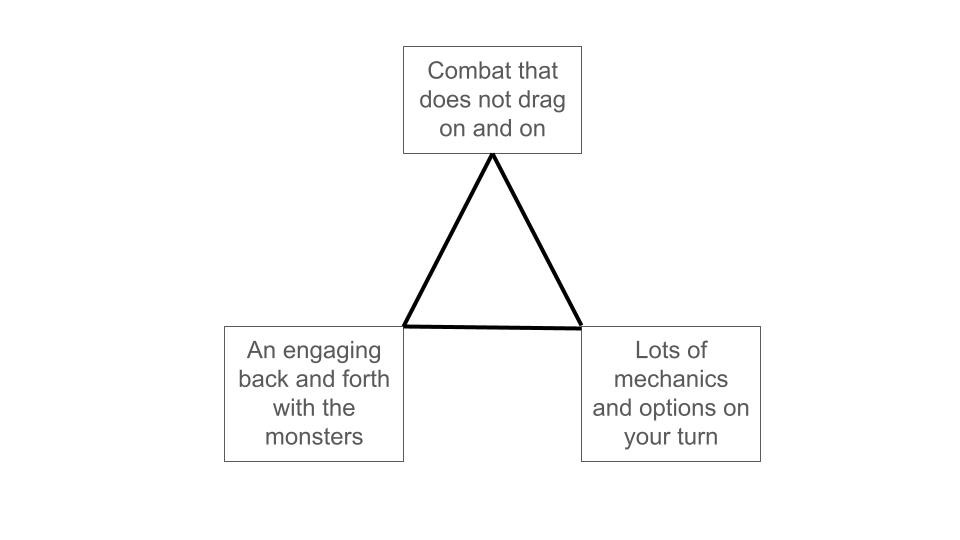
The Iron Triangle of Combat Systems 

This is the iron triangle of tabletop RPG systems. You can pick any two options for your RPG, but you can never get all three. 

Now all of these three ideas are good insights and fun ideas. There are plenty of reasons to support any of these and any combination of these. However, as a designer I have to accept that I will always sacrifice the third option is I prioritize the other two. 

For 5e D&D, the vast majority of combat ends in 2-3 rounds. That is the game working as intended. But as a DM and storyteller, I hated this. It removes any chance for the party to have to regroup and find a new approach to re-engage the enemy. That engaging back and forth matters. I find this hilarious because this is actually something the D&D movie gets right but that game gets wrong. From the first few scenes of the movie you know that Chris Pine’s bard is going to have to outwit the final boss. And he does in an entertaining way. But it is only entertaining because one the first attempt it failed. More rounds were needed for the regroup and second try. That is just the basics of good storytelling.

The problem is if you want those fights with lots of player options and power as well as the back and forth, that is just a really long fight. Great for the climax of a film, too many hours at the table. This is part of the mistake 4th edition D&D made. Combat took way too long and was way too complex. 5e was largely built on 4e’s math and 3.5e character sheets but with things gutted down to a 2e level of simplicity, or at least as close to that level of simplicity as they could get. The key with 5e being that they designed the characters and monsters to be 2-3 fights because they were actively avoiding longer fights. 

And that is the choice here: 1) the 5e approach of lots per round but only 2-3 rounds or 2) what I just did in Star Chaser with 6-10 rounds but less options per round. Both systems preserve the top of the triangle. I think that part of the Triangle is the most mandatory just due to the practicality of running games regularly. 

Now in Star Chaser I did sneak around that a bit. Most sessions were the red line while one or twice a year we had a series of green line sessions. Those green line options were large scope battles that lasted multiple sessions. I did this not by giving each character more options, but instead just gave everyone many simple characters to play all at once. I think that worked well in the campaign, fits right in with what the Blackmoor campaign did, and is actually what the D&D movie did as well. I think this mostly red line to sometimes green line but never blue line design is what the OSR community has backed into. The problem being that as time goes on, the obvious addition is adding in more things to classes which pushes you from the red line to either the blue line (with weaker monsters) or the green line (with stronger monsters). 

Combining these two frameworks 

Traditionally a character class is define as “here is the list of cool powers you get” 

So what is a character class in a system with a focus on: 

  • Faction level play 
  • Combat with lots of rounds but minimal per round 
  • A focus on very large dungeons with real resource limitations 
  • And character growth limitation governed by Time, not selecting between bonuses 

That is the challenge I am working through. This is not about balancing the DPS of different classes. This is about larger structural questions on how a class would interact in a much larger world and seeking more long term goals.

And that says nothing of things like characters aging, creating a lineage of characters, or the details of Kingdom management and technological development or magical development. This is not really a class system but a whole series of class system applied to different aspects of the game.

Analysing the previous game design

Warning: this is a 3,000+ word analysis of my previous 1,000 word design pitch. 

As part of my creative endeavors, there are a few processes that I have found helpful over the years. Three of them are… 

  • Write out your ideas to the point that it is in a testable state. Don’t try to build the perfect system or a full system, just get something down. You do not need to fully flesh out every permutation of a subsystem, but you do need to have a few options for each for testing and clarifying ideas. Once this is done, publish a draft or preserve in a state as a reference. 
  • Give yourself some time before you return to the previous draft. Then iterate with a focus on challenging assumptions, unifying systems, and really drilling down to where the fun or interesting idea is. It is really easy to build a complex system that is unfun to play and get bogged down in the rules. It is hard to build a simple system that is intrinsically fun to play. 
  • Make sure you understand what your characters/classes are not. I think this is a detail lots of designers miss. If this is a group centric game, creating internal group dependence is powerful. 

So in doing that with this design from my last post, we have to pull out a bit and ask the question: do I need classes? What would a classless version of this look like? 

So let’s review the things in the original design:

  • Crafting 
  • Might 
  • Weapons 
  • Cunning 
  • Magic – Divine/Druidic 
  • Magic – Dark Sorcery 

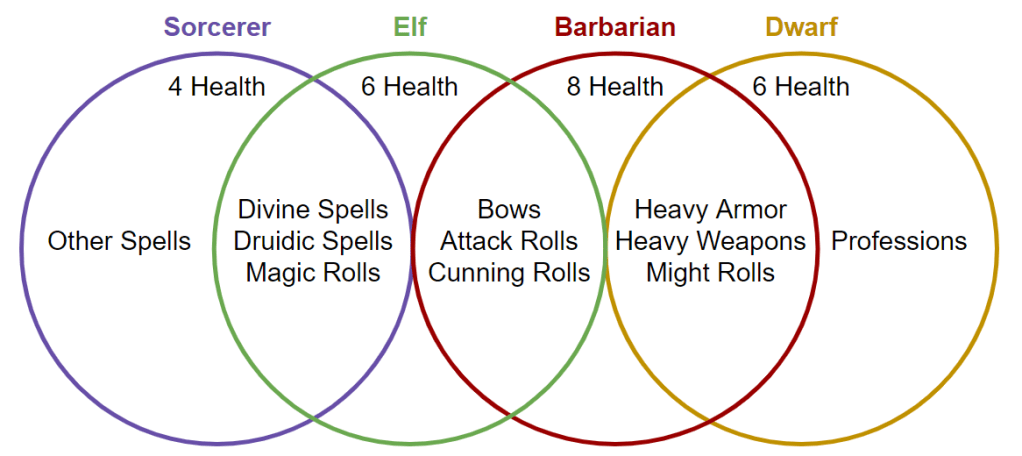
In the original design Barbarians and Elf were the middle 2 classes in the spectrum and they got 3 options. This gave each of them a nice internal triangulation to work with so they had an interesting choice to make every time to gain an upgrade. The Dwarf and Sorcerer were the end pieces, which only got 2 options but they each got one of the most powerful options in the game. Both the Dark Sorcery and the Crafting have a ton of smaller options within them, thus giving tons of customization and flavor. Those two end pieces are also more powerful than the other options. The game designers sleight of hand here was that 2 of the 4 classes have heavy design asymmetry which means that they can’t be easily compared. 

To further the class distinction I gave half, Barbarian and Dwarf, some specific bonuses with weapons/armor. This helped split the Barbarian from the Elf, which otherwise were too similar, and gave the Dwarf a bit more combat options since currently they have the least. This does make the Barbarian a bit of a stronger choice than the other 3 options… but I am actually ok with that. This is a sword and sorcery setting, I was wanting a disproportionate number of barbarians in my world. I was thinking about making an optional 1d6 to choose your character with 1-3 all being different kinds of barbarians. I think the design itself may produce similar results. 

So with the explanation of why the previous system is what it is, can I make a classless system? Let’s not answer the question of should I make one just yet, just can I make one. 

So basic idea: There are 6 things, gain any 2. Maybe later you can gain a 3rd. Simple enough. Does this create a good system across characters and within characters: no, I think there will be notable imbalances. Specifically: 

  • The internal choices of melee vs. magic at the character level 
  • Crafting maybe too powerful given the extra downtime without a penalty 

So there is clearly both a feel and power difference between melee and magic. On the table melee is far more reliable but magic is more powerful. Or at least sorcery magic is more powerful, the divine/druidic magic is a smaller set of spells that serves to give other classes support. Supporting other classes gives you the power impact of… those other classes, thus support is generally self balancing with martial options. This is why the Elf has standard health and melee options while the Sorcerer is designed as a glass cannon. That is a balance correction. They are more powerful but also riskier to play. So what happens when we are about to mix sorcery with the other classes? Well when leveling sorcery is always better in a one on one choice against a melee option. 

This is an internally design imbalance. I want sorcery to be game changing in challenging situations like it is in early D&D. The problem in early D&D is players quickly become reliant on magic like the sleep spell which turns every combat into feeling similar. There is a similar feel in games like Everquest where classes like the Enchanter can charm enemies to fight for them. Note that in Everquest any given enemy is always notably more powerful than any given player character. Heroes can never go mono e mono and win thus they have to rely on groups. The Enchanter’s charm ability to control something more powerful then they are is thus very powerful… but sooner or later the enemy will resist it and turn to attack the party at a random time. Thus charm is both overpowered in the offense it brings to a group but also overly risky in consequences when the offense turns against you. That is the kind of magic we want here. 

So to use make a mathematical example here: if a barbarian does 2 damage, a sorcerer needs to do 6 damage to feel the impact. Note, this is not 6 raw damage necessarily but something that has the impact of 6 damage. But to balance the game we need to get that back down to 2, thus the DC mechanic on the spell so they only work two-thirds the time. This lowers the result to an average of 4 and it forces the players to not rely on specific spells all the time, thus fixing early D&D’s Sleep issues or 5e D&D’s Fireball issue. This forces sorcerers to develop multiple answers instead of focusing on ways to overleverage a single answer again and again. The sorcerer also needs some other penalty of -2 in some way so they are weaker or more limited than a Barbarian. This makes the Barbarian a 2 & 0 while the Sorcerer is a 4 & -2. 

Now many of you may point out “you don’t need the extra penalty, just make spells only work one-third of the time.” While that is mathematically correct… it feels awful in play. A low chance event in a system where they can be repeated on a success actually introduces more randomness than fewer high chance events in the same system. The average result is the same, but the low chance approach creates a much larger distribution. We are seeking a Goldilocks zone of sorts here which is really tricky to determine. We want magic to be unreliable enough that players always make a plan B but not so unreliable that Sorcerers are worthless 75% of the time and Gods the other 25% of the time. 

Currently I have that -2 as just weaker weapon options, lower health, and a lack of other roll choices. I think that works fine for Sorcerers and fits into the classical “glass cannon” of magic users that we have seen in past games. It works fine, but I am open to other kinds of -2. I have strived to keep this game simple, so I am unsure what the other penalty options would be here. But if we opened up to the classless system I would be happy to say “if you gain sorcery, you also have to take this penalty set of your choice”. I just have no clue what those other penalty sets would be at the moment. 

So looping back to the topic of a classless system, for me the issues above create an interesting question: if Sorcerers need this kind of penalty, do any of the other options need it? 

Cunning, Might, and Weapon all have pros and cons already. Divine/Druidic Magic is balanced with those as discussed before. Crafting is a bit trickier. 

Crafting actually has lots of powerful long term effects and short term boosts built into it. This also allowed for me to lean into the Dwarf vs. Elf dichotomy with each have opposite martial skills and completely different party support mechanisms. Both classes are medium power martial classes with support elements but since neither class shares a single element of either, they feel very different to each other.  

Since I limited the Dwarves combat potential a bit in original design I was happy to give them the free crafting downtime. This design asymmetry let me dodge the question of balancing crafting vs. other melee investments. Basically, if crafting comes with a free downtime then take crafting becomes an automatic pick for the free resources that happens outside of your downtime investment. Thus not really a choice, you do this or you are just wrong. 

Currently in the crafting system there are tons of options. Some have temporary effects, like increasing regeneration out of combat or a small batch of potions to use in combat. Others have significant campaign effects, like setting up a castle or training mounts/pets. Since downtimes serve as our leveling mechanic here it is debatable if those one-off bonuses are worth the investment. I am not sure if I am comfortable with short term power at the cost of a character being weaker in the long term. I think that is less of an issue in this system than most others since the power curve is flatter, but it does feel like a character build trap and I never want to design for that. I don’t want a player to get pressured into being a permanent brewer of health potions every downtime and thus never improve their baseline abilities. Having a full-time alchemist would be powerful for the campaign, but weak for the player in the long term.

So I think the answer for crafting is similar to the answer for Sorcerer, we need that X & -2 format if you get a free crafting option each downtime. That -2 has to be a big enough penalty that people don’t want the free powerful crafting bonus abilities. 

So restating the classless design with updates: There are 6 things, gain any 2. Later you can gain a 3rd. 

  • Crafting with the extra crafting downtime but also with a notable penalty 
  • Might 
  • Weapons 
  • Cunning 
  • Magic – Divine/Druidic 
  • Magic – Dark Sorcery but also with a notable penalty 

I like where this is going in terms of balance and more character options, but I have a lot of work to do on penalties options. 

So now we come back to the question of can vs. should. Let’s assume I come up with good penalty options for Crafting and a few alternatives for Sorcery too. Is this version of the game better than the original 4 class design? 

Pros of classless 

  • More flexibility in character creation, more ways to make your character you own 
  • That “gain a 3rd” moment has a nice feel to it. I like the idea of really forcing players to focus their downtimes on just two ideas early on and develop a strong character specialization and feel and then the character has a maturing/versatility moment at a later level.
  • Allows later game players to invest in areas that are needed after the world has become more settled. 

Cons of classless

  • Way less specific class identity. This may muddy the waters a bit but I don’t think it does so too much. This is something to watch for. 
  • The advantage of the HeroQuest 4 classes design is people already have a strong feeling for those specific class ideas. Even if you don’t know this specific game at all, people near instantly understand the ideas behind those characters. Losing classes means losing that instant clarity for new players. 

The interesting thing about the classless design is that I don’t think it contradicts the 4 class HeroQuest design. I think you can just add in a 5th class, let’s call it the Vagabond. A character who picked up an odd mix of things as they traveled. I would expect the Vagabond to have lots of crossover with other classes, maybe even identical characters but that is an outcome that is already possible. 

So what would the Vagabond add or remove from the game? 

  • A magic and martial hybrid different from the default Elf. Sorcerer penalties limit how good these will be. 
  • Crafting and different martial builds. Need a more fleshed out set of penalties applied to crafters to understand any drawbacks here. 
  • The Enchanter style character: a sorcerer or healer who is as focused on crafting. 
  • That maturing moment later in the game 
  • The other 4 classes have great clarity for new players. The Vagabond is messy. 

I think this will be a net gain for the system. Getting the crafting penalties figured out will be tricky because the campaign needs crafters more than the dwarves need to craft. The design choices around the dwarf is a really powerful sleight of hand that I can no longer use, so I now have to either create a balanced integration for it or find a good set of penalties to apply to crafters. 

So I want to talk about one more thing here: the Bard Problem. Having a character that is a jack of all trades and master of none is a very tricky piece of design. In 3rd edition D&D Bards were the worst class. In 5th edition D&D Bards are the best class. First place or last place, they are never in the middle. 

Why am I talking about Bards? Because I think the obvious unanswered question here is: if everything costs a downtime, why limit it at all? Why not let anyone invest in anything at any time. And the answer is because I don’t think that level of balance is possible. I don’t think you can make every choice balanced with every other choice. Very slight imbalances in those kinds of systems lead to an automatic pick option which leads to everyone making the same character or at least very similar players. To take that even one step further, even if you could perfectly balance everything, I think doing so is a bad idea. What I want is different people at my table playing slightly different versions of the same game tailored to the way they like to play. 

Types of players and how this game meets their styles: 

  • Helpful to the party: Support magic both provides more complex tactical options as well as feels different at the table than stabbing an enemy with a sword. The game itself is better with them but the individual player may or may not be. That is ok, because some players just like to be helpful and this gives them a clear path to that. Some crafting does this as well but in a more circuitous way. 
  • Overpower: Might and Weapons provide players the abilities needed to overpower their enemies. Paired with the push your luck action economy for a more fluid set of choices on each and every turn, this gives player’s their power fantasy options. 
  • Out Smart: Cunning and called shots are for players who want to think around situations instead of bulldozing through them. They want to out smart the DM. They want to leverage their game knowledge against specific enemies. Here is a clear set of tools to do so. Some long term crafting options also fit this choice as they are ways to prepare for specific enemies or situations. 
  • Seeking the Big Moment: Sorcery is built entirely around this. The overpower melee  also allows for this kind of game play by saving up for the big moment instead of using resources bit by bit. The encounter has to pivot around this big action. These are super satisfying for a lot of players. 
  • World Changing: These are for the player who is less interested in any given dungeon or any given villain and more interested in the world as a whole or just the advancement of their group members. There are parts of crafting that lean into this heavily. Things like taming mounts, building keeps, and enchanted items help change the long term status of the game and the characters in it. The devoted smithy slowly and steadily making every Barbarian a full set of armor, one piece at a time. I have not written all the spells yet, but I expect some Sorcery or Divine magic options for long term effects may emerge. Think a network of teleportation circles or sanctifying a temple. 

The problem with the “everything available” Bard option is the style ideas above are not shared by everyone, or to be more precise, different parts are favored by different amounts by different people. To make each idea work and feel good at the table, some may need to have a bit more kick than the others. That is ok if groups are a team of specialists, because there is a need for a bit of everything. Slight differences in the power of styles does not hold up in a more free form system because if some options are just a bit more powerful those options now mathematically become the “best” pick, thus an automatic pick, and thus a mandatory “choice”. 

So the balancing challenge now becomes selecting between two different choices: 

  1. trying to balance each option within each style to be fun against similar options 
  2. trying to balance each option within each style to be absolutely equal to every other option in every other style

Given those two choices, I lean to option 1 which does not work with the everything system. I would much rather have more fun options within a style than a perfectly balanced system across styles. If this was a computer game, I would have more faith that an option 2 balance could work. That is because you can reasonably do things like fractional damage, track lots of complex bonuses, or make minor game play changes like a 4 1⁄2% increase to swing speed. That kind of granularity and complexity works in the video game space, but it does not on a table top. You can also track the play of 1,000 players down to the smallest detail as part of your alpha test. Video games also have sound effects, VFX, and other animation tricks to make an ability or spell feel impactful in a way that a table top just does not have. 

The Bard problem leads me back to one of the points I made at the start: make sure you understand what your characters/classes are not. By determining what they can’t do first, you remove the automatic pick option because different skill mixes will have different pros and cons. Designing from a negative space instead of a positive space is a bit trickier but worth the effort as it can produce some interesting ideas and is a great way to ensure a diversity of options is being pursued. It can’t produce a Bard but it can produce a Vagabond. 

So thanks for sitting through my 3,000+ word analysis of my previous 1,000 word design pitch. Yes, it does often take this level of analysis to answer simple questions like “should I add a 5th class that is a hybrid?” For some designers that is a “why not” question but for me I want to make sure it actually has something worth adding to the system.

The ground work for my next campaign

So for my next campaign I am working on something both more in the west marches style and something in the Sword and Sorcery vein. The issue with the latter is most RPGs are written with high fantasy in mind. So I have been working on a simple system that best matches the Sword and Sorcery style and also leans into the west marches ideas. 

I have a few overarching goals 

  • Warrior types should have a risk and reward play style. Brave heroes require brave players.
  • Warrior types should be given bonuses for cunning plays. Cunning heroes require players with good ideas and who have figured out the enemies. 
  • This should feel gritty but require minimal paperwork and complexity 
  • Ways to handle the flavor character types: the trickster, the hunter, the beastmaster, etc. but require minimal paperwork and complexity. These are flavors of warriors, not fully their own thing. 
  • Capture the parallel duality of magic and civilization
    • Magic should feel chaotic and corrupting but also powerful and strategic; spells should have an effect and a possible cost that reflects that effect; there is an element of corruption to magics, an element of darkness 
    • Civilization should feel chaotic and corrupting but also powerful and strategic, i.e. an Army; being in a civilization should have advantages and also drawbacks, risks, or complications; there is an element of corruption to civilization, an element of darkness 
  • Each character should have lots of small upgrade options within each class. I don’t want big leveling moments or lots of heavily delineated classes but instead lots of small bonuses. I would rather have a spectrum of Barbarians than multiple warrior classes. I would rather have a spectrum of Sorcerers than multiple magic classes. 

Here is my attempt to answer those goals 

Core mechanics 

You will pick 1 of 4 classes: Barbarian, Sorcerer, Elf, and Dwarf. You start with 3 “downtimes” to spend how you like. 

  • Characters gain upgrades from “downtime” which happens every 4 sessions. Spending downtime is how people upgrade their character from a pool of options specific to their class. They can also spend loot to buy helpful things.
  • Everything in this game is a d20, sometimes with advantage, and rarely with disadvantage 
  • The action economy is generally one movement and one action. 
  • Reactions: this allows you to take an action even if it is not on your turn. This is reserved for some spells, blocking with a shield, and specific maneuvers. If you use a reaction then you have to give up either your action or movement on your next turn.

The 3 part combat system 

  • This game does NOT use modifiers added to a d20 roll. Instead, you will gain charges of advantage in places where you would normally gain +1 bonuses in other systems. You can use multiple charges in a single action if you like. 
  • Pushing the action economy: You can take extra movements or actions on your turn but for each additional action/movement you make increases the DC. While pushing, failure to succeed any part ends your turn and you fall prone, giving others advantage against you. This allows for a blaze of glory or falling on your face right out of the door. DC starts at 11 and increases by +3 for each additional task. 
  • Attack vs. Called Shot: Attack is generally the more powerful option, but Called Shot allows players to engage a more roleplay style choice by trying to engage enemies in their weak spots. It is riskier but offers more rewards if you read the situation correctly. This is NOT a universal set of trip/blind/grapple mechanics driven by the players but a set of enemy specific weaknesses driven by the narrative.

Note that all three of these ideas flow together. You can use multiple charges of advantage on your turn to increase your odds of successfully pulling off multiple called shots in a single turn with a whirlwind of attacks. Of course doing all of that will blow through a lot of resources and put you at risk. Or you can use charges sparingly and be that fighter that is steadily ripping through enemies.

Magic 

  • Spells Casting: each spell has a DC, generally a DC 11. If you roll over, the spell happens as written. If you roll under then nothing happens and you forget the spell temporarily. The divine/druidic spells have no negative consequence. All other spells can have a negative consequence on a low roll, normally just a 1. 
  • Not all spells are equal. More powerful spells will have a higher DC and greater negative consequences but also are way more powerful.
  • Note: spells work just like attacks and you can use them within the “3 part combat system” with magic rolls replacing weapon rolls.
  • spells are less in the vein of magic missile and lean more to rituals or riskier combat abilities. Think less tactical and more strategic.
  • Spells are… odd. Some have extra features that are discoverable. So as an example: you may have two copies of Cure Wounds and then two more copies that can be reversed into Inflict Wounds and a fifth copy which is Curing Words that works at range. Inflict Wounds and Curing Words heal like Cure Wounds but have a second option and higher DC.

Where to spend your down time

  • There are 4 stats: Might, Magic, Cunning, and Weapons. A bonus in each is just another charge of advantage.
    • Might: athletics, strength, endurance, movement (including pushing)
    • Magic: casting spells and understanding magical effects 
    • Cunning: stealth, thievery, traps, lying, wilderness survival, and general trickery 
    • Weapons: melee and bow 
  • Those with magic can copy a spell they already know, learn a spell from a scroll, make a scroll of a spell they know, or combine magic fragments to create a random spell
  • Dwarves gain a bonus down time which can only be used on professions. This allows dwarves to craft stuff or access new professions.
  • This is not a complete list. As you play the game and discover things, more options will become available. As you build up the town and additional outposts, more options will become available. Some in game events may also open up additional options as well.

Recovery while adventuring

  • In town, regain any mix of 10 from charges of advantage to spells to health. Most of the time you will not be in town.
  • In the field, regain any 3 from charges of advantage to spells to health. Some spells or dwarven crafts may increase this.

Why writing a role playing game with space combat is hard

Let’s start at the beginning… 

What is a role playing game? Broadly speaking, something where players act out their characters’ choices/reactions and also face challenges in the game. Those challenges and the character powers to face those challenges are often highly tied to the settling/genre. So fantasy gets swords, arrows, world bending magic, and dashing tricksters with feathers in their caps over bardic charisma while sci-fi gets energy swords, lasers, world bending technology, and dashing tricksters with vests over their Harrison Ford-like charisma…

Yep, those are totally different things. 

But either way, I have always tried to build games that are high on impact and interesting decisions and low on minor technical fiddly bits. That means avoiding +1 bonuses, they neither change decisions and these are the most fiddly of bits. I prefer combat which has a healthy back and forth between the enemies and the players. This means avoiding combat where players charge in, unleash all their powers on turn 1 or 2, and then the enemy is dead before there is any back or forth much less adaptation by the players. I want my players to have real choice and for those choices to play out over a dozen rounds of combat or so. There needs to be time to punish the usual tactics if relevant, allow the players to adapt, and then overcome the enemy.

But that is at the ground level, the infantry level. When you get into fantasy you start to ask about how Kingdoms and large monsters affect the world. While in sci-fi you have to wrestle with the limits of different kinds of technologies, space travel, how industrialization or automation affects daily life, and even how just the scale of it all affects it all. 

For this blog post, I want to zoom in on just one of those Sci-fi ideas: space combat. So same goal here, I want my space captains, crews, and ace fighter pilots to have real choices and for those choices to play out over a dozen rounds of combat or so. 

So what are the options that came before me for this genre? Well, there are 3 approaches and sure enough these 3 align with 3 big sci-fi IPs. I have never seen official names for these approaches so forgive the over dramatic names I will be making up. The first is the “multiple different phase command bridge” which is used in multiple Star Trek games. The second is “WW2 IN SPACE!!” which is used by fantasy flight in their Star Wars minotaur game. The final is not a well known IP but it has become a bit of a darling in the tabletop community, and that is Lancer, specially Lancer:  Battlegroup whose playstyle I would describe as “stack +1, 2 rounds of nothing, then everything dies in round 3”. 

So let’s start with the Star Trek example because I think in many ways it is the most telling. Trekkies… are nerds, and like all good nerds and other people of great taste they have a long and deep love for table top games. This is where I started my hunt for an example of a good space combat system I could bring into my game. It is also a place I failed very, very quickly. I start to grab the many, many, many archives of Let’s Play the videos of Star Trek games. Many had additional small but devoted reddit communities. I started to run a few in the background and once I heard space combat I was going to start taking notes. 3 days of podcasts later I stopped that approach without a single instance of space combat. So to reddit I went to ask why. Across many games and many different versions of Star Trek tabletop, there was a surprising universal answer. Space combat sucks, you play this for the interesting away missions or not at all. This was universally agreed on across niche fan communities that it was just an unspoken rule. 

The reason? The phases were very complicated. There was no room for imagination. And even if you did it right, it was very hard to follow the battle or make it feel impactful. It was a lot of work for all involved for no narrative or imaginative reward. To make this worse, the away mission play was solid so no one wanted to give up that bit of play time for the other. Thus, the space rules are largely ignored. I was able to find 1, only 1 example of play during a let’s play. At the start of the episode after that one, they announced they were not going to do space battles any more and apologized to their fans. Yikes. When your space combat is so bad Trekkies apologize for it to other Trekkies for being too niche and nerdy, that is saying something. 

The problem is other games have followed suit. Stars Without Number and the classic Traveler also split their roles into pilot, engineering, sensors, weapons, or repair with people doubling up in the last two as is needed. Things tend to be balanced around “energy” with a pool of it being smaller than the number of systems it could run. So power is moved around to meet the needs at that moment. Once again this quickly gets into the fiddly bits of design and while the goal is for everyone to do something useful, power may limit that and basically cost someone their turn. Also, not all of those roles are anywhere near equal to each other. If you want things like sensors and engineering to be meaningful, multiple phases with their own complex or set of bonuses will likely be needed which just adds in more complications. 

I get why people like this design and I think it does have potential… but has the potential shown itself? If a few hundred Trekkies can’t fix it, I doubt a lowly normie like me has a chance. So what is the next option? The Star Wars miniature game. 

So this is a really fun game and can still be found in most game shops. The mechanics are taken from an older WW1 war game and is overall a good design. Each player has limited movement options, hides their movement choice, and then both sides reveals it at the same time. You fire but only at the end of your turn. This means both players or teams of players have to find a way to maneuver around their enemies and out-think them. This matches great for Star Wars as many of the original space battles were actually modeled directly off of WW2 footage. 

This is actually the best version I have tested thus far. The problem is: role playing stops once this mode starts. It also requires a Star Fox like set up where everyone is a fighter pilot or they have nothing to do. The hidden maneuvering and only firing forward with those you maneuvered behind is the limitation that makes this puzzle engaging. Add in turrets or larger ships and it quickly loses its spark. It does the fighter niche well, but fails if you push on it any other way. That inflexibility makes it a bad fit for a tabletop game.

So this takes us to Lancer: Battlegroup. As you would expect from a Lancer game: great art, great story, and tons of customization options. But most things are not impactful. So some slight context. The whole battlegroup acts as your character, so they all stick together and share an action economy. There are 3 kinds of ships: Battleships for long range fire power but only after spinning up big weapons for a few turns. Carriers which can launch your expected fighters and bombers but also medium sized escort ships for defense and boarding pods filled with mechs…. because this is Lancer after all. All of those launched assets are only good at short range; it takes a few turns to get in range. And finally Frigates provide defenses bonus and just extra hulls to hit. You get 20 points to build your battlegroup. Ships cost between 3-5 points and most have 0-4 point worth of optional upgrades. Battlegroups run 3-5 ships depending on where you fall on the quality vs. quantity line. 

The result of this design are two fold: 

  1. There are only 2 kinds of battlegroups 
  2. Nothing happens in turns 1 and 2, tons of death in turn 3, little happens in turns 4 and 5. 

So how does this happen? Well, basically the optimal way to play is to build your fleet around either Battleships or Carriers but never both because they are optimized to play at different ranges. Mix in Frigates to your desired level of protection. 

The first two turns are just maneuvering a bit, spinning up large weapons, and maybe gaining some minor bonuses that will most likely not be relevant. What does not happen here is decision making. If you build your battlegroup to do X, then you do X. There are zero situations where you switch gears and do Y instead. This makes the game almost programmatical in nature. It is less a tabletop game and more like the novelty electric football game from the 1970’s that was based on vibrations. You set it up and then let it go and what happens, happens. Everything is built to do something specific so there is limited room to do something else. 

With turns 1 and 2 out of the way the Carriers are now in range and the big guns of the Battleships come on line. The big guns are hit big, miss big and a few lucky rolls hit make or break the whole battle. Expect to see 20 health Battleships with +2 bonuses from maneuvers get hit for 35 points. Carriers do a bit more consistent damage per turn but less upfront. So you either break their back, or they break your back, and then the Carriers clean up over a few turns. That is every battle in Lancer: Battlegroup. The NPC fleet is weaker than the PC fleet, so you will win most fights but bad luck will catch up to you sooner or later and you will lose everything quickly. Nothing you can do about it. This is just a really complex weighted coin flip. 

So which of these best fits a sci-fi campaign? None of them. The “multiple different phase command bridge” is a known loser and while it does leave some room for RP moments it is largely an exercise in tediousness and favors some roles far over others. “WW2 IN SPACE!!” only works if it makes sense for everyone to be a fighter pilot. And even then, I am unsure if there is role play potencial there. And finally the “stack +1, 2 rounds of nothing, then everything dies in round 3” may be the most scientifically accurate and worse option. If you are a 5e player that likes to go nova the exact same way in every fight, you will like this. I think that good stories do not come out of those kinds of mechanics. Or most specifically, that kind of combat shuts stories down faster than they can carry the narrative forward. 

… and so I return to my journey to find option 4…. 

A pair of string quartet pieces

Today I brings you a pair of short string quartet pieces. One was written awhile ago but I was finally able to recover the mp3 file. Forgive the sound quality. This is not a really instruments and there are no dynamic controls. Lots of the little nuances or larger dynamic shifts are missing from the recordings.

This second one came to me over the weekend and I knocked it out in a few hours.