Today I brings you a pair of short string quartet pieces. One was written awhile ago but I was finally able to recover the mp3 file. Forgive the sound quality. This is not a really instruments and there are no dynamic controls. Lots of the little nuances or larger dynamic shifts are missing from the recordings.
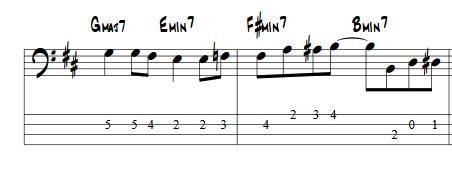
For this post we are going to analyze just 6 measures from single song to figure out how we can write better basslines. The song is Ain’t No Mountain High Enough by Marvin Gaye and Tammi Terrell. It is a Motown recording using their studio band, the Funk Brothers, with James Jamerson on bass. James Jamerson is one of the most influential bass players of all time so if you are unfamiliar with him, go do your homework and then come back.
Listen to the song if you don’t already know it. This version has the bass turned up and has a visual for the bassline. The sheet music below is from www.thebassment.info.
So this is just 75% of the chorus and you have a fairly a straight forward 4 chord progression.
G… E… F#… B…
If you are used to 4 chord power songs then you already know a dozen different fills to connect these chords. This is slightly different as it is in the key of Bm with you ending on the root. Thus you have a traditional 6 – 4 – 5 – 1 line. Otherwise, nothing really note worthy here, and most bass players would have played some simple licks to connect the parts and moved on.
But not Jamerson… and lines like this are why he is a legend.
Take just a second to think of a more traditional bassline under this song using some of the riffs you already have in your arsenal. You make it sound a bit funky, you put a bit of groove in it, and I’m sure you execute on it well. Listen back to it in your head I sure it sounds good. But does it have that rolling roar of a Jamerson line? So let’s break it down.
Using Octaves Asymmetrically
So we have our line of 6 – 4 – 5 – 1 in the key of Bm, but what octave do we play it on? For many the answer is often either what has the tone we want or if we specifically want to play the root higher or lower then the rest. On lines that end on the root, we often play it lower than everything else to give it extra oomph and create a feeling of resolve with in the line.
So what does Jamerson do with the root notes of the chords in terms of octaves?
Low – Low – Low – Low High – High – High – Low High – High – High – High
Each line is different. We start low, go to a mix, and end high. That is 3 different basslines just in terms of the where we place our root notes. Let’s look at the transitions between roots.
Low (go up to walk down) Low (walk up) Low (walk up) Low (walk up)
High (bounce around) High (walk up) High (go down to walk up) Low (walk up)
High (walk down) High (walk up) High (walk up) High (go down to walk up)
Every transition is different from line to line with one exception. The transition from Em7 to F#m7. This one part is the same every time. Notice he also walks up 7 of the 12 times, walks down 3 times, and bounces around only once. This is mostly an ascending line with intentional movement to make dramatic moves down so he can chromatically walk back up.
Using Rhythm Asymmetrically
Jamerson is a bit less dramatic here (not so with the verses, but that is for another time). The first and third pass through the chord progression we see the same rhythm. Note that by holding out on the & of 2 in the second (and sixth) measure it breaks the 1 and 3 flow from the first (and fifth) measure.
The second line reflects the first and third pass through the chords, in fact is one note busier in each measure, which is every other chord. This means it still feels very close… but isn’t quite the same.
Bring the Asymmetrical Element Together
So what is the big picture of these 6 measures?
Low Octave – Rhythm 1
High/Low Octave Mix – Rhythm 1 with slight variations
High Octave – Rhythm 1
He uses similar chromatic walk up throughout. He keeps the relationship between the Em7 and F#m7 the same at all stages. He never radically changes the style or tonality. That said, go listen to the song again. That chorus has a this rolling roar that brings you in and is constantly shifting below your feet.
In an earlier blog post I ranted against musician’s obsession with tone, and I concluded with the idea that if you feel like your tone is lacking, maybe the problem is with the bassline you are playing. In an earlier post I also talked about the role of a bass player as selecting between great lines, not just being good enough to play one good line. The exercises needed to seek out those better basslines are the same kinds of approaches that can be applied across a verse or chorus to create a dynamic asymmetric bassline. Notice that we are ignoring our preferred tone across octaves to write a line that moves across octaves.
And that is part of the barrier to asymmetric basslines. You must put the technician aside and lean hard, hard, into the musician side for being a bass player. A bias for specific tones or specific riffs will actually stand in your way as you try to write broader lines.
Dear Guitarists and Bass Players: NO ONE BUT YOU CARES ABOUT YOUR TONE! Shut up, get over it, and move on.
Really, that is it. I’m going to pontificate (read: rant) on this for a few minutes. If you laughed when you read the above then you get it so feel free to skip this blog. If you are shocked or disagree, please keep reading.
Ok, let’s dive in a bit. Musician’s obsess over their tone. They spend thousands of dollars on their instrument and again spend thousands of dollars on their amp and then again spend hundreds of dollars per unit on a mix of pedals and effects board all to get that perfect tone.
What a complete waste of time and money. Yes, I would argue you need roughly the right tone. You should not use an acoustic guitar on a death metal song. But how good does it need to be? Tone quality has a fundamental purpose in your playing. You need a good tone so people can hear what you are doing. Tone is for emphasis and clarity, not filling out your sound. Not filling out the song.
In my experience, most people can’t actually hear the difference between the highest quality tones and mid quality tones. I worked in a music store and watched this happen day in and day out. If you play high end and mid tier side by side then you will hear a difference. If you just play them in isolation, most people will guess roughly 60/40 right to wrong. If you mix it into a band in a live setting, fellow musicians often guess wrong when asked if another musician is using a high end or mid tier piece of gear.
In a high end recording studio under ideal situations, sure there is a difference. Yes, cheap gear has issues and non-musicians can hear the difference between low-tier and mid-tier. Mid-tier vs. high end in a live setting, the difference is small. Yes, as the player of the instrument you will hear a difference, but does the audience know?
Here is my counter-thesis as to why this obsession exists: your tone is not lackluster, your playing is. If you are just playing a whole note/chord on the root, letting it ring out and then think ‘huh, that needs a bit more to it’ then yes, you are correct. But it does not need a better/more/different tone, it needs you to play a riff, layer on counterpoint, play a passing note or two between chords, add in syncopation. DO SOMETHING! Before you “fix” your tone, add more to your playing. If you add just a bit more to the song and all of a sudden you don’t notice the tone issue then guess what? It was never a tone issue.
Everyone who plays an instrument is required to be two things: a technician and a musician. For most instruments, the technician is the dominant part of that duality. For bass players, the musician is the greater part.
A common phrase kicked around musical circles is “less is more” and it is often applied to the rhythm section. God I hate that phrase. Don’t get me wrong, it is often right. But people are often right about it for the wrong reason. There are specific times and specific situations where this is correct, and I guess if you lack diversity in your playing so you are always in that time and place then I can’t blame you for falling into that trap. But I want to take a second and walk you through what decisions a bass player faces while placing “less is more” in the context of actually writing a bass part.
So to start with, what is the job of a bass player in music? Why is this instrument even in the band? Well…. there are six answers to that question. That’s right: 6 answers.
First answer, laying down that groove. Giving the song that feel and oomph that makes the rhythm section define the tone of the song. This is largely rhythm centric and done closely with the drummer and specifically with the bass drum. You will find bass players who absolutely obsess over the bass drum. Those guys are focused, maybe too focused, on the groove. Overall “Less is more” works with answer one… to a point.
Second answer, pushing the chord progression along. This is commonly done in conjunction with the rhythm guitarist and maybe a keyboard player. You will often hear the chorus of a song really ramp up the intensity with the guitarist and bassist really digging into the same line in unison. “Less is more” works here as well… to a point.
The third answer is a counter melody. Here is where “less is more” completely falls apart. A strong, interesting counterpoint can make the core melody of the song so much more powerful and interesting. It can give new light to an old idea and bring out complexities that were hidden before. This is super powerful but lacking in the arsenal of many bassists because “less is more” forces them to shy away from the “more” when it can do the song the most good.
So before we talk about the fourth, fifth, and sixth answers, let’s apply the first three to a generic rock song. You open up the verse with a nice groove to bring people into the song. The rhythm guitarist is doing a light effect or fingerpicking the chord. As the first chorus hits, the bassist switches to pushing the chord progression and the rhythm guitars digs in for a heavier feel. This combo brings a ton of energy to the chorus without changing the core of the song. You then slip back to groove in the second verse. If the song has a bridge, this is where you may play with a counter melody or you may be the only one pushing the chord progression while others play with counter melody.
This is the traditional setup for a bassist, but notice the overall highs and lows of the song are driven by the bassist switching answers. It is not the groove itself or the chord progression itself that is the art of playing bass, but determining which you should be focusing on. This is what I mean when I say a bassist has to be a musician over being a technician. The hard part isn’t playing the riff, it is knowing which riff will add the most to the song. Our job is not just to create a good answer, but to select from between a range of good answers that help the song become great.
Answers four, five, and six are simply hybrids of any two previous answer. A groove that also pushes the chord progression forward is often a compromise of the two and those compromises produce complex bass lines. Pushing chord progression while providing a counter melody normally involves weaving in and out of the chord progression or providing emphasis on a different part of the chord, literally changing the progression of the song by adding a new layer to it. A groove with a counter melody is a roaring alternative line or poignant counterpoint. These are never simple. These revel in their complexity.
The math here is simple. Two of the six answers can be done to some extent with a “less is more” approach. And once again, a simple line is often a great answer in these two cases. But “less is more” is simply a third of the job. And if you are going to be a great bass player, you have to be able to do the two-thirds that require the “more”. So many bass players limit themselves by never stepping out beyond the switch between laying down a groove and pushing a chord progression.
If you are going to be a bass player, a really good bass player, having one good answer is never enough. You have to be able to provide a range of answers and the song will dictate which is a good answer and which is a great answer. The more you limit yourself, the less likely you are to find the great answers.


 Sean Witherspoon's Blog