Star Chaser Review and next steps into the Wondering Station

So I have thus far not written a post-mortem on my last game, Star Chaser. So let’s do a quick good/bad. 

The Good: 

  • The flexible gear system means the players switch up their characters every session. This means every session people have to coordinate and make choices. Those choices often took a bit of time for some players. This is actually a system I used in the first game Burning Light but it worked here as well. 
  • The choices were mostly balanced. More precisely, they were balanced enough that people would switch up what they were doing and go in different directions between sessions.  
  • Players often moved freely between multiple characters or NPCs. This switched up the play style once again. 
  • Players made wildly different characters. I was super happy with the level of customization and unique characters. 
  • We flipped between lots of small scale combats and then a few larger multisession battles with mechs, tanks, and large infantry squads. 
  • Near the end of the game I had a repair system for the large battle-scale assets that worked well to make those big hitters only used rarely. 

The Bad

  • Sci-fi as a setting is just not as popular as fantasy. This makes recruiting for new players hard, specifically as most boards are specifically focused on 5e D&D. 
  • We originally launched with a crafting system that my players speed runned within 6 weeks. We had to disable that because it just was too much too quickly
  • While the horizontal advancement was great, the vertical advancement was minimal and that was ultimately unsatisfying to a few players. The number balance was good so I need ways for some characters to “be better” without unbalancing those numbers. 
  • Consumables weren’t a thing for most of the game. There was already power creep happening so a burst of power from consumables was not sustainable. 
  • I made some even higher tier weapons but at the cost of less flexible builds. Players never took those options. 
  • This took a huge amount of time to prep for. As talked about in a previous post, the world build work was very large and I was just lacking in some of the tools needed to tell these kind of stories at a consistent quality given that scale. 
  • I had players coming in and out. I kept trying to execute on player centric arcs… only for that player to leave the game. Thus I feel that although the setting was good I need something where it is not character arc driven but still has character arc potential. 
  • This whole blog on my failures to get space combat to be fun

I sunset the Star Chaser campaign and switched over to a Blackmoor/Westmarches style fantasy campaign. This has been great for a few reasons. Because it is an open world where I prep things and put them out there, I have only needed to do a fraction of the prep time compared to previous campaigns. I was also able to repurpose something from earlier campaigns for it, so while there are new dungeons and a new town, that is very minimal compared to what I was doing before. This means I can focus on other things and be a bit more loose while DMing, which has made this my favorite campaign to run thus far. When I want to prep, I do so I am not held to a content deadline of 6 days for the next session. It is done when it is done and can wait there when the players are ready for it. We are 6 months into the current campaign and I have 1½  years worth of content waiting for them. I am sure I will add more onto that as we move forward and I have other DMs adding in their own content. 

That said, I am missing Sci-fi. Despite the problems it is just more engaging and interesting. And that is why I have started to work on “The Wondering Station”. 

The broad idea is I am trying to take the best parts from my last 4 campaigns and get them all into one place. 

  • From the Burning Light I am taking the satirical dystopian setting and the easy to use slot system. 
  • From Before the Empire I am trying to build a more rich and focused world with larger character arcs. 
  • From Star Chaser I am bringing many of the oddities, large scale war systems, and the “big crew” feel. I am also porting over a lot of the old maps as well. 
  • From Ruins of Ah’Moor I am bringing the flexible xp system, the town centric West Marches style of play with player driven changes to the town, and the “everything is just a d20 roll” mechanic.  
  • I am also pulling inspiration from the Beat system found in Slugblaster and many, many systems and secrets found across the various SS13 servers.

In terms of game play, my goals is to focus in on these 4 elements: 

  • The prepped large dungeons work well both in terms of my workflow and craving out space for others to try DMing in the setting. Those are now alien archeology sites. The station is part of the corporate office of “Galactic Research Arcologists and Verification Experts with Robust Operational Budgets and Battle Effectiveness for Risky Situations”. These can be specific to each world, connected via Stargates a la Stargate GS-1, and other DMs can add in whatever they like. These are alien worlds… so we can get weird with it. 
  • I want to do more mysteries and town based RP sessions. These are designed to take place on the station itself, so players will already know the characters and the station. This gives us more opportunity to RP in the open world setting. I have been using ChatGPT to help write a mystery style missions. Overall, I have not been too impressed with ChatGPT’s writing ability, but that is partially a complaint about dialogue which is something I would improv. 
  • The Station will also “jump” from time to time. This new location creates an opportunity for thematic crew members to join, new tech/weapons options, and villains/threats specific to this area. The station will have a shuttle for taking some of the larger combat elements to larger battles, i.e., the Mechs and Tanks from Star Chaser, which can be invested in leading up to combat. This gives the players some of the long term investment options. 
  • The players can make periodic investments to improve the station and themselves. This will change the station itself and open up other options for the players. The updates grant session to sessions bonuses as well as long term upgrades. 

So how do characters work? – The general design 

I need characters that can both 1) be interesting on missions from session to session 2) be interesting across their development as characters and 3) be interesting across the development of that station and crew as a whole. 

I think I can broadly accomplish point 1 with the gear slot system I have used in the past. The lower tier of items are accessible to anyone. The higher tier of items require training in them. I think that is a good but not great solution. I want to add powerful consumables into that mix as well to give a bit more variety but at greater costs than I am doing now in Ah’Moor

For point 2, characters need a more traditional leveling up path. I plan on leaning on the station side, specifically spending xp to gain access to crafting consoles and or specific skills. There is a lot of room complexity and growth here. Part of the goal to create more character development is to make the verticality happen on the station side and in stockpiling resources for the big battles. I want that element to absorb the big hitting powers, not every session of the game. In part, this means I am trying to answer point 2 by making it point 3. 

The second way I want to accomplish point 2 is through Slugblasters beat system. In our system a 1 or 20 on a d20 for trouble and style that then attaches to your job on the station. Instead of these turning into teen angst flashbacks, they will turn into issues on the station. This is a way to force the story telling a bit and connect the players to their specific jobs in a more natural way. 

So how do players work? – The details

So first of all…. all of this is due to change. I am sure that as I flesh out more of the details I will find problems and develop new ideas that just work better. Think of this blog post as a dev update, not a release. 

So broadly there are 4 kinds of characters. The first 3 are standard, then the 4th is the oddity. The 3 are the Station Crew, the Mad Scientist, and the Marine Clone. The Station Crew largely focuses on the ship’s morale, which is what I use for health in Ah’Moor. Many of these positions are pulled from Space Station 13 and they affect both healing between sessions and max health during sessions. Most Station jobs contain some strange and secret bonuses for those who really master their field. A lot of the bonuses here come from spending xp to gain access to new machines or making items for the crew. 

Next is the Mad Scientist, which once again pulls ideas from Space Station 13, and they invest in the bigger picture things like explosions, giant fighting robots, bigger explosions, superhuman mutant powers granted by pharmaceuticals, different kinds of explosions, research on those acquired alien relics, and… explosions. They are trying to make things available for those big battles or develop new options for the Marines to play or the Crew to use. 

The 3rd is the Marine Clone. A semi-lost soul being born and reborn into valor. These are basically just a Star Chaser character but with extra lives and focused on the combat side. The specialist versions of these are based off of TF2 characters to give you a thematic starting point. Your skill gains are access to more weapons, armor, and combat gear options.

The 4th and final is not really anything specific. Part of what Star Chaser did right was leave room for oddness. That is available here as well. I have a giant list of strange ideas but will also take ideas from players. I want a more limited pool of Strange Characters as they are the hardest to balance and work around. So maybe let player either choose 1 of the main 3 or they can roll and take what every they get, with Strange being accessed this way.

After that there are lots of options within each of the 4 big groups so players still have lots of choices to make. Currently I have about 10ish subclasses in each of classes so players still have plenty of choices. There is also the option of letting some people to take 2 options (roll over 16 of each?) but have a higher xp cost or another similar mechanic. Once again limiting this to random rolls.

And on a final note about characters…. I want these to be more communally held, not just “your character”. This happened with the NPCs in Star Chaser and it was great. I will probable just make some random characters as examples and then allow players to add in more characters if they want but only after they have played a session or two.

Characters, Classes, and World Context

As I am working on my next campaign, I thought I would take a few minutes to write some of the context that goes into that. For this post we will have two parts: 1) elements of play and 2) trade-off between combat systems.

Element of play or What the heck is this game going to actually be? 

The early Blackmoor campaign, from which D&D was derived, was an odd mix of mostly crawling a single large mega dungeon with characters being units from a war game, raising an army for the big end battle, and then a smaller mix of one-off adventures in the land. 1st and 2nd editions of D&D, or OSR if you prefer, are also focused on a mix of smaller dungeons and hex crawling. In the early game, getting a burst of power to work through a dungeon works. For a mega dungeon… not so much. Raising an army for large battles was important in Early D&D but only in late game. Modern D&D is mostly split between DM’s doing small dungeons with a specific theme and then lots and lots of characters and one-off adventures matching them. 

The reason why this matters is because we have to call out what a character needs to do if we are making something like a class or character creation process. Given the previous ideas: 

While every campaign is different, between the editions there has been a shift in focus on what D&D games are and are not. On what kind of content they do and do not tackle. One of the reasons why more recent versions of D&D have struggled with designing Fighters is because in the early version the two most important things about Fighters is their ability to raise armies and their use of magic swords. Now everyone gets magic items and they are not raising armies, i.e. everyone is now part-fighter and half of the Fighters job is no longer a core part of the game. No wonder they are bland. 

There is also this core idea of player feedback in response to the content. Originally there was no thief class. Players created the thief class and suggested it to TSR, not TSR offering it to the player. And the original thief class is a completely logical response to a dungeon filled with traps and trickery. As the published modules started to lean on hex crawls more and more, the Ranger class went from a specialty within the fighter to its own stand alone thing. The Ranger class and its themes only really make sense in a game that is leaning into that niche of content. Rangers in 5e struggle… because they are best Hex Crawlers in a game that does not hex crawl. 

So if you ask me “How do I make a good Ranger class?” my answer to that will vary wildly based on which edition of the game you are playing or what kind of campaign you are running. In a Dark Sun like setting where you have to scavenge for water, Rangers are totally overpowered. In a generic superheroes in high-fantasy setting, Rangers have lackluster DPS. 

So in this next campaign, what are the marquee ideas I am pinning the campaign on?

  • Mega-Dungeons… or at least much larger dungeons with interactive elements between sections. 
  • Hunting down great beasts… with a focus on turning their hides into armor and weapons 
  • Faction Play… with a focus on building an army, raising a castle, and improving the realm with infrastructure 
  • A Real Time game, so one day in the real world is one day in the game. Time is a resource you use for self healing, regaining magic, crafting, self training, and training others. 

So how do these ideas affect the game? The biggest is how the real time game interacts with magic. There is always a cost to regaining magic so there is always an incentive to not cast a spell. At the same time, there is a meta level of play where magic users can stack up a large pool of spells in their magical arsenal. It is best to look at magic users not in terms of long rest but instead in terms of their total magic over their career.

Tools, which are throwaway items in 5e, are actually super critical to helping you and your allies to power up. Crafting will be more powerful and reliable than enchantment magic. It also means that many players will be dependent on other players for their “level up”. I double down on this idea with a team being needed to hunt down large monsters to make better weapons and armor but that creature only giving a limited amount of crafting material. 

And finally, given the faction play element, it is important to look beyond your character and instead look at your role in the world. Gaining +1 soldiers is more powerful than gaining +1 to your sword hand when fighting in a big battle. This creates a very different leveling experience because you are facing a trade off between different elements of play.

This goes back to the classic failure of modern D&D players to read only the class section of the older player handbooks and declare that Fighters are linear. They are not, they keep gaining extra attacks and more health via adding more minions to the battlefield. Neither the Beastmasters Ranger nor conjuring Wizards are the best pet class in D&D. The 1st Edition Fighting-Man is the best pet class in D&D. That is why Fighters use basic mechanics. You’re basic because you will be playing 4 Fighters at once. 

Of these three examples, note how they interact with each other. Crafting, regaining magic, training others, and resting to recover from tanking a dungeon all share the same resource: Time. Something like an Eldridge Knight or a Bladesinger becomes challenging in this system because they would want to drop all their Time into resting and regaining magic, but doing that ;eaves them with nothing left for Faction Play or leveling up their character with training and crafting. Those kinds of apex dungeon crawlers can be a thing… just know that sustaining those is hard and comes at a cost to other parts of the game. 

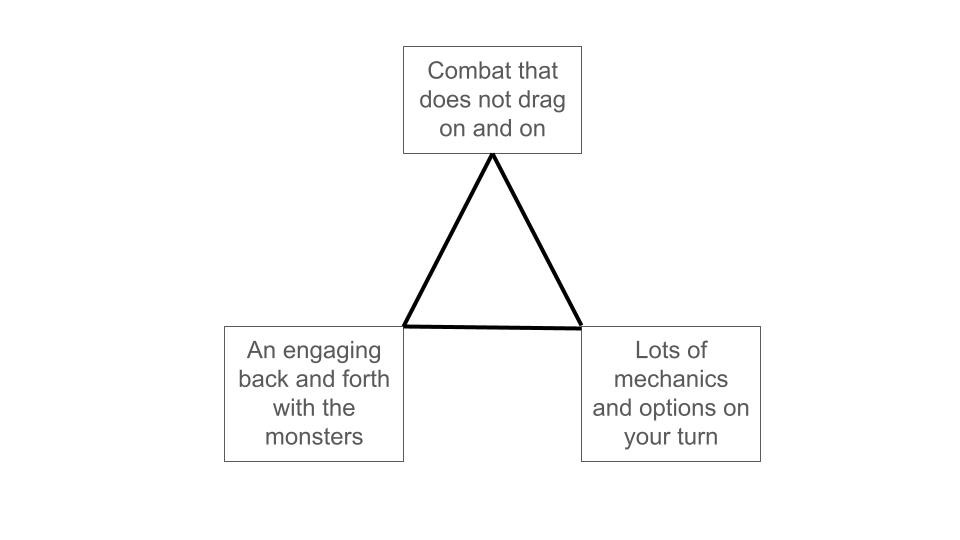
The Iron Triangle of Combat Systems 

This is the iron triangle of tabletop RPG systems. You can pick any two options for your RPG, but you can never get all three. 

Now all of these three ideas are good insights and fun ideas. There are plenty of reasons to support any of these and any combination of these. However, as a designer I have to accept that I will always sacrifice the third option is I prioritize the other two. 

For 5e D&D, the vast majority of combat ends in 2-3 rounds. That is the game working as intended. But as a DM and storyteller, I hated this. It removes any chance for the party to have to regroup and find a new approach to re-engage the enemy. That engaging back and forth matters. I find this hilarious because this is actually something the D&D movie gets right but that game gets wrong. From the first few scenes of the movie you know that Chris Pine’s bard is going to have to outwit the final boss. And he does in an entertaining way. But it is only entertaining because one the first attempt it failed. More rounds were needed for the regroup and second try. That is just the basics of good storytelling.

The problem is if you want those fights with lots of player options and power as well as the back and forth, that is just a really long fight. Great for the climax of a film, too many hours at the table. This is part of the mistake 4th edition D&D made. Combat took way too long and was way too complex. 5e was largely built on 4e’s math and 3.5e character sheets but with things gutted down to a 2e level of simplicity, or at least as close to that level of simplicity as they could get. The key with 5e being that they designed the characters and monsters to be 2-3 fights because they were actively avoiding longer fights. 

And that is the choice here: 1) the 5e approach of lots per round but only 2-3 rounds or 2) what I just did in Star Chaser with 6-10 rounds but less options per round. Both systems preserve the top of the triangle. I think that part of the Triangle is the most mandatory just due to the practicality of running games regularly. 

Now in Star Chaser I did sneak around that a bit. Most sessions were the red line while one or twice a year we had a series of green line sessions. Those green line options were large scope battles that lasted multiple sessions. I did this not by giving each character more options, but instead just gave everyone many simple characters to play all at once. I think that worked well in the campaign, fits right in with what the Blackmoor campaign did, and is actually what the D&D movie did as well. I think this mostly red line to sometimes green line but never blue line design is what the OSR community has backed into. The problem being that as time goes on, the obvious addition is adding in more things to classes which pushes you from the red line to either the blue line (with weaker monsters) or the green line (with stronger monsters). 

Combining these two frameworks 

Traditionally a character class is define as “here is the list of cool powers you get” 

So what is a character class in a system with a focus on: 

  • Faction level play 
  • Combat with lots of rounds but minimal per round 
  • A focus on very large dungeons with real resource limitations 
  • And character growth limitation governed by Time, not selecting between bonuses 

That is the challenge I am working through. This is not about balancing the DPS of different classes. This is about larger structural questions on how a class would interact in a much larger world and seeking more long term goals.

And that says nothing of things like characters aging, creating a lineage of characters, or the details of Kingdom management and technological development or magical development. This is not really a class system but a whole series of class system applied to different aspects of the game.

Analysing the previous game design

Warning: this is a 3,000+ word analysis of my previous 1,000 word design pitch. 

As part of my creative endeavors, there are a few processes that I have found helpful over the years. Three of them are… 

  • Write out your ideas to the point that it is in a testable state. Don’t try to build the perfect system or a full system, just get something down. You do not need to fully flesh out every permutation of a subsystem, but you do need to have a few options for each for testing and clarifying ideas. Once this is done, publish a draft or preserve in a state as a reference. 
  • Give yourself some time before you return to the previous draft. Then iterate with a focus on challenging assumptions, unifying systems, and really drilling down to where the fun or interesting idea is. It is really easy to build a complex system that is unfun to play and get bogged down in the rules. It is hard to build a simple system that is intrinsically fun to play. 
  • Make sure you understand what your characters/classes are not. I think this is a detail lots of designers miss. If this is a group centric game, creating internal group dependence is powerful. 

So in doing that with this design from my last post, we have to pull out a bit and ask the question: do I need classes? What would a classless version of this look like? 

So let’s review the things in the original design:

  • Crafting 
  • Might 
  • Weapons 
  • Cunning 
  • Magic – Divine/Druidic 
  • Magic – Dark Sorcery 

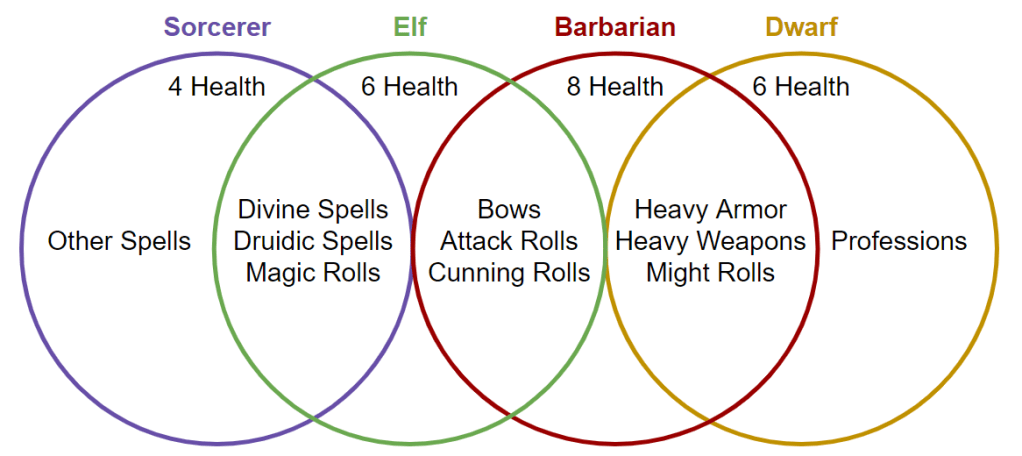
In the original design Barbarians and Elf were the middle 2 classes in the spectrum and they got 3 options. This gave each of them a nice internal triangulation to work with so they had an interesting choice to make every time to gain an upgrade. The Dwarf and Sorcerer were the end pieces, which only got 2 options but they each got one of the most powerful options in the game. Both the Dark Sorcery and the Crafting have a ton of smaller options within them, thus giving tons of customization and flavor. Those two end pieces are also more powerful than the other options. The game designers sleight of hand here was that 2 of the 4 classes have heavy design asymmetry which means that they can’t be easily compared. 

To further the class distinction I gave half, Barbarian and Dwarf, some specific bonuses with weapons/armor. This helped split the Barbarian from the Elf, which otherwise were too similar, and gave the Dwarf a bit more combat options since currently they have the least. This does make the Barbarian a bit of a stronger choice than the other 3 options… but I am actually ok with that. This is a sword and sorcery setting, I was wanting a disproportionate number of barbarians in my world. I was thinking about making an optional 1d6 to choose your character with 1-3 all being different kinds of barbarians. I think the design itself may produce similar results. 

So with the explanation of why the previous system is what it is, can I make a classless system? Let’s not answer the question of should I make one just yet, just can I make one. 

So basic idea: There are 6 things, gain any 2. Maybe later you can gain a 3rd. Simple enough. Does this create a good system across characters and within characters: no, I think there will be notable imbalances. Specifically: 

  • The internal choices of melee vs. magic at the character level 
  • Crafting maybe too powerful given the extra downtime without a penalty 

So there is clearly both a feel and power difference between melee and magic. On the table melee is far more reliable but magic is more powerful. Or at least sorcery magic is more powerful, the divine/druidic magic is a smaller set of spells that serves to give other classes support. Supporting other classes gives you the power impact of… those other classes, thus support is generally self balancing with martial options. This is why the Elf has standard health and melee options while the Sorcerer is designed as a glass cannon. That is a balance correction. They are more powerful but also riskier to play. So what happens when we are about to mix sorcery with the other classes? Well when leveling sorcery is always better in a one on one choice against a melee option. 

This is an internally design imbalance. I want sorcery to be game changing in challenging situations like it is in early D&D. The problem in early D&D is players quickly become reliant on magic like the sleep spell which turns every combat into feeling similar. There is a similar feel in games like Everquest where classes like the Enchanter can charm enemies to fight for them. Note that in Everquest any given enemy is always notably more powerful than any given player character. Heroes can never go mono e mono and win thus they have to rely on groups. The Enchanter’s charm ability to control something more powerful then they are is thus very powerful… but sooner or later the enemy will resist it and turn to attack the party at a random time. Thus charm is both overpowered in the offense it brings to a group but also overly risky in consequences when the offense turns against you. That is the kind of magic we want here. 

So to use make a mathematical example here: if a barbarian does 2 damage, a sorcerer needs to do 6 damage to feel the impact. Note, this is not 6 raw damage necessarily but something that has the impact of 6 damage. But to balance the game we need to get that back down to 2, thus the DC mechanic on the spell so they only work two-thirds the time. This lowers the result to an average of 4 and it forces the players to not rely on specific spells all the time, thus fixing early D&D’s Sleep issues or 5e D&D’s Fireball issue. This forces sorcerers to develop multiple answers instead of focusing on ways to overleverage a single answer again and again. The sorcerer also needs some other penalty of -2 in some way so they are weaker or more limited than a Barbarian. This makes the Barbarian a 2 & 0 while the Sorcerer is a 4 & -2. 

Now many of you may point out “you don’t need the extra penalty, just make spells only work one-third of the time.” While that is mathematically correct… it feels awful in play. A low chance event in a system where they can be repeated on a success actually introduces more randomness than fewer high chance events in the same system. The average result is the same, but the low chance approach creates a much larger distribution. We are seeking a Goldilocks zone of sorts here which is really tricky to determine. We want magic to be unreliable enough that players always make a plan B but not so unreliable that Sorcerers are worthless 75% of the time and Gods the other 25% of the time. 

Currently I have that -2 as just weaker weapon options, lower health, and a lack of other roll choices. I think that works fine for Sorcerers and fits into the classical “glass cannon” of magic users that we have seen in past games. It works fine, but I am open to other kinds of -2. I have strived to keep this game simple, so I am unsure what the other penalty options would be here. But if we opened up to the classless system I would be happy to say “if you gain sorcery, you also have to take this penalty set of your choice”. I just have no clue what those other penalty sets would be at the moment. 

So looping back to the topic of a classless system, for me the issues above create an interesting question: if Sorcerers need this kind of penalty, do any of the other options need it? 

Cunning, Might, and Weapon all have pros and cons already. Divine/Druidic Magic is balanced with those as discussed before. Crafting is a bit trickier. 

Crafting actually has lots of powerful long term effects and short term boosts built into it. This also allowed for me to lean into the Dwarf vs. Elf dichotomy with each have opposite martial skills and completely different party support mechanisms. Both classes are medium power martial classes with support elements but since neither class shares a single element of either, they feel very different to each other.  

Since I limited the Dwarves combat potential a bit in original design I was happy to give them the free crafting downtime. This design asymmetry let me dodge the question of balancing crafting vs. other melee investments. Basically, if crafting comes with a free downtime then take crafting becomes an automatic pick for the free resources that happens outside of your downtime investment. Thus not really a choice, you do this or you are just wrong. 

Currently in the crafting system there are tons of options. Some have temporary effects, like increasing regeneration out of combat or a small batch of potions to use in combat. Others have significant campaign effects, like setting up a castle or training mounts/pets. Since downtimes serve as our leveling mechanic here it is debatable if those one-off bonuses are worth the investment. I am not sure if I am comfortable with short term power at the cost of a character being weaker in the long term. I think that is less of an issue in this system than most others since the power curve is flatter, but it does feel like a character build trap and I never want to design for that. I don’t want a player to get pressured into being a permanent brewer of health potions every downtime and thus never improve their baseline abilities. Having a full-time alchemist would be powerful for the campaign, but weak for the player in the long term.

So I think the answer for crafting is similar to the answer for Sorcerer, we need that X & -2 format if you get a free crafting option each downtime. That -2 has to be a big enough penalty that people don’t want the free powerful crafting bonus abilities. 

So restating the classless design with updates: There are 6 things, gain any 2. Later you can gain a 3rd. 

  • Crafting with the extra crafting downtime but also with a notable penalty 
  • Might 
  • Weapons 
  • Cunning 
  • Magic – Divine/Druidic 
  • Magic – Dark Sorcery but also with a notable penalty 

I like where this is going in terms of balance and more character options, but I have a lot of work to do on penalties options. 

So now we come back to the question of can vs. should. Let’s assume I come up with good penalty options for Crafting and a few alternatives for Sorcery too. Is this version of the game better than the original 4 class design? 

Pros of classless 

  • More flexibility in character creation, more ways to make your character you own 
  • That “gain a 3rd” moment has a nice feel to it. I like the idea of really forcing players to focus their downtimes on just two ideas early on and develop a strong character specialization and feel and then the character has a maturing/versatility moment at a later level.
  • Allows later game players to invest in areas that are needed after the world has become more settled. 

Cons of classless

  • Way less specific class identity. This may muddy the waters a bit but I don’t think it does so too much. This is something to watch for. 
  • The advantage of the HeroQuest 4 classes design is people already have a strong feeling for those specific class ideas. Even if you don’t know this specific game at all, people near instantly understand the ideas behind those characters. Losing classes means losing that instant clarity for new players. 

The interesting thing about the classless design is that I don’t think it contradicts the 4 class HeroQuest design. I think you can just add in a 5th class, let’s call it the Vagabond. A character who picked up an odd mix of things as they traveled. I would expect the Vagabond to have lots of crossover with other classes, maybe even identical characters but that is an outcome that is already possible. 

So what would the Vagabond add or remove from the game? 

  • A magic and martial hybrid different from the default Elf. Sorcerer penalties limit how good these will be. 
  • Crafting and different martial builds. Need a more fleshed out set of penalties applied to crafters to understand any drawbacks here. 
  • The Enchanter style character: a sorcerer or healer who is as focused on crafting. 
  • That maturing moment later in the game 
  • The other 4 classes have great clarity for new players. The Vagabond is messy. 

I think this will be a net gain for the system. Getting the crafting penalties figured out will be tricky because the campaign needs crafters more than the dwarves need to craft. The design choices around the dwarf is a really powerful sleight of hand that I can no longer use, so I now have to either create a balanced integration for it or find a good set of penalties to apply to crafters. 

So I want to talk about one more thing here: the Bard Problem. Having a character that is a jack of all trades and master of none is a very tricky piece of design. In 3rd edition D&D Bards were the worst class. In 5th edition D&D Bards are the best class. First place or last place, they are never in the middle. 

Why am I talking about Bards? Because I think the obvious unanswered question here is: if everything costs a downtime, why limit it at all? Why not let anyone invest in anything at any time. And the answer is because I don’t think that level of balance is possible. I don’t think you can make every choice balanced with every other choice. Very slight imbalances in those kinds of systems lead to an automatic pick option which leads to everyone making the same character or at least very similar players. To take that even one step further, even if you could perfectly balance everything, I think doing so is a bad idea. What I want is different people at my table playing slightly different versions of the same game tailored to the way they like to play. 

Types of players and how this game meets their styles: 

  • Helpful to the party: Support magic both provides more complex tactical options as well as feels different at the table than stabbing an enemy with a sword. The game itself is better with them but the individual player may or may not be. That is ok, because some players just like to be helpful and this gives them a clear path to that. Some crafting does this as well but in a more circuitous way. 
  • Overpower: Might and Weapons provide players the abilities needed to overpower their enemies. Paired with the push your luck action economy for a more fluid set of choices on each and every turn, this gives player’s their power fantasy options. 
  • Out Smart: Cunning and called shots are for players who want to think around situations instead of bulldozing through them. They want to out smart the DM. They want to leverage their game knowledge against specific enemies. Here is a clear set of tools to do so. Some long term crafting options also fit this choice as they are ways to prepare for specific enemies or situations. 
  • Seeking the Big Moment: Sorcery is built entirely around this. The overpower melee  also allows for this kind of game play by saving up for the big moment instead of using resources bit by bit. The encounter has to pivot around this big action. These are super satisfying for a lot of players. 
  • World Changing: These are for the player who is less interested in any given dungeon or any given villain and more interested in the world as a whole or just the advancement of their group members. There are parts of crafting that lean into this heavily. Things like taming mounts, building keeps, and enchanted items help change the long term status of the game and the characters in it. The devoted smithy slowly and steadily making every Barbarian a full set of armor, one piece at a time. I have not written all the spells yet, but I expect some Sorcery or Divine magic options for long term effects may emerge. Think a network of teleportation circles or sanctifying a temple. 

The problem with the “everything available” Bard option is the style ideas above are not shared by everyone, or to be more precise, different parts are favored by different amounts by different people. To make each idea work and feel good at the table, some may need to have a bit more kick than the others. That is ok if groups are a team of specialists, because there is a need for a bit of everything. Slight differences in the power of styles does not hold up in a more free form system because if some options are just a bit more powerful those options now mathematically become the “best” pick, thus an automatic pick, and thus a mandatory “choice”. 

So the balancing challenge now becomes selecting between two different choices: 

  1. trying to balance each option within each style to be fun against similar options 
  2. trying to balance each option within each style to be absolutely equal to every other option in every other style

Given those two choices, I lean to option 1 which does not work with the everything system. I would much rather have more fun options within a style than a perfectly balanced system across styles. If this was a computer game, I would have more faith that an option 2 balance could work. That is because you can reasonably do things like fractional damage, track lots of complex bonuses, or make minor game play changes like a 4 1⁄2% increase to swing speed. That kind of granularity and complexity works in the video game space, but it does not on a table top. You can also track the play of 1,000 players down to the smallest detail as part of your alpha test. Video games also have sound effects, VFX, and other animation tricks to make an ability or spell feel impactful in a way that a table top just does not have. 

The Bard problem leads me back to one of the points I made at the start: make sure you understand what your characters/classes are not. By determining what they can’t do first, you remove the automatic pick option because different skill mixes will have different pros and cons. Designing from a negative space instead of a positive space is a bit trickier but worth the effort as it can produce some interesting ideas and is a great way to ensure a diversity of options is being pursued. It can’t produce a Bard but it can produce a Vagabond. 

So thanks for sitting through my 3,000+ word analysis of my previous 1,000 word design pitch. Yes, it does often take this level of analysis to answer simple questions like “should I add a 5th class that is a hybrid?” For some designers that is a “why not” question but for me I want to make sure it actually has something worth adding to the system.

The ground work for my next campaign

So for my next campaign I am working on something both more in the west marches style and something in the Sword and Sorcery vein. The issue with the latter is most RPGs are written with high fantasy in mind. So I have been working on a simple system that best matches the Sword and Sorcery style and also leans into the west marches ideas. 

I have a few overarching goals 

  • Warrior types should have a risk and reward play style. Brave heroes require brave players.
  • Warrior types should be given bonuses for cunning plays. Cunning heroes require players with good ideas and who have figured out the enemies. 
  • This should feel gritty but require minimal paperwork and complexity 
  • Ways to handle the flavor character types: the trickster, the hunter, the beastmaster, etc. but require minimal paperwork and complexity. These are flavors of warriors, not fully their own thing. 
  • Capture the parallel duality of magic and civilization
    • Magic should feel chaotic and corrupting but also powerful and strategic; spells should have an effect and a possible cost that reflects that effect; there is an element of corruption to magics, an element of darkness 
    • Civilization should feel chaotic and corrupting but also powerful and strategic, i.e. an Army; being in a civilization should have advantages and also drawbacks, risks, or complications; there is an element of corruption to civilization, an element of darkness 
  • Each character should have lots of small upgrade options within each class. I don’t want big leveling moments or lots of heavily delineated classes but instead lots of small bonuses. I would rather have a spectrum of Barbarians than multiple warrior classes. I would rather have a spectrum of Sorcerers than multiple magic classes. 

Here is my attempt to answer those goals 

Core mechanics 

You will pick 1 of 4 classes: Barbarian, Sorcerer, Elf, and Dwarf. You start with 3 “downtimes” to spend how you like. 

  • Characters gain upgrades from “downtime” which happens every 4 sessions. Spending downtime is how people upgrade their character from a pool of options specific to their class. They can also spend loot to buy helpful things.
  • Everything in this game is a d20, sometimes with advantage, and rarely with disadvantage 
  • The action economy is generally one movement and one action. 
  • Reactions: this allows you to take an action even if it is not on your turn. This is reserved for some spells, blocking with a shield, and specific maneuvers. If you use a reaction then you have to give up either your action or movement on your next turn.

The 3 part combat system 

  • This game does NOT use modifiers added to a d20 roll. Instead, you will gain charges of advantage in places where you would normally gain +1 bonuses in other systems. You can use multiple charges in a single action if you like. 
  • Pushing the action economy: You can take extra movements or actions on your turn but for each additional action/movement you make increases the DC. While pushing, failure to succeed any part ends your turn and you fall prone, giving others advantage against you. This allows for a blaze of glory or falling on your face right out of the door. DC starts at 11 and increases by +3 for each additional task. 
  • Attack vs. Called Shot: Attack is generally the more powerful option, but Called Shot allows players to engage a more roleplay style choice by trying to engage enemies in their weak spots. It is riskier but offers more rewards if you read the situation correctly. This is NOT a universal set of trip/blind/grapple mechanics driven by the players but a set of enemy specific weaknesses driven by the narrative.

Note that all three of these ideas flow together. You can use multiple charges of advantage on your turn to increase your odds of successfully pulling off multiple called shots in a single turn with a whirlwind of attacks. Of course doing all of that will blow through a lot of resources and put you at risk. Or you can use charges sparingly and be that fighter that is steadily ripping through enemies.

Magic 

  • Spells Casting: each spell has a DC, generally a DC 11. If you roll over, the spell happens as written. If you roll under then nothing happens and you forget the spell temporarily. The divine/druidic spells have no negative consequence. All other spells can have a negative consequence on a low roll, normally just a 1. 
  • Not all spells are equal. More powerful spells will have a higher DC and greater negative consequences but also are way more powerful.
  • Note: spells work just like attacks and you can use them within the “3 part combat system” with magic rolls replacing weapon rolls.
  • spells are less in the vein of magic missile and lean more to rituals or riskier combat abilities. Think less tactical and more strategic.
  • Spells are… odd. Some have extra features that are discoverable. So as an example: you may have two copies of Cure Wounds and then two more copies that can be reversed into Inflict Wounds and a fifth copy which is Curing Words that works at range. Inflict Wounds and Curing Words heal like Cure Wounds but have a second option and higher DC.

Where to spend your down time

  • There are 4 stats: Might, Magic, Cunning, and Weapons. A bonus in each is just another charge of advantage.
    • Might: athletics, strength, endurance, movement (including pushing)
    • Magic: casting spells and understanding magical effects 
    • Cunning: stealth, thievery, traps, lying, wilderness survival, and general trickery 
    • Weapons: melee and bow 
  • Those with magic can copy a spell they already know, learn a spell from a scroll, make a scroll of a spell they know, or combine magic fragments to create a random spell
  • Dwarves gain a bonus down time which can only be used on professions. This allows dwarves to craft stuff or access new professions.
  • This is not a complete list. As you play the game and discover things, more options will become available. As you build up the town and additional outposts, more options will become available. Some in game events may also open up additional options as well.

Recovery while adventuring

  • In town, regain any mix of 10 from charges of advantage to spells to health. Most of the time you will not be in town.
  • In the field, regain any 3 from charges of advantage to spells to health. Some spells or dwarven crafts may increase this.

Why writing a role playing game with space combat is hard

Let’s start at the beginning… 

What is a role playing game? Broadly speaking, something where players act out their characters’ choices/reactions and also face challenges in the game. Those challenges and the character powers to face those challenges are often highly tied to the settling/genre. So fantasy gets swords, arrows, world bending magic, and dashing tricksters with feathers in their caps over bardic charisma while sci-fi gets energy swords, lasers, world bending technology, and dashing tricksters with vests over their Harrison Ford-like charisma…

Yep, those are totally different things. 

But either way, I have always tried to build games that are high on impact and interesting decisions and low on minor technical fiddly bits. That means avoiding +1 bonuses, they neither change decisions and these are the most fiddly of bits. I prefer combat which has a healthy back and forth between the enemies and the players. This means avoiding combat where players charge in, unleash all their powers on turn 1 or 2, and then the enemy is dead before there is any back or forth much less adaptation by the players. I want my players to have real choice and for those choices to play out over a dozen rounds of combat or so. There needs to be time to punish the usual tactics if relevant, allow the players to adapt, and then overcome the enemy.

But that is at the ground level, the infantry level. When you get into fantasy you start to ask about how Kingdoms and large monsters affect the world. While in sci-fi you have to wrestle with the limits of different kinds of technologies, space travel, how industrialization or automation affects daily life, and even how just the scale of it all affects it all. 

For this blog post, I want to zoom in on just one of those Sci-fi ideas: space combat. So same goal here, I want my space captains, crews, and ace fighter pilots to have real choices and for those choices to play out over a dozen rounds of combat or so. 

So what are the options that came before me for this genre? Well, there are 3 approaches and sure enough these 3 align with 3 big sci-fi IPs. I have never seen official names for these approaches so forgive the over dramatic names I will be making up. The first is the “multiple different phase command bridge” which is used in multiple Star Trek games. The second is “WW2 IN SPACE!!” which is used by fantasy flight in their Star Wars minotaur game. The final is not a well known IP but it has become a bit of a darling in the tabletop community, and that is Lancer, specially Lancer:  Battlegroup whose playstyle I would describe as “stack +1, 2 rounds of nothing, then everything dies in round 3”. 

So let’s start with the Star Trek example because I think in many ways it is the most telling. Trekkies… are nerds, and like all good nerds and other people of great taste they have a long and deep love for table top games. This is where I started my hunt for an example of a good space combat system I could bring into my game. It is also a place I failed very, very quickly. I start to grab the many, many, many archives of Let’s Play the videos of Star Trek games. Many had additional small but devoted reddit communities. I started to run a few in the background and once I heard space combat I was going to start taking notes. 3 days of podcasts later I stopped that approach without a single instance of space combat. So to reddit I went to ask why. Across many games and many different versions of Star Trek tabletop, there was a surprising universal answer. Space combat sucks, you play this for the interesting away missions or not at all. This was universally agreed on across niche fan communities that it was just an unspoken rule. 

The reason? The phases were very complicated. There was no room for imagination. And even if you did it right, it was very hard to follow the battle or make it feel impactful. It was a lot of work for all involved for no narrative or imaginative reward. To make this worse, the away mission play was solid so no one wanted to give up that bit of play time for the other. Thus, the space rules are largely ignored. I was able to find 1, only 1 example of play during a let’s play. At the start of the episode after that one, they announced they were not going to do space battles any more and apologized to their fans. Yikes. When your space combat is so bad Trekkies apologize for it to other Trekkies for being too niche and nerdy, that is saying something. 

The problem is other games have followed suit. Stars Without Number and the classic Traveler also split their roles into pilot, engineering, sensors, weapons, or repair with people doubling up in the last two as is needed. Things tend to be balanced around “energy” with a pool of it being smaller than the number of systems it could run. So power is moved around to meet the needs at that moment. Once again this quickly gets into the fiddly bits of design and while the goal is for everyone to do something useful, power may limit that and basically cost someone their turn. Also, not all of those roles are anywhere near equal to each other. If you want things like sensors and engineering to be meaningful, multiple phases with their own complex or set of bonuses will likely be needed which just adds in more complications. 

I get why people like this design and I think it does have potential… but has the potential shown itself? If a few hundred Trekkies can’t fix it, I doubt a lowly normie like me has a chance. So what is the next option? The Star Wars miniature game. 

So this is a really fun game and can still be found in most game shops. The mechanics are taken from an older WW1 war game and is overall a good design. Each player has limited movement options, hides their movement choice, and then both sides reveals it at the same time. You fire but only at the end of your turn. This means both players or teams of players have to find a way to maneuver around their enemies and out-think them. This matches great for Star Wars as many of the original space battles were actually modeled directly off of WW2 footage. 

This is actually the best version I have tested thus far. The problem is: role playing stops once this mode starts. It also requires a Star Fox like set up where everyone is a fighter pilot or they have nothing to do. The hidden maneuvering and only firing forward with those you maneuvered behind is the limitation that makes this puzzle engaging. Add in turrets or larger ships and it quickly loses its spark. It does the fighter niche well, but fails if you push on it any other way. That inflexibility makes it a bad fit for a tabletop game.

So this takes us to Lancer: Battlegroup. As you would expect from a Lancer game: great art, great story, and tons of customization options. But most things are not impactful. So some slight context. The whole battlegroup acts as your character, so they all stick together and share an action economy. There are 3 kinds of ships: Battleships for long range fire power but only after spinning up big weapons for a few turns. Carriers which can launch your expected fighters and bombers but also medium sized escort ships for defense and boarding pods filled with mechs…. because this is Lancer after all. All of those launched assets are only good at short range; it takes a few turns to get in range. And finally Frigates provide defenses bonus and just extra hulls to hit. You get 20 points to build your battlegroup. Ships cost between 3-5 points and most have 0-4 point worth of optional upgrades. Battlegroups run 3-5 ships depending on where you fall on the quality vs. quantity line. 

The result of this design are two fold: 

  1. There are only 2 kinds of battlegroups 
  2. Nothing happens in turns 1 and 2, tons of death in turn 3, little happens in turns 4 and 5. 

So how does this happen? Well, basically the optimal way to play is to build your fleet around either Battleships or Carriers but never both because they are optimized to play at different ranges. Mix in Frigates to your desired level of protection. 

The first two turns are just maneuvering a bit, spinning up large weapons, and maybe gaining some minor bonuses that will most likely not be relevant. What does not happen here is decision making. If you build your battlegroup to do X, then you do X. There are zero situations where you switch gears and do Y instead. This makes the game almost programmatical in nature. It is less a tabletop game and more like the novelty electric football game from the 1970’s that was based on vibrations. You set it up and then let it go and what happens, happens. Everything is built to do something specific so there is limited room to do something else. 

With turns 1 and 2 out of the way the Carriers are now in range and the big guns of the Battleships come on line. The big guns are hit big, miss big and a few lucky rolls hit make or break the whole battle. Expect to see 20 health Battleships with +2 bonuses from maneuvers get hit for 35 points. Carriers do a bit more consistent damage per turn but less upfront. So you either break their back, or they break your back, and then the Carriers clean up over a few turns. That is every battle in Lancer: Battlegroup. The NPC fleet is weaker than the PC fleet, so you will win most fights but bad luck will catch up to you sooner or later and you will lose everything quickly. Nothing you can do about it. This is just a really complex weighted coin flip. 

So which of these best fits a sci-fi campaign? None of them. The “multiple different phase command bridge” is a known loser and while it does leave some room for RP moments it is largely an exercise in tediousness and favors some roles far over others. “WW2 IN SPACE!!” only works if it makes sense for everyone to be a fighter pilot. And even then, I am unsure if there is role play potencial there. And finally the “stack +1, 2 rounds of nothing, then everything dies in round 3” may be the most scientifically accurate and worse option. If you are a 5e player that likes to go nova the exact same way in every fight, you will like this. I think that good stories do not come out of those kinds of mechanics. Or most specifically, that kind of combat shuts stories down faster than they can carry the narrative forward. 

… and so I return to my journey to find option 4…. 

Writing a magic system for your table top RPG, part 2

Heroquest Magic 

So Heroquest is designed more as a board game than a tabletop game. That said, it is completely compatible as a tabletop game and people have been using it for larger campaigns for years. In Heroquest there are magic cards which are divided into magic schools. Each magic school has 3 spell cards in it. When you cast the spell, you discard the card. This is a super simple system but within it lies a really great piece of game design. So instead of balancing each spell against every other spell, Heroquest balanced each set of 3 spells against every other set of 3 spells. This allows for a range of magical strength within your options. One school may have 3 medium power spells while another may have 1 very powerful spell but paired with 2 weak spells. Once school may have 2 very useful spells but paired with a super niche spell. 

Overall, this is the simplest system which maintains a nice diversity of spell casting. The guy who only casts fireball can take all the offense options, but in this case they still have to pick from between different blasting spells, they can’t just lean on one all the time.  

The issue here is it is designed for a board game, so the range of spell options is more limited and I think bringing in the larger range of niche spells often found in a tabletop game may break the system by clogging it up with too many niche spells. 

I still feel like this is a Vancian system because it is still specific spells and one cast per spell. The balance mechanism between spells is different. It is a subtle solution to balancing different spell levels without having to have spell levels as a mechanic. The spell sets are built around an element with an attached theme. So all fire options increase offense while all earth options help with defense. The spell sets really do give the casters a specific feel, which helps give flavor to the casters. 

Full custom spells on the fly – Soft-ish Magic Systems 

The idea here is fairly simple. The wizard says “I want to do X with Y”. The DM sets a DC and then the wizard rolls. On a success it happens and the DC sets the effect. On a failure the Wizard faces some kind of penalty. This means that a wizard can cast… any spell or magical effect they make up off the top of their head. Yea, that is a big change. It is also a great way for players to add flavor into your world and allow for more co-creation. 

So to simplify adjudicating, let’s say there are four tiers of spells. Each spell has four parts. Two are effects: the kinds of spells it includes – what the spell does. Two are costs: the DC of the spell (here I use a d12 system) – penalties if you fail to get the DC. Generally, the tier level of the spell is aligned with the cost. 

Effect 

  1. Conjuring of Cheap Tricks – whimsical/flavorful effect 
  2. Evoking  basic magics and subtle casting of tricks – 2.5x non-magical damage/healing, minor utility (would otherwise take a turn or 2 with risk), or no one knows you cast the simple trick  
  3. Evoking powerful effects, healing, and bending nature – 5x non-magical damage/healing to one, 2 to many, or powerful utility 
  4. Bending reality or extend a powerful evocation – this can be very powerful and very specific, DM’s choice 

Cost

  1. DC 5 – can’t use a magic charge for 5 minutes 
  2. DC 7 – can’t use a magic charge for 1 hour
  3. DC 9 – can’t use 2 magic charges for 1 hour, take 1 damage 
  4. DC 11 – can’t uses 3 magic charges for 8 hours, also you might explode

All wizards start with 2 “magic charges” each are used up on failed casting. These are regained on a long rest. Magical power sources like drinking dragon’s blood, a pact with a demon or God, or a magical staff will grant you more charges. Some of these things may have specific limitations. For example a magic ruby ring will grant you a charge but only for fire spells. 

The second is magical specialty. Here the wizard needs to state 2 things they know about or are attuned to magically. Be at least moderately specific. So ancient languages/history of a certain group, fire spells, telekinesis, animals, alchemy, etc. Spells they make up have to connect back to these ideas.

Lowering or Increase Cost

  • If something you want to do requires an element or other material and that is not present in abundance, then increase the cost by 1 tier. 
  • If something you want to do is outside your specialty, increase the cost by 1 tier.
  • If you have a tool specialized in casting a specific spell, lower the cost by 1 tier. For example, a wand of fire bolt
  • Casting a spell as a ritual over multiple minutes, lower the cost by 1 tier
  • Have another casting support your spell casting with their action, lower the cost by 1 tier
  • Have an enemy caster counter your spell with their action, increase the cost by 1 tier

*Things never go to 0 and then never increase or decrease by more than 1 tier.

The unspoken rule here is no “mining for DCs”. Players have to say what they want to do, the DM makes a decision, and then roll. No back and forth or a dozen “what about this, or what about this”. The magic user has to commit to doing something and only afterward do they learn all the details. This is about keeping magic fluid and chaotic, not an optimized set outcome.

Syntactic Magic

This system generates magic by combining a noun and verb keyword to produce whatever effect you want that fits within those bounds. This is one of the options available in GURPS.

  1. Nouns: Air, Animal, Body, Death, Earth, Fire, Food, Image, Light, Magic, Mind, Plant, Sound, Water
  2. Verbs: Communicate, Heal, Sense, Weaken, Strengthen, Move, Protect, Create, Control, Transform

Things like “control fire” and “transform plant” give you a ton of options with the DM improving the effect along some broad guidelines. As players gain level/knowledge in their game they learn new magic words and thus expand what they can do.

The full-custom-on-the-fly method is hard to adjudicate. Trying to solve the adjudication problem creates complexity. This options adds a few more guardrails to steer players. It also places some limitations on a caster which means they still have a weakness for a DM to exploit. On of the things that Avatar the Last Air Bender did that was great was give their benders (magic users) access to a super flexible system linked to an element. But, if you remove that element then that bender is powerless. This system allows for a similar set of options and thus builds in both flexible thematic power but also exploitable weaknesses.

Magic as debt or a curse or a mutation 

This is another fun mechanic to play with for your casters but it is darker. This is most definitely for more gritty or flat out grim dark worlds. The idea here is you gain mana points from piety from gods, pacts with demon lords, or risking your health to access wild magics. As you cast spells you gain a debt. At some point that debt becomes due. Doing missions or good may lower that debt depending on who you got your powers from. Unpaid debts can result in random misfortunes or mutations. The famous “1d1000 Mutations” PDF is great for this. This can be a simple saving throw between dungeon runs with the DC increasing with each spell used and the DC decreasing with each good deed or appeasement made.

This is a lore and RP heavy option and while I don’t think it is a great system by itself I do think it is a great addition to other systems. 

Magic as exhaustion 

So in 5e D&D there is an exhaustion system. It is a simple 6 level system. 

  1. Disadvantage on ability checks 
  2. Speed is half 
  3. Disadvantage on attack rolls and saving throws 
  4. Health max is half
  5. Speed is 0 (or 1 if you are a nicer DM) 
  6. You Dead, D-E-D Dead 

While this is a nice flavor centric approach you can also just say “-1 to rolls per exhaustion” or “-1 to movement and max health” or similar ideas. If you want a 10 or 12 step exhaustion system you can just add in more options to the above and get something like: 

  1. Disadvantage on either physical or mental abilities, whichever you are weakest in 
  2. Health max is at 75%
  3. Movement is at 50% 
  4. Disadvantage on all ability checks 
  5. Health max is at 50%
  6. On you turn you can either move or take an action, not both 
  7. Disadvantage on spell rolls, attack rolls, and saving throws 
  8. Health max is at 25% 
  9. Movement is 1 
  10. Death

In this system, you get 1 free cast per short rest and after that you start to gain or risk exhaustion. This makes it play like a warlock but with more that can be risked. 1 level of exhaustion is then removed by taking a long rest. You may want to either increase the long rest regain or allow for a saving throw during short rests to remove exhaustion. 

This is not that different from Shadowrun’s Drain system, it is a negative applied to using magics and the more you use magics the more the negative is. 

What if we just did everything? Or at least most things.

Ok, so this is a horrible idea to combine everything into one. I like simple systems, but as a thought exercise let’s try this. 

This system would have the following: 

  1. You have 1 free exhaustion charge and start with a few known spells 
  2. You can cast spells by either A) mana knowledge or B) mana exhaustion or C) wild knowledge or D) wild exhaustion.
    • On mana knowledge, forget that spell and the spell happens. 
    • On mana exhaustion, gain 1 level of exhaustion and the spell happens. 
    • On wild knowledge, roll to see if either the spell happens or you forget that spell. 
    • On wild exhaustion, roll to see if either the spell happens or you gain 1 level of exhaustion. 
  3. You can still have 1 signature spells that used any of the casting methods above 
  4. Meta-magics: from the 5e D&D sorcerer. These can be added to spells but only for wild casts and the DC is increased. Also, negative versions of the meta-magics can be applied to each for a lower DC. 
  5. Mana spells can’t critically hit. Wild spells can. On critical hits, both double the effect of the spell but also apply the cost to the caster. 
  6. On wild magics, if you miss the DC by 1 then use the mis-spell mechanic but only if the DM can think of one off the top of their head that is funny.
  7. You can use the “make it up off the top of your head” custom spell option at will, but the “charges” will be larger. Maybe a random known spell and an exhaustion on a fail. It will be just one of those of your choice on a success. Same rules for Syntactic magic.
  8. The debt option is still on the table. That is very roleplay and world specific. This needs to be worked out between the DM and magic user early on. 
  9. Also the ideas of gaining more magic charges from magic items, pacts with gods, and Dragon’s Blood still fits into this system. 

I really like this set of ideas. I still think it will be too heavy mechanically in play. So how can we pare this down and make it into an organic storytelling set of ideas. 

Evolving your spell list

Start the game with 1 signature spell and then draft 3 wild knowledge spells.

The 1 signature spell is from: 

  • Healing Word 
  • Healing Touch 
  • Counter Spell 
  • Mana Burn: guarantee their spell will be a success, but they take damage in the process. 
  • Redirect Spell 
  • Empower Spell: roll with a friend to help them cast their spell 
  • Blink
  • … and all the arcane artillerist options from Steam Chaser 

These spells can be cast by either forgetting a wild knowledge spell of your choice or by gaining levels of exhaustion. DMs, change this list to match whatever are the “common spells” of your world.

The 3 wild knowledge spells are drafted from a very large list of secret spells. These spells are a DC check of 7 (in a d12 system). If successful, the effect happens and you still have the spell. If you fail, you forget the spell. Spells are relearned after a rest, the number being set by how good the rest was. This matches whatever your rules are for travel, dungeons crawls, and inns.

There are three ways to gain new spells: Learn Spell, Copy Spell, and Evolve Spell.

  1. Learn Spell allows you to take a magic spell scroll found in a dungeon and gain that spell. This takes 6 weeks in real time or whatever your leveling mechanic is.
  2. The second option is Craft Spell. Simply pick a spell you like and already know and make a copy of it. This copy gets its own spot on your spell list. This also takes 6 weeks of time. This can also be done in tandem with another magic user with the result being each learns the other ones spell. This allows magic to spread from mage to mage.
  3. When you roll a critical hit on a Wild Knowledge spell you gain 1 charge of “evolve” for that specific spell. The Evolve Spell option works just like Copy Spell but this time you can change the spell just a bit as you copy it. This can’t be done in tandem with other magic users. Your options are…
    • Apply a meta magic (D&D 5e) as an upgrade at DC 9 or a negative meta magic at a DC 5. 
    • Mana knowledge: don’t roll. Forget that spell and the spell happens. 
    • Mana exhaustion: don’t roll and keep the spell knowledge, gain 1 level of exhaustion and the spell happens. 
    • Mana drain: keep the spell knowledge, the spell happens and afterward you roll to stop the spell from doing significant damage to yourself.
    • Wild exhaustion: keep the spell knowledge, roll to see if either the spell happens or you gain 1 level of exhaustion. 
    • You see deeper magic behind this spell, syntactic magic, you gain option 7 but it has to tie back to this spell’s original nature somehow. Syntactic magic is a noun + a verb. You can find the “true meaning” behind this spell. Each spell only gives you either a noun or a verb that best fits that spell. You risk two spells when using this power.

This combo of spell drafting and wild knowledge gives magic a chaotic feel while still letting players have a reliable fall back option in their signature spell. Other spells are in the world and can be gained through Learn Spell. Maybe once per 4 – 6 weeks in real world time you can use Learn Spell to gain a new spell you found/bought. 

Overall, what you have here is a system to generate not spells, but variations on spells and instead of focusing on gaining levels the casting is directly investing into either Learn Spell or Craft Spell over time. Yes, you can replace my “4-6 real world weeks” with “you gain a level” if you like. Note that this upgrade is used on either Learn Spell or Craft Spell but not both at the same time. If you are also using the character wide bonus for gaining debt or custom casting then that would be the 3rd option. Either way it takes the complexity of all these variants and boils them down to a more focused spell list and one that is entirely specific to how the character wants to evolve. Their spell variants are directed by them while their new spells and new power options are found in the world. 

To put this a different way, as you play the game each Wizard is generating a custom set of leveling options for that Wizard. Each month (or so) you decide which of those options you want to focus on to gain at the start of next month. New spells, variant copies of your spells, and power sources are the ever changing mix of options being generated. Players have some direct control over variants but the world itself will provide other options as a chaotic jumbled mess. What the player is doing in wrestling with these chaotic and unique options is actually bring order in the form of their character.

Writing a magic system for your table top RPG, part 1

What is the role of magic in your world? 

Most tabletop games are really designed to be played in high magic settings. There are plenty of reasons to run a high magic world where common enchanters solve common problems with their overflow of magics. There are plenty of reasons to run a gritty world where magic is rare, never the go to solution, and a spell going off is enough power to cause awe and fear in equal measures. 

This may be the most important question for people engaged in world building or writing RPG mechanics. If you want magic to be rare but powerful and awe inspiring, then having 4 of 5 party members being able to cast unlimited cantrips tells the opposite story of your world. This is not a minor world building issue, but it is the most common mismatch I see in games. 

That said, if magic is widely available, then your world would not be like the European middle ages. Those magics should change the world dramatically and, once again, having those magics available but not recognized by or folded into the world building is story breaking. It is using mechanics to tell one story while the DM’s narration tells an entirely different story. If prestidigitation is everywhere, then you don’t need public baths. If healing potions are in every shop, why do towns have doctors and are people still going to churches to pray for healing? 

This thread is core to your world building. It determines if every town has an enchanter or if only the King can afford a court wizard, and a dubious court wizard at that. Is your world’s magic a larger interconnected system or a mix of odd abilities cobbled together by mad sorcerers playing with powers they don’t understand. The former needs a library or a school and those would have heavy political influence or be controlled by those who do. The latter needs a scattering of odd abilities and nebulous power sources. Each approach requires different histories and areas in your world. 

How powerful do you want it to be in combat? In non-combat challenges? In support? 

Regardless of whether this is an author challenging their main character or a DM challenging their players, part of what you have to determine is what kind of questions does magic contain the answers for. A story without a challenge is a crappy story. So if magic is always available and always solves everything without a cost then there is really no story. Magic can destroy your story… so be careful. Don’t build a system that is so cool that it makes your story or world suck. 

There are two approaches to solve for this: 

  • Limit the amount spells that can be used, either by cost or limit charges 
  • Limit the power of spells, so they help to solve more that entirely solve the problem 

While this pair of approaches is common, many games end up with both limitations breaking down due to power scaling. While there are many ways to control the amount of spells, the bigger problem is often limiting the power of spells, specifically utility spells. Trying to keep a limit on those spells so they are still useful compared to other spells while also not just entirely solving the problem at hand. 

As an example, older versions of D&D had really detailed and nuanced travel mechanics that forced critical game decisions… unless you got Good Berry, Leomund’s Tiny Hut, and Pass without a Trace at which point travel challenges lost all meaning. Resources no longer mattered and all strategic concerns are removed. As a DM, if you want travel to be an issue in your world then you have to get rid of those three spells. If you think travel is a pain in the butt and a waste of time, then give those spells away as much as you can. 

Now this is also where we run into the “whimsical high magics”. These are worlds like Harry Potter or many old Disney movies. The spells are very specific, very silly, and are generally played for a laugh or a smile. This level of flavor but not power is often really engaging. Let owls deliver the mail or brooms sweep the floors themselves. Let a princess sing so birds fly in and give her a french braid. This gives the world a magical feel without giving players god-like powers. 

Vancian Magic 

This was the original system used in D&D and variations of it are still core to most tabletop RPGs games. It is a highly formal system. The idea is that magic users have a limit on how many spells they can have memorized at a time. This limit is not just the total number of spells, but also takes into account the power of those spells. When they cast a spell, they “forget” that spell. The spell list limited both the quantity and quality of spells available. 

Spells in this system are traditionally discreet and consistent between casts and casting magic is reliable. You are able to take multiple copies of the same spell but this limits your versatility as a caster. 

Vancian Variant 0.1 – the 3rd edition Cleric 

So this was less a system and more a special rule. Clerics used the traditional vancian system but with one exception. Life Clerics could mark off any spell and instead cast Cure Wounds. Death Clerics could do the same thing but it would be Inflict Wounds. In a game without flexible casting, this was seen as very powerful. 

But there is no reason this can’t be done with other classes using a Vancian system. Basically it is just picking a first level spell that can scale with level and making that your “signature spell”. I see no reasons why a specialist wizard should not have the same ability. An illusionist gains silent image. Evocation gains burning hands or magic missile. All of this is super simple to house rule. 

Vancian Variant 1 – Mana 

The first variant method is so common it is actually in the 5e D&D DMG and thus an official variant, that is the spell point system or mana system. This is often written as a conversion option for magic users in the game as it exists today. Spell slots are converted to a pool of mana points. Spells are given a mana point cost. Total number of known spells is generally lower because in the original Vancian system players would often take multiple copies of their favorite spells. So if you have 10 spell slots, maybe learn about 6 spells. 

This system is often seen as a more flexible and less complex version of the original. The problem here is it does often encourage one trick pony casters. The guy who only casts fireball loves this system… but that does get old. If your spell list has any imbalances between spells, then this system often emphasizes that problem. 

Vancian Variant 2 – Spell Save System 

This is a fairly common variant in the OSR world. Instead of spells being guaranteed to be successfully casted each time, you roll for success or fail. On success the spell goes off and you still remember that spell. On a fail, no spell happens and you forget the spell. This changes the risk reward profile of magic, making it far more hit and miss. 

Like variant 1, this system can simply be applied on top of an existing system without the need to change everything around. It does add a level of randomness to your game, so it will be more unbalanced. The good news is it does produce both overpowered and underpowered outcomes naturally for a larger dungeon. The problem is in moment to moment encounters, this kind of casting can make them entirely trivial or the party is basically down a player. 

This goes back to the question “what is magic in your world” because if you want rare but powerful magic, then this does a great job of that as casters chain a series of big spells together. If you want rare magic, then just wait until 2 or 3 spells fizzle in a row. Magic will feel rare and unreliable. 

Vancian Variant 2.1 – Mis-spell System 

Similar to above but the negative consequence is not you forgetting the spell but miscasting it. So this is a tongue-firmly-in-cheek system. So for example, the spell “send message” on a fail would instead turn into “send massage” and the target would get a nice back rub instead of critical information. “Speak to Dead” could become “Speak to Dad” and trying to cover the floor in “Grease” could instead covers it in “Geese” and that flock starts to run around and pull Untitled Goose Game shenanigans for the rest of the session. This takes a bit of extra work from the DM and players but it does add humor to the table. For balance reasons, maybe you lose the original spell for an hour or so, but not the normal length of time.

I actually really like this system, but not for all worlds. This does not fit in a gritty setting, but is great for a one shot in a magic castle. I am also unsure how well the jokes will play out over a long campaign. 

I first saw this idea here: https://www.prismaticwasteland.com/blog/spelling-errors-a-magic-miscast-alternative and I kind of love it. So credit where credit is due. 

Vancian Variant 1.1 or 2.2 – Shadowrun’s Drain 

So in the kitchen sink of a cyberpunk game, Shadowrun uses a drain system. This game basically has two different health pools and some abilities, like magic, damage the second pool. If you are a fighter type, this second health pool is just extra health. If you are a magic or special skills user, this is your mana pool, AKA variant 1.1. Generally you can assign incoming damage from enemies to either health pool so you are always playing a mini risk vs. reward game negating incoming damage vs. having mana to spend on attacks next turn. 

Here the spell always works… but you roll to resist stun damage. So while the power of the spells is far more consistent, here the wildness of the system created by a failed roll is the cost you paid to cast the spell, thus making it a bit like a spell save system, AKA variant 2.2. This magic system fits into the narrative of that extreme setting as spells always work, something spells get a ton of extra damage, and something they render the caster unconscious afterwards because they dealt too much damage. It is all very metal and very Shadowrun. 

Vancian Variant 3 – what the heck is 5e’s system exactly? 

So 5e D&D doesn’t really use any of the 3 previous interchangeable systems. They have kind of a mix of Original Vancian and Variant 1. In effect, they have multiple tiny mana pools which overlap down and multiple tiny spell lists with overlap up. Casters are able to cast any 2nd level spell with any 2nd spell slot. That sounds simple. But the nuance here is that many 2nd level spells can also be cast with higher level spell slots for extra kick and higher level spells slots can be used to cast lower level spells, thus higher quality slots actually give you both more power and more versatility. 

This system gives you some of the flexibility of the Variant 1 with some of the rigidness of the original still in there. When you get into the details, it gets fairly complex very quickly and that gives you some strange decisions at various points in time. This system has a nice mix of spell balance and flexibility, but the strange overlaps do end up feeling a bit less like a flexible design and more like it’s wobbly enough that players can make it fit if they shove on it hard enough. 

Thank you all for reading, we will pick up next week with part 2 where we talk about alternatives to the Vancian variants and see what happens when we try to combine all the ideas into one system.

Hardcore WoW, unlearning old lessons

Blizzard’s new hardcore World of Warcraft servers have been really interesting to play on for the last 2 weeks. This server is classic wow but with the twist that characters can’t come back to life. Because it is classic wow, a game that is really well understood and as expected, a hundred videos and blog posts popped up about what to do and which route is best and what classes you should play. 

… and almost all of those have been proven to be completely wrong. Why? Why is advice about a game from 2004 wrong? Is nearly 20 years and millions of nerds not enough to understand it? 

So in this case the issue is clear: people misunderstand the problem. Almost all of that advice was based on how quick you can get to level 60 or what class was the best at level 60. Currently, the average character dies at level 13. This completely changes the dynamics of the game. 

Turns out the end game is not the hardest part of wow, it is surviving the early levels. And this makes a lot of sense. Characters at level 60 have a large and well rounded set of skills to deal with a range of situations. This is something that content makers know and spend a lot of time talking about those classes in the level 60 context as the end game is the part they play regularly. But those skills are slowly given out as you level up. It doesn’t matter if a hunter has the best survival skill in the game if they don’t get that skill until level 30. 79% of the hunters die before level 30 and thus will never see that skill. In fact, most hunters never see their pet… which is what the entire class is built around. 

The second great mistake is all the leveling guides. These are all built around efficiency of time to xp… but in hardcore they really need to focus on risk mitigation. Quests are designed to push you to the next zone or go fight a deadly monster… which is the least safe way to play. Picking a spot with the most escape routes and steadily but quickly killing enemies a few levels lower than you gives you the most money and most xp in the safest way. This is an MMORPG where the quests are bad. In many ways this is a return to the old everquest style of grinding out levels against random enemies. 

Now Blizzard made very little changes to the game itself. In fact, they were so lazy they left in the resurrection spells but just disabled their effect. The one thing that has been added in is an announcement system via add-ons. If someone dies in your guild, you learn who, at what level, and what killed them. Generally this is followed by lots of “F” in the chat to show respect. But this also really brings the guild together in an odd way. Everyone learns to avoid certain areas. Everyone shares the pain when a higher level player dies. In a social game, this does really change how the game feels. 

This design also forces you to ask yourself “what is powerful in this game?’. And in this case it is not the traditional dps meter (overall offense) or even best tank/healing abilities. It is the pairing of the panic button abilities that let you stay alive just 3 more seconds to run away and awareness by the player to know they need to run away. This forces much of the traditional wisdom out the door. 

For example, Paladins are slow levelers so everyone on classic goes Retribution spec to get just a bit more damage on a normal server. But by doing so, you skip past some of the Paladin’s best survival mechanisms. Turns out to play well in hardcore, you have to unlearn much of what you did originally because the priority is risk mitigation now. 

This also leads us to an important note. The best class in the game… maybe a profession. At low levels, the target dummy from engineering is an amazingly strong panic button ability. In fact it is better than what most classes have at this level. And because there are so many low level characters starting over again there are plenty of cheap materials on the auction house for you. At level 40, the gnomish invisibility device gives you 10 seconds of invisibility, which is one of the strongest survival options in the game. Alchemists get a similar potion that doesn’t require the profession, so keep an eye out. These two options are better than what most classes get for the whole of the game. 

An update on Star Chaser… and a bit more

So lots of changes, some rewrites, and finally a big update

I think the result of the last patch went well. The game moved forward better and I am being more direct about the underlying mechanics behind the game, which helps clarify some of the math for players. Originally there were 4 tiers of power with the 3rd and 4th tiers having 1 and then 2 drawbacks. My players universally did not engage with the two drawback options after many repeat offerings, so easy enough to remove. 

Over the last year, I have had two players engage with the magic relic system. Neither really followed through with it but for reasons outside the game mechanics. This means I have an entire subsystem that is mostly untested. Good news: one of my players has made a new character that leans hard into the relic system so we will finally see how that plays out. 

I have been testing the larger mech and armor side of the game and overall… I am just not happy with it. Originally I was using BattleTech as a starting point and simplifying the mechanics again and again until it was quick and simple to learn/play. BattleTech is built around 5 types of weapons for a total of ~31 different weapons. I cut it down to 8. I then assigned those weapons to a few frames to add a feel of mech battle to the game. 

The rough design was: 

  • Missiles were the best damage but had limited ammo and some hard counters to them 
  • Cannons were ok damage and as a bonus there are no counter measures to them
  • Some of the hard counters to missiles had secondary usages 

Missiles ended up being overly powerful. Not in terms of damage but in terms of decision making. If you could fire a missile, you should fire a mission regardless of what the other options are. The other weapons were just not as engaging as they should have been. The EW and other anti-missiles systems were ok, not great but also not bad. 

In the last 2 weeks I have done a bit of redesign on it. I have spent some time with Lancer. Great set of ideas, really messy game. This is one of those games that is filled to the brim with great ideas but due to complexity, and a poorly organized players handbook, it ends up being far less than the sum of its parts. That said, there are some really simple and easy to administer ideas that I think can be patched over. This should give players more fun lateral options. I also like how Lancer handles both their action economy as well as their heat system, which they do far better than BattleTech does. 

This redesign has reduced the pool of mechs to 7, 3 are the traditional good-better-best mix and then 4 niche mechs are added in. I was also using “pods” to hold 1 big weapon or a mix of small weapons. Then there were rules for constructing those mixed pods, the idea being to bring in all those infantry weapons they were collecting along the way. That may be too messy. I am instead making this less fluid with large slots which can hold predetermined pieces or systems where systems grant some of those unique flavor abilities. This allows me to realign to a new mech specific action economy: 

  1. Move and Full Action (read, larger weapons and missiles) 
  2. Move and 2 Quick Actions (read, smaller weapons and systems) 
  3. Overdrive: Move, 3 Quick Actions, gain 1 Heat (Overdriving boosts some systems) 
  4. Shed Heat, this is automatically triggered at 3 Heat 

Here the quick actions are some of the smaller weapons and systems. With missiles being the problem child, this provides a boost to the non-missiles weapons but with a controllable  drawback. I also wanted to provide two very different styles of play here, the first being the slow lumbering mech firing powerful weapons but in a style that is simple to play and adjudicate. The second is a multi-step comboing of actions with some push your luck elements thrown in. I might end up folding action 2 and action 3 together based on play testing.

All of these ideas still need a lot of testing, once again the mech level of the game needs to be able to move fluidly with the infantry level and the star-fighter level as well as be its own system with dynamic play. I do like that idea of giving different levels of play different action economies to make them feel different.

RPG Chaser

And while all of that is great, it is not the big news. I have put together the core rules for “RPG Chaser”. A system designed for DM’s who want to build their own worlds and their own systems. I see this as the front 80% of whatever custom system a DM wants to build. This doc will be free and released with multiple campaign settings included in it. This includes Star Chaser for sci-fi, Steam Chaser for steampunk, Cyber Chaser for cyberpunk (this is actually my original burning light setting) and Bullet Chaser for a post-apocalypse campaign, be it more zombie or more Fallout. I have few other settings I may or may not include. These settings are not “the correct way to play” a genre but example of how you could do it.

Back in my Alpha Test part 3 post… 4 years ago, I talk about having a system where DMs can bring in different themes to match their worlds. RPG Chaser is a more granular version of that. I recognized that my attempts to define themes was actually super limiting. Instead I am now focused on letting DMs create their own themes and I am fleshing out the rules and long lists of examples that DMs can leverage as building blocks to make whatever kind of world or game they want to run.

An Introduction by Dave Arneson

So the following words are not my own. They are the introduction by Dave Arneson to his Blackmoor setting. The odd piece of history that exists between post-Chainmail and pre-D&D. It has some odd ideas but is also a brilliant piece of game design. I see large complex design issues being solved by combining these pieces together that I would normally not think to do.


From the first excursions into the dark depths of Blackmoor Castle’s Dungeon, it became apparent that these first hardy bands of adventurers would soon seek out new worlds to pillage. From the castle itself the small town of Blackmoor grew, then the surrounding countryside became filled with new holes to explore and beyond that talk was already spreading about visiting the Egg of Coot. Each of these steps entailed a great deal of work upon a naive Judge who felt that there was already more than enough trouble already available to satisfy any band of adventurers, a phrase no doubt heard rather frequently since then, in other areas. In general, a fairly loose procedure was set up for the establishment of each of these new areas, with a great deal of emphasis being placed on the players themselves setting up new Dungeons, with my original Dungeonmaster role evolving more into the job of co-ordinating the various operations that were underway at any given moment. At the height of my participation as chief co-ordinator, there were six Dungeons and over 100 detailed player characters to be kept track of at any one time.

Each area had to mesh with those areas that were around it, in so far as setting up the various monsters, etc, were concerned. It was also readily apparent, from previous experience running a “Conventional” Napoleonic Wargames campaign that some sort of Overall Background would have to be constructed to provide a framework within which the players could work. Thus the overall concept of the Evil Egg of Coot and the Great Kingdom was born. These two entities could prove to be the source of great events outside of the actual campaign, a source of new recruits and monsters, and give the stimulus, in the way of quests and adventures to give the players more of a motive than just looting the Dungeon. Also with such powerful and potentially aggressive neighbors, the locals decided that at least some taxes should be collected to provide for the common defense. This was a good plan but one which failed to take into account the drain placed on the local manpower pool by the repeated sorties into the Dungeon areas. So it was with the Dungeon of Blackmoor. It began with only the basic monsters in Chainmail and was only some six levels deep. Six levels was chosen since it allowed random placement with six-sided dice (no funny dice back then) (sic). So even in the Dungeon it became quickly apparent that there was a need for a greater variety of monsters, more definition even within the type of monsters, and certainly a deeper Dungeon.

So there were now different types of Dragons (by Size) and other new creatures, like Gargoyles, from standard mythology. AC was determined by description of the creature (Hide, scales, etc.) and how impervious it was in the accounts given in mythology about it. HD [read: hit dice or health] was determined pretty much on the size of the creature physically and, again, some regard for it’s mythical properties. For regular animals that were simply made larger, like Beetles, a standard text book provided interesting facts about the critters and all were given HD proportionate to their size, relative to other Beetles for instance. Insects were all given about the same AC with additions, again, for unique properties.

Character motivation was solved by stating that you did not get Experience Points until the money had been spent on your area of interest. This often led to additional adventures as players would order special cargos from off the board and then have to go and guard them so that the cargo would reach their lodging and then the player would get the Experience Points. More than one poor fellow found that his special motivators would literally run him ragged and get him killed before he got anything.

Combat was quite simple at first and then got progressively complicated with the addition of Hit Location, etc.. as the players first rolled for characteristics, the number of Hits a body could take ran from 0-100. As the player progressed, he did not receive additional Hit Points, but rather he became harder to Hit. All normal attacks were carried out in the usual fashion but the player revived a “Saving Throw” against any Hit that he received. Thus, although he might be “Hit” several times during a melee round, in actuality he might not take any damage at all. Only Fighters gained advantages [read: leveled up] in these melee Saving Throws. Clerics and Magicians progressed in their own areas, which might or might not modify their Saving Throws. And so it went, Hit Location so that even the mighty Smaug could fall to a single arrow in the right place (very unlikely), height differentiation, so that the little guys could run around more and the big ones could kill more, etc. Still these were guidelines, Hit Location was generally used only for the bigger critters, and only on a man to man level were all the options thrown in. This allowed play to progress quickly even if the poor monsters suffered more from it.

By the end of the Fourth year of continuous play Blackmoor covered hundreds of square miles, had a dozen castles, and three separate Judges as my own involvement decreased due to other commitments. But by then, it was more than able to run itself as a Fantasy campaign and keep more than a hundred people and a dozen Judges as busy then as they are today. Whether there will ever be the co-ordination of all the area Dungeons in the future as they were way back in “the Good Old Days” is unlikely, but already there are 20-30 people meeting every 4th Saturday to do Blackmoor and other Fantasy in related areas, so who can tell…after all, the keynote is that “Anything is Possible”, just that some are more likely than others.

– Dave Arneson


So lots of interesting ideas in there to unpack. First off, I think every DM can appreciate the world growing too fast and the players running off in the wrong direction… c’est la vie. It is also worth noting the Dave did not try to DM everything. He quickly let other people run things and made himself more of a WM (World Master) with others running dungeons as is needed.

Paragraph 4 has the best idea I have heard in a while and it is a details that is often missed. Yes, players want gold. But they gain xp by spending that gold. You don’t kill the dragon to gain a level and become powerful. Instead you kill the dragon, loots its’ horde, and then spend that horde on new armor and training… which makes you powerful in the story and gains you the level in the class.

Player are looking for a gold sink to gain levels with. Spending was not a second source of power to be controlled, it was the primary source of power so why not spend it in a way that helped your class. Players were trying to empty their pockets as fast as they could. Cleric would make scarifies to their Gods… because it was a gold sink, not for some boon. Yes, the bard going to the brothel is a legit gold sink to gain levels. And to add a level of story, the bard is not pious and the cleric stays pure, so they don’t get each other’s gold sinks. Both gold sinks have a set cost and thus growth is limited so players would spread it out over multiple sessions in town.

This inverts the tradition rules of player incentive. Fights are skilled in all weapons… so they can carry one of each, thus giving them more gold sinks. Players want to pay 5,000 gold for a +1 sword, but not for the sword. This also means gaining a title or rights to build a castle is a really big deal. This is why old school players would always build a keep and raise an army. The is how you gain the higher levels.

This also changes how the players interact with the world. The thief does not want to steal from vendors because that is lost xp. The town does not have unlimited supplies, so the players want to town to grow. Securing supply lines means more items means more gold can be spent means you gain a level. The party wants to save the town blacksmith when he is kidnapped by goblins… because if they don’t then they are limiting their own leveling. This solves for all kinds of in game problems.

The “saving throw” is really more an active dodge mechanic. I think it would slow the game down… but I like the feel. It allows for health to be kept lower so there is still a thrill. Maybe both roll at once, one to hit and the other to save to keep the game moving. Also limiting it to the fighters would work. This is also why armor originally went down instead of up. It was leaning into not an armor mechanic but a dodge mechanic.

If you start to look into the math underlying this systems, or at least as much of the math as we still know since Dave didn’t take notes and was always changing the rules, what you are looking at is:

  1. Hero, Fighter: 4 health, coin flip to dodge, coin flip to hit enemies with a killing blow (mostly)
  2. Hero, Cleric and Magic User: 2 health, coin flip to hit
    • Cleric get healing and some defense to stay alive
    • Magic User get invisibility and some movement spells to stay alive
  3. Basic Enemy: 1 health, coin flip to hit for 1 damage
  4. Big Enemy: more health but could still be killed on a lucking hit, player roll d100 against this enemy instead of a coin flip, the big enemy still does a coin flip to hit the heroes for 1 damage (or bonus effect)

This gets you a combat where the fighter can take out a half dozen basic enemies before they need healing. It is super fast… and just kind of works. Yes that example is over simplified to the point of inaccuracy, but if you want to do a quick test on the old system then use those numbers and see what you think.

Giving big enemies their own rule set is odd by modern standards, but is makes sense going from a war gamer. One-off rules to handle things like siege weapons or tanks were common and this does give the game that video game feel when the boss’ health bar appears on screen and you know things just got serious.