A Rant On Tone

Dear Guitarists and Bass Players: NO ONE BUT YOU CARES ABOUT YOUR TONE! Shut up, get over it, and move on.


Really, that is it. I’m going to pontificate (read: rant) on this for a few minutes. If you laughed when you read the above then you get it so feel free to skip this blog. If you are shocked or disagree, please keep reading.


Ok, let’s dive in a bit. Musician’s obsess over their tone. They spend thousands of dollars on their instrument and again spend thousands of dollars on their amp and then again spend hundreds of dollars per unit on a mix of pedals and effects board all to get that perfect tone.

What a complete waste of time and money. Yes, I would argue you need roughly the right tone. You should not use an acoustic guitar on a death metal song. But how good does it need to be? Tone quality has a fundamental purpose in your playing. You need a good tone so people can hear what you are doing. Tone is for emphasis and clarity, not filling out your sound. Not filling out the song.

In my experience, most people can’t actually hear the difference between the highest quality tones and mid quality tones. I worked in a music store and watched this happen day in and day out. If you play high end and mid tier side by side then you will hear a difference. If you just play them in isolation, most people will guess roughly 60/40 right to wrong. If you mix it into a band in a live setting, fellow musicians often guess wrong when asked if another musician is using a high end or mid tier piece of gear.

In a high end recording studio under ideal situations, sure there is a difference. Yes, cheap gear has issues and non-musicians can hear the difference between low-tier and mid-tier. Mid-tier vs. high end in a live setting, the difference is small. Yes, as the player of the instrument you will hear a difference, but does the audience know?

Here is my counter-thesis as to why this obsession exists: your tone is not lackluster, your playing is. If you are just playing a whole note/chord on the root, letting it ring out and then think ‘huh, that needs a bit more to it’ then yes, you are correct. But it does not need a better/more/different tone, it needs you to play a riff, layer on counterpoint, play a passing note or two between chords, add in syncopation. DO SOMETHING! Before you “fix” your tone, add more to your playing. If you add just a bit more to the song and all of a sudden you don’t notice the tone issue then guess what? It was never a tone issue.

Alpha Test of my Cyberpunk Table Top Game, part 3

Part 3: the larger goal

My goals for this system are far grander than this specific game and even this specific design. Cyberpunk is a broad set of ideas without a single definition. Much like fantasy settings will often label specific races as optional or provide guidelines for a low-magic version of the game, I’m seeking to build a flexible system that allows people to make their vision of the future. Part of the challenge here is that cyberpunk/sci-fi is actually far broader in scope and options than most fantasy settings.

So let’s talk about those themes. In actuality, I’m building out 18+ themes instead of just the 7 I gave to my players. Here is the rough idea of the grand vision: before there is a formal character creation process by the players, there is formal world creation process by the DM. That DM will look at all the themes and label each in one of 3 ways: Nope, Specialized, or Widespread.

Nope simply means that this is not part of your world and you leave those cards/elements out. The Nope option is critical because it lets me design the weird stuff from the start and balance it against everything else. This insures there is a niche in the game for those skills to fit into if you want them and they have interesting gear choices that are neither overwhelming nor underwhelming nor redundant vs. other themes. At the same time, I expect that most of the weird stuff is going to get a Nope from the DM… and that is great! If these elements are in your world, they need to affect your world. If those kinds of stories don’t fit what you are trying to do, by all means just leave them out. Nopes are a powerful tool to shape your world. In my test version, I gave a Nope to 9 of 18 options, or 50%, and I feel like we still have a diverse world.

Specialized means that it is in the game but only some players can use it. These will be the class flavors of your game. As a DM, you will also need to decide how many of these specialized themes your players can have. There is a case to be made for different approaches which we will talk about later. The goal of the specialized themes is they are interesting and will draw your players into the game on its own as well as provide them with those clutch moments that are unique to that character in the party.

Widespread means everyone can use it. This basically means the specialized gear is now treated like basic gear. Once again, this is a way to express the nature of your world. Is it heavily militarized? Make the Marksmen cards widespread. Are drones and robots all over the place? Make the Rigger cards widespread. The game will always have basic options, but these are somewhat limited so you need 1 or 2 widespread themes to flesh out that pool of cards and give players a reason to engage with the basic cards of your world and switch up what they can do. This is also a great way to give players a critical choice, alignment like issues, or other similar mechanics.

I do not know what the right mix is yet for players between these labels on themes. If I had to guess, and I feel like a need to so I can at least give people a starting point, I would suggest one of the following:

  • 2 Widespread, 7 Specialized (Selects 2), and 9 Nope
  • 4 Widespread, 5 Specialized (Select 1), and 9 Nope

Notice I used Nope on 9 themes. I feel like that gives you a tight, consistent world that people can quickly digest. As people become more familiar with this system that maybe too many nopes, but I think it works well for now to both focused world creation and still giving players plenty of options. That said, don’t be afraid to make decisions based on your players. If they like tons of system, use only 1 or 2 nopes. If you know it will always be 4 players, then you can only have 4 specialized with single select.

It is also worth talking about another play variations.

  • You can have “specialized” meaning it takes 1 gear slot if you have that theme and 2 or 3 gear slots if you don’t have that theme.
  • You can also simply house rule that you are allowed to have 1 piece of specialized gear from a theme you don’t have.
  • You could also select 1 major specialty and 2 minor specialties. The major works as normal. You are then allowed 1 piece of gear from between your minors.
  • Another option is to keep to a single specialty but carving out 3 to 5 sets to be widespread so there is a deep pool of options for players to pull from.

Once again, I want DMs to have extreme control over the kinds of worlds they can build, while giving players quick and interesting cards to select between. I classify these variations options as “1+”. It is a single specialty with a niche exception allowed. All of these are just other ways to combine gear and choices. Simply giving players 2 specialties also works well.


Alpha Test of my Cyberpunk Table Top Game, part 2

Part 2: How well did it work? 

TL;DR

Good but still needs refinement 

  • Characters were quick and easy to both make, play, and change between sessions 
  • I need to slack up on the constraints, most players found it too limiting 
  • I need to give a few more options within each archetype 
  • Classes based on gear is odd. It will take a mental leap to engage with the system 

Full Story

Everyone picked up the game quickly and made their character quickly. The buffet of card choices worked really well and the players read each one multiple times. I could tell they were debating between their options (interesting choices!) and when they were given a chance to buy more cards they were into it and quickly started to negotiate with each other for resources. The card system worked! Our Face, who has access to less gear and thus spent less money, instantly turned into a loan shark which I did not foresee but totally fits the character and theme. 

We played a total of 3 missions over 2 seasons. The first was an infiltration with a lengthy stakeout, a systematic break-in, and then a rolling gunfight. They RPed the stakeout great. Gear was well used for the break-in and they handled the fights with a mix of tactics and gear. I also gave them an NPC to help and then killed off that said NPC to show how deadly this world is. Not sure if that hit home.  

The second was to find a specific person. I gave them 3 locations to RP through and then a tactical escort mission in the sewers. They dodged the red herring location and then missed two of three clues at the remaining locations. The third clue was enough to get to the location of their escort mission. A great blackmail attempt is in process by one of the characters against one of the corps. That is fantastic because it means people are doing their own RP in the system. Part of why you build a dystopia is because you are ok with your players burning it down. Now doing this RP caused her to miss the clue she was looking for, but the RP is more important. 

The third and last mission was reactive, they were being infiltrated. This placed them in a responsive position. They spent 2 hours trying to plan for every extra sly option they could think of when my plan was a straightforward frontal assault by crashing through the front door. I ended up adding in an unplanned rooftop assault to “reward” their creative thinking and over planning. Never forget that your players are always smarter than you are. 

I also almost killed one of the players. I pulled my punches just a bit because someone else was playing his character. He still had to sit out 6 turns to heal himself which was good with since he charged 4 people with assault rifles while wielding a sword. Never forget that your players are always dumber than you are. 

Missions aside, let’s talk about how people interacted with the system. Getting people to understand each theme took some time. I’m not sure they are 100% there yet. Since the game unloads all those mechanics on to cards, you truly don’t know the class until you know all the cards. That is a bit of a messy answer. I will continue to expand the options via the pawnshop until this feels better. This is a spot where a quick simple cut sheet and a bit of RP style may be very helpful, like what they did with Cyberpunk 2020 but include gear examples. Understanding what your players know is also a very nebulous concept, so I may be underestimating them. I will be watching to see how they react to some of the additional cards. 

I do not know what the optimal number of skills selection within a character is. I’m currently expanding that card pool because I think the additional options will continue to be engaging. Specifically, I’m trying to put a bit more breath into some of the themes. More alternative ways to do what the theme already does. 

Classes based on gear is odd to people. In D&D people are forced to pick from a specific spell list or select only 1 subclass. People are fine with limitations. That seems to not bother people but switching between gear does. They keep wanting the thing they left at home. I will expand the gear limit to 5 next game but they are also getting a chance to buy more gear so I’m not sure if that will help or hurt. They really aren’t balancing themselves as a group yet, so that may alleviate the pressure. I know these players like to build characters, so I’m wondering when they make the jump to seeing this as character building and not limitations. 

I think the super simple form of hacking let my hacker be creative. I gave him minimal signals and he jumped to great ideas. I need to give him more interesting options while hacking or from his gear. 

Changes for Next Times 

There are two big changes we are going to test next time. 1) People can carry 5 pieces of gear. My players pitched a few ideas about extra gear for more gear dependent characters. I may go that way in the end. For now, I will just make it a universal law. 2) Revert to low health system matching the enemies. This removes the asymmetry between the players and enemies. This means reworking some gear but I think it will help overall. My group is more timid than most, so I’m a bit concerned that less health may make them clam up more. 

Alpha Test of my Cyberpunk Table Top Game, part 1

Part 1: What did I make and why?

A few years ago I decided to write a cyberpunk tabletop game. I had a few years of D&D under my belt and I wanted to explore the game space. So before I set off on this activity I watched for a few pitfalls: 

  1. Is the setting wide-ranging and diverse enough to support a long campaign? Specifically, can you naturally make game shifts from difference in kind and difference in scale work? 
  2. Is there already a dominant player in this setting? If Yes, is this different enough that there is an open niche for it?  
  3. Is there a diverse range of choices/differences between characters? 
  4. Do the players have a range of interesting choices to make? 

The answers to these questions are not about how to make your game, but if you should make your game. I don’t see a ton of advantage in reinventing the wheel. The tabletop world is old enough now that many of the major players are on their 4th or 5th editions. That is a level of refinement you can’t match out of the gate. 

So to answer the first question, cyberpunk in its strictest definition would not pass this test. Both hacking and gunplay can be good mechanics but are just not enough by themselves. So right out of the gate, we need a bit of a looser definition for cyberpunk. So which elements do we add to cyberpunk to create that diversity? I think there are a couple of obvious choices: post-apocalypse adjacent to the megacity, fantasy elements to twist the setting and play options a bit, general sci-fi element to create additional options ad-hoc, and bringing in dehumanizing/spiritual elements. 

There are two major players in this field: The popular Shadowrun and the older and more niche Cyberpunk 2020. Both are very complex games with multiple hours to create a character, tables for massive lists of skills, and tons of different subsystems for different elements of the game. This is what lead me to create this game. I could not find a rules-light or simple Cyberpunk game so there is my niche. I would focus on quick character creation and straight forward mechanics. 

Now both Shadowrun and Cyberpunk 2020 dealt with the settings lack of diversity in different ways. Shadowrun added in tons of the fantasy elements as well as some of the dehumanizing/spiritual elements. Cyberpunk 2020 leaned into the post-apocalypse elements. I plan to focus on large amounts of general sci-fi with a small amount of post-apocalypse and dehumanizing/spiritual. This is partially to create a different option in the current game space. I also think this is just a good mix overall. I plan to use the general sci-fi elements to ensure lots of interesting player choices and shifts in scope with the other two really focusing on a difference in kind elements to theme and play. 

So character creation and character differentiation are where I wanted to make sure I could deliver on cyberpunk. In the current consciousness of the fantasy genre, there are iconic classes and character archetypes that players are comfortable both playing with, playing against, and just generally recognize in the other characters at the table. Playing into these troupes is actually super useful for game designers as it allows a very quick and efficient shorthand way to inform people about who does what at your table. If you are a Wizard playing next to a Knight, you don’t need to understand all the mechanics behind their armor, sword, marshal techniques, or their code of honor. You know they want to get next to the enemy, swing their sword, and they can take a few hits. The rough idea of the Knight lets you know how to play alongside a Knight. And the rough idea of the Wizard let the guy playing the Knight know to stand between them and danger even though the Knight player does not know any of their spells or magic mechanics. 

This is trickier in cyberpunk as the genre is more niche, the iconic roles are fewer, and each setting is more unique because the lack of diversity in the setting is address differently in each specific setting. This lack of short-hand created both a problem and an opportunity. This allowed me to specifically build my character creation around both developing the short-hand, establishing the broad iconic roles expected in my players, and delivering on the goal of super simple character creation. 

I tested a few different approaches here. My criteria for game design: 

 [(range of outcomes) x (the impact of outcomes)] / (complexity) = (elegance of the design) 

… with my goal being to maximize (elegance of the design).

After a few attempts, I settled on a system inspired indirectly by D&D. D&D has a multifaceted and complex mathematics underpinning which is why that system is so math-heavy. Most tabletop games followed in their footsteps. Over the years, D&D has had various digital assistants and card decks to help players track the metric ton of details found on a character sheet and in spellbooks. I decided to skip the character sheet and go straight to the endpoints, the cards. I then set out to make a ton of interesting endpoints. Once I had a moderate amount of endpoints around a range of ideas, I started to split them into groups. These groups formed the archetype. There is no underpinning, just a scattered collection of endpoints. 

Once I grouped these endpoints into collections, I then started to label those roles. This created an iterative process where the mechanics → theme → more mechanic ideas → more refined theme. As an example, I created some cards focused around defense. Some distracted the enemy for a turn while others just absorb a turns worth of damage. I called this “The Bouncer” as that idea is already recognizable to players. As I made more cards, this specialty got messy as I made both defense and melee abilities for the theme. I later redefined it to “the Bodyguard” with the melee abilities moving to another theme. The new theme still fits the original cards, gives that player a specific role they can lean into, and inspired a range of new cards. 

This approached worked great for themes built around special abilities. I still wanted some specific additional themes that I thought worked for the world as a whole, specifically the Face, the noir detective, and the hacker. These were meant to flesh out the soft time between the combat elements in the game. As these were for soft RP kinds of spaces I kept them rules-light. 

Making hacking a light system was the hard decision and I’m not 100% if it worked. The Face could leverage NPCs and I could use the Detective for exposition dumps, but the idea of the hacker has been in cyberpunk since Nerumancer as a core element. It is literally the cyber in cyberpunk. I looked at multiple games and how they handle it. All of them did so in an overly complex way. I then looked at incorporating elements of the card game NetRunner into the game, but that really slowed it down and was still highly complex.

What I learned from the Classic WoW stress test

Questing is for chumps 

The traditional leveling methods just don’t work in classic wow when the starting zones are flooded with people. They DO NOT WORK! The first day of the launch will be radically different than retail so get ready to play radically differently. Any “kill bears and bring me 10 bear butts” style quest will take multiple hours to complete. That is right, that 2-minute starter quest now will take 2 hours to get done because a hundred people are going after the same 12 spawn points and they all need 10 bear butts each. 

Skip these quests. In fact, just go ahead and plan on skipping the first few quests. They are a time sink and you will struggle to complete them. So what should you focus on? 3 things and in this priority order: 

  • Kill everything that you can
  • Get money 
  • Delivery quests

Farming Mobs… as a group

Getting out of the starting area ASAP is your primary objective. You don’t have the power to do that at level 1 and you will struggle to level up by yourself. Get a group for 5 random people. Most mobs will be tagged on spawn by the massive number of people in the area. Getting a large group will help you tag more mobs faster and will dissuade others from trying to farm your area. It will also allow your group to go up against higher level mobs, so skip the level 1 mobs and look for level 3 mobs. The second your party can quickly take down a level 3 mob, LEAVE THE STARTING AREA. Grinding level 5 mobs just outside the starting zone with a group will be much faster than spawning camping level 1 mobs and hoping the other 3 people around you don’t tag them first. Once you get around level 5 to 6 you can solo as before… but staying as a group is still a better strategy. 

So what is the highest level mob a full group of fresh characters can take on? I do not know. The stress tested ended before I could test that idea. 

Get Money

Yes, you want to level up but in classic money matters. Just because you have levels does not mean you can afford all your abilities, or even most of your abilities. Basic vendor gear is actually really good early on as well… if you can afford it. Get a gathering profession and sell as much as you can. An extra 10 to 20 silver is actually really, really useful. I know in retail you can make 1,000 gold in an hour, but in classic money is very tight. Getting slightly more gold will set you up for leveling faster in later levels as it will let you do things like level up different weapon skill as you play, select from a wider range of weapons, and take on slightly higher level mobs because you consistently have slight better gear. If it saves you a death run or two it is worth it. 

Delivery Quests

These are worth it for the XP and they are the only quests that will be guaranteed completable while the server is crazy crowded. The problem is these are few and far between. Grab them where you can but don’t expect them to be a significant portion of your XP. They are a cherry on top, but not a meal. This will be a mob grind. 


My Bass Philosophy

Everyone who plays an instrument is required to be two things: a technician and a musician. For most instruments, the technician is the dominant part of that duality. For bass players, the musician is the greater part.

A common phrase kicked around musical circles is “less is more” and it is often applied to the rhythm section. God I hate that phrase. Don’t get me wrong, it is often right. But people are often right about it for the wrong reason. There are specific times and specific situations where this is correct, and I guess if you lack diversity in your playing so you are always in that time and place then I can’t blame you for falling into that trap. But I want to take a second and walk you through what decisions a bass player faces while placing “less is more” in the context of actually writing a bass part.

So to start with, what is the job of a bass player in music? Why is this instrument even in the band? Well…. there are six answers to that question. That’s right: 6 answers.

First answer, laying down that groove. Giving the song that feel and oomph that makes the rhythm section define the tone of the song. This is largely rhythm centric and done closely with the drummer and specifically with the bass drum. You will find bass players who absolutely obsess over the bass drum. Those guys are focused, maybe too focused, on the groove. Overall “Less is more” works with answer one… to a point.

Second answer, pushing the chord progression along. This is commonly done in conjunction with the rhythm guitarist and maybe a keyboard player. You will often hear the chorus of a song really ramp up the intensity with the guitarist and bassist really digging into the same line in unison. “Less is more” works here as well… to a point.

The third answer is a counter melody. Here is where “less is more” completely falls apart. A strong, interesting counterpoint can make the core melody of the song so much more powerful and interesting. It can give new light to an old idea and bring out complexities that were hidden before. This is super powerful but lacking in the arsenal of many bassists because “less is more” forces them to shy away from the “more” when it can do the song the most good.

So before we talk about the fourth, fifth, and sixth answers, let’s apply the first three to a generic rock song. You open up the verse with a nice groove to bring people into the song. The rhythm guitarist is doing a light effect or fingerpicking the chord. As the first chorus hits, the bassist switches to pushing the chord progression and the rhythm guitars digs in for a heavier feel. This combo brings a ton of energy to the chorus without changing the core of the song. You then slip back to groove in the second verse. If the song has a bridge, this is where you may play with a counter melody or you may be the only one pushing the chord progression while others play with counter melody.

This is the traditional setup for a bassist, but notice the overall highs and lows of the song are driven by the bassist switching answers. It is not the groove itself or the chord progression itself that is the art of playing bass, but determining which you should be focusing on. This is what I mean when I say a bassist has to be a musician over being a technician. The hard part isn’t playing the riff, it is knowing which riff will add the most to the song. Our job is not just to create a good answer, but to select from between a range of good answers that help the song become great.

Answers four, five, and six are simply hybrids of any two previous answer. A groove that also pushes the chord progression forward is often a compromise of the two and those compromises produce complex bass lines. Pushing chord progression while providing a counter melody normally involves weaving in and out of the chord progression or providing emphasis on a different part of the chord, literally changing the progression of the song by adding a new layer to it. A groove with a counter melody is a roaring alternative line or poignant counterpoint. These are never simple. These revel in their complexity.

The math here is simple. Two of the six answers can be done to some extent with a “less is more” approach. And once again, a simple line is often a great answer in these two cases. But “less is more” is simply a third of the job. And if you are going to be a great bass player, you have to be able to do the two-thirds that require the “more”. So many bass players limit themselves by never stepping out beyond the switch between laying down a groove and pushing a chord progression.

If you are going to be a bass player, a really good bass player, having one good answer is never enough. You have to be able to provide a range of answers and the song will dictate which is a good answer and which is a great answer. The more you limit yourself, the less likely you are to find the great answers.

A Return

So… the long pause. I had a few things to saying at the start of the last election… but then found myself at a loss for words. Thus the lack of posts.

So to return, I have brought everyone a string quartet piece I wrote last week. Use as you like, pdf link below.

return

An Alternative History of Detroit and an Actual History of Greece

Given the debt crisis in Greece, I have been shocked to see no one in the media talking about the effects of currencies on a nation and how that fits into the idea of Grexit. So let’s fix that with a game of “what if”. There are a dozen reasons why economists avoid playing “what if” games but here I think it will help to explain the situation. With that said, give me a bit of leeway with the detail. What if Detroit seceded from the union in late 1960’s?

So in our alternative history, Detroit along with some of the adjoining area (specifically those including the MSA data area) leaves both the US and the State of Michigan in an organized manner starting in 1966 and finished their transition in 1968. They are on good terms with Canada and America helps with the transition to ensure everything happens smoothly. Detroit even launches their own currency, the Seger, named for the musician who plays at the bar where the open market committee meets. The Seger is pegged at 1 Dollar to 1 Seger during the transition. The Nation of Detroit continues to export cars to America and import, well, most other things.

This continues for a few years with the value of the Seger fluctuating from .9 to 1.1 of a Dollar but roughly staying near the original 1 to 1 rate. The people of Detroit will remain in roughly the same economic shape as Americans in neighboring areas. But in 1973 the oil crisis hits and things change. American customers start to favor smaller foreign vehicles, which are not built in Detroit. This lowers the demand for the larger style cars made in Detroit. With exports down, the value of the Seger drops to 1 Seger = 75 US cents. This has two effects. All those imports that Detroit buys just got a lot more expensive. This means the living standards of a Detroiter just got lowered. However this also makes all those heavy cars that are for export much cheaper for American buyers.

And this is where history really splits. This currency adjustment cushions the hit that automakers actual took in the mid 70’s, however it does so at the cost of a drop in buying power for everyone else in Detroit. Over the next decade, more factories stay open and less of the industrial base of Detroit is gutted, but each of these adjustments happens both via a drop in the value of the currency and in the buying power of those in the community. Economics is a double edged sword and with a floating currency there is a relationship between exports and currency value that acts as two steps backwards and one step forward in this crisis.

Of course this Detroit is a “what if” scenario. No massive currency adjustment happened and Detroit did lose a lot of its industrial base and the buying power of those living in Detroit is not fundamentally different from those elsewhere in the US. But for fun, let’s apply the same analysis to Greece.

There are many problems in the Greek economy, but let’s focus on of the core ones. The cost of labor is higher than the productivity of that labor. To those who do not study economics, please do not read this statement as a personal or racist insult to the Greek people. It is not. It is a calculation and that calculation is affected by many elements including technological sophistication, the maturity of the industrial base, the role of automation, and availability to capital to only name a few. It is not a critique of culture.

Now, if a country has its own currency and its labor to productivity rate is too expensive there are a few options. First, the nation can become more productive and thus worth the price that labor is charged. Second, the labor prices could drop to match their productivity levels. Third, and the focus of this blog post, is the value of the currency could drop. This last option would naturally happen over time if neither of the other two options happen. However Greece is not Greece, it is Europe and on the Euro. So does Europe’s labor price match its productivity? Yes, yes it does and thus a long term drop in the value of the Euro is not likely.

A quick note on scale and GDP: the US is $16.8 trillion and Detroit is currently $225 billion. The EU is $18.5 trillion and Greece is currently $242 billion. As you can see I did not pick Detroit at random. Much as we did not spin-off Detroit, a “Dexit” one would assume, neither was Greece forced out of the EU… thus far. But we also can’t expect the result to be much different. As Detroit suffered from their high labor costs as factories moved to the South or oversees, do not expect Greece to dodge that fate as long as their labor to productivity ratio remains high.

Would Detroit have been better as a spin-off nation of the US? In purely economic terms, it would have been a mixed result. Would Greece be better in or out of the EU? Once again there are no good answers and the result would be mixed…. but with one caveat: the transition.

In our “what if” the US helped Detroit transition. When Greece joined the Euro it did so via an orderly transition. The danger is not in the long term result, but in the short-term transition. Both enlightened experts and even the markets themselves can get this transition wrong, at least in the short term. Pegging the right price to a new currency will dramatically affect Greece. And yes, the Drachma will be a new currency even if it has an old name. In 2008, Greece exported $17 billion and imported $61 billion. By 2011, after the start of their crisis, those levels have adjusted to exports of $27 billion and imports of $48 billion. This means 31% of their economy is directly linked to trade and thus that currency evaluation rate. Another 18% of Greece GDP is based on travel and tourism, processes that are greatly simplified by a single currency.

I have heard many, many economists and politically savvy individuals point out that Greece should not Grexit and the recent bailout deal is wrong. Greece should instead focus on growing their economy via a Keynesian approach by increasing deficit spending to increase consumption and thus create economic growth. I understand that desire and I personally agree with large swaths of Keynesianism. However I do have a problem with it in this case. In the US from 1932 to 1936, the worst years of the Great Depression, budget deficits were equal to 4.8% of GDP on average. Since 2008, the start of the Greek Crisis, budget deficits have been equal to 10.2% of GDP on average. Greece is not running a New Deal, they are running two of them in terms of deficits and they have ran them for more than twice a long! I understand why some many have suggested this, but if this policy was going to have an effect it would have happen already.

There are some problems you can grow out of and there are some problems that just keep spawning more problems until something fundamentally changes. I’m afraid Greece is the second form in which case the reforms are still a poison pill but one correctly prescribed. The real question is if they go far enough. If they do, then and only then can I see some form of targeted deficit spending becoming a functional policy option. Until that day, deficit spending in Greece under the current conditions is just doing the same thing again and again expecting a different result.

A New Goal for High School Math and Science

Over the past 100+ years our education system has improved. We have increased the standards of our curriculum, improve our teaching methods, implemented a range technological tools, brought in social services and child psychologist to address issues beyond the classroom, and are now trying to track, measure, and even standardized the data we collect so we can make more improvements. While all of this is good the strange thing is in all these years the target our education system as not really changed.

The while this system has many goals, the primary focus within mathematics has been to prepared studies for college level calculus while the goal of the sciences has been to introduce students to the scientific methods then provide them with a survive of current theories. As the years have moved on, the sciences have become a bit more applied which I fully support. Today, the high school curriculum requires four units of math which is a focus on algebra leading to pre-calculus and three to four (depending on state) unit of science. Generally these are taken as one math and one science per year.

But during this time, specifically the last 30 years, the sciences and math have fundamentally changed. Data is everywhere and more importantly the computer power needed to process that data is available. 60 years ago, courses is statistics were a low priority for colleges and a team of mathematicians was need to tackle most projects. Today, the standard high school math classroom has enough scientific calculator to give every student the processing power the only college department heads had back in the 1950’s.

Collegiate Math departments are having to grant degrees in not just mathematics, but specifically statistics. Graduate programs have dropped foreign language requirements and added mandatory statistics courses. In fact, courses like Econometrics or Quantitative Analysis have become foundational courses is many programs. Some colleges are even marketing their SAS or SQL certifications over their athletic departments or small class sizes.

What we have seen is a shift from calculus being the apex of mathematics to statistics being the language of researchers. This is a massive shift on how we research at the college level…. and a change that is completely ignore at the high school level.

So problems and preamble aside, what am I suggesting we change? Well, here it is in a nutshell:Math and Science
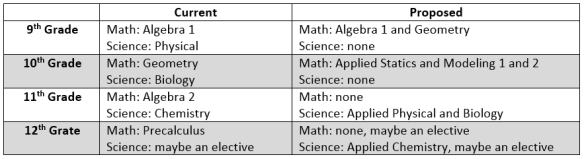
Thing to note:

  • I’m replacing the goal of mathematics from preparing for college level calculus to students being able to apply statistics to the sciences.
  • All math is getting moved into the first 2 years of high school
  • All science is getting move into the last 2 years of high school
  • All science is “Applied” because students now have the statistical foundation to bridge data and ideas. This is not a survey of science. It is comparing the predicted outcomes from scientific theory to observed data.

This is a complete rewrite of how both mathematics and science are taught. That said, I would argue that it is not a rewrite in how students learn. Sooner or later every high school math teacher gets asked “why do I need to know this?” This question has plagued math classes for decades and frankly, I think the student is right for asking the question. Much of what we teach they don’t need to know… yet. You need it to do calculus but few professions use calculus day to day. What we have done is the equivalent of asking a shop teacher to talk about carpentry to a group of students who do not know what wood is.

There is an old saying: “use it or lose it”. Like many high schoolers, I learn enough Algebra 2 to take the test and then quickly forgot it all. As an undergraduate, I made due without it and still made Dean’s List repeatedly. During my time in graduate school I had a moment that struck me. It was after an econometrics class. The professor used the Sin and Cos functions to adjust a model, specifically she added a wave like effect on top of yearly data. In other words, she used Algebra 2 to make an equation reflect the natural ebb and flow that we were seeing in the data due to the change of seasons. After class, I grabbed something to eat and then headed to the library to find an Algebra 2 book to remind myself of the details around Sin and Cos. As a graduate student I saw tremendous value in these idea that as a high schooler, and undergraduate, I could not even image a need for.

When I got to the mathematics section of the library, I not only found an algebra book but I found about half my econometrics class there as well. We had all completely discard the knowledge that was given to us in Algebra 2 since we saw no need for. Now, in the context of graduate level statistics, we were learning how useful Algebra 2 was. We were reading a mathematics text book and found it invigorating. This was not “why do I need to know this” this was “oh, I can see how this tool is very useful in these specific statistical situations”.

That last part, “useful in these specific statistical situations”, brings us to science. There is a large gap between using the scientific method to produce data, turning that data into a specific mathematical theory, and then comparing different mathematical theories. High school science is currently doing the first of those tasks, it is not even attempting to do the second and third part. Once again, the technology to do those calculations are already in the classrooms. Although we say we want our students to engage in science, really what we are doing is making them memorize a bunch of scientific trivia.

Real science requires not only an experiment to produce data, but quantifying a theory and then comparing your theory with others. That is actually making science, no just memorizing it for the test only so you can forget it later.

Politicians, educators, and innovators are doing their best to promote the STEM fields right now, but what is the choice we are really presenting our students with based on their experiences. Filtered through the high school experience, what high schoolers transitioning in to colleges are hearing from STEM promoters is “our set of trivia is more important than those other sets of trivia.” What is happening, because our curriculums do not allow it to happen, is that during high school the STEM fields are never about creation, discovery, communication, or innovation. Those elements of science, which require mathematics, are within the reach of high schoolers, but under our current system only the few who enter graduate school ever get to see it.

Social Media Marketing For Small to Mid-Sized Businesses

So let’s get a few things out of the way:

  • If you are a large company, you should be doing this already. Your scale alone justifies a minimal social media presence even if it is only a secondary part of your overall marketing.
  • If you think social media marketing is critical because it is the newest thing… please stop. You are not helping yourself and you are not helping your company. There are a million and one ways to waste money/time in marketing. If you are not critical of your methods you are doing it wrong.
  • Some think social media is so organic that it can’t be quantified. “It is your image after all.” There is no perfect quantification in marketing. That said, yes, parts of social marketing can be quantified and it is critical to do so even if the number is imperfect. Once again, be critical of your methods.
  • Some think social media is a flash in the pan and it will disappear. No, it will not. It has changed many times and will change again, but the core elements have not changed and they are not going to change anytime soon either. Although the avenue is the different, the core goals are almost identical to what you are already doing in traditional marketing and across your sales force. You are giving people your elevator speech in a flashy way so they look at it. Social media is simply that paired with basic text tools to make the communication two-way.

So given those points let’s set the stage for who this advice is targeted at: mid to small sized companies. Odds are you are not the “marketing guy”; you just wear the marketing hat along with a few others. You might not be a female in her teens or 20’s who lives on their smart phone, but at a minimum you do have a Facebook page and keep up with old friends, family, and some people from work.

Great! With that out of the way let’s get down the core of the discussion: what are your marketing channels? Have they been shifting over the years? Newspapers are taking a massive hit in readership, iPod/iPhone based play lists are used directly in cars over the radio, if not then satellite radio has at least taken a big share of that market away. As a mid-sized company most TV ads are probably too expensive for you so that only really leaves social media, sponsored events, direct mail, e-mail blasts, and maybe billboards.

Tracking radio, events, and billboards is difficult. With newspapers, you could at least run a coupon. If you are going to track direct mail and e-mail blasts this is also a great method. Most things you did in the past to quantify newspaper ads can be used with e-mail blasts in addition to the click-through and open rates that e-mail blast programs are already tracking for you.

So the core question: How do you quantify social media? Let’s talk about both numbers worth looking at as well as numbers worth ignoring.

Social Media Specific Coupons or Codes

The same techniques used in newspapers can be applied to social media. Social media specific coupons can be used isolate the effect of social media shares at the register. If anything is going to be the gold standard for social media this is it. Make sure that using the coupon is easy. Make it possible to use it from their phone as well as present a paper copy. Using a specific phone number or special e-mail address is also useful. In your POS or CRM system, flagging specific sales as from social media can also be useful.

Likes

Nope, sorry but “likes” have very limited value in business. They are not completely useless but are a third tier piece of information at best. It is a tempting number to care about because it is the tool people know best. That said I have some big problems with it. First off in my own marketing efforts I have seen a very poor correlation between our gold standard (coupons), and shifts in likes. Secondly, you need to remember that “likes” are free, your services and products aren’t. One of the basic principles of economics is price effects people purchasing decisions. Measurements on free items/action rarely match actual business transactions.

Demographic Data

Most of the major social media companies do provide some level of basic demographic information. Know this information and watch it carefully. I assume that you already have a good handle on demographic details from your current customers. Are your social channels the same?

Odds are they are the same but if not then you need to recognize this and adjust your marketing accordingly. One of the interesting things about e-commerce is that people interact very differently with companies online than they do with companies in-store. Watch for opportunities to either expand your customer base or more precisely target subgroups via social media. Remember: you should not use social media for the sake of social media but because it produces results for you.

The other critical thing to remember about social media is that there is a retail sweet spot… surrounded by some semi-fertile space that is itself surrounded by a lot of dead space. The stereotypes do hold true in this case, closing rates on sales via social media are much higher for females, those ages 20 to 35, and on items between $30 to $100 dollars. Each of those elements holds independently of the others but most of the great social media success stories involve clientele that hold all 3 characteristics in common. If your clientele/products are completely outside those 3 characteristics, go ahead and lower your expectations.

Views

What is the value of a “view”? If you have heard any good jokes about “branding” then this is where you can insert them. Views are the same vague beast as branding or visibility. They should have value, but are commonly hit or miss in terms of the effect on sales. While most other forms of advertising are geographically centered by their very nature, in the case of online views this will have to be an issue you have to work on. There is a common view of the internet not as a network of people but as a system of niche communities. I prefer this approach when dealing with digital marketing issues like “views”. Not all views are of the same value. Tracking total views is not very useful information. Tracking targeted views, with the definition of target being clientele that meet a very specific pattern of most likely to buy, is a very useful number.

Shares (including retweets, reblogs, etc.)

Once again, the value of these is defined the same as views. The various forms of shares are great because it is free advertising with no additional effort on your part. However it is often being shared with a completely untargeted group and you will not know the demographic information for that group. 10 high quality shares can outperform a 1,000 low quality shares. With shares 1 ≠ 1 so don’t fall into that trap.

The List of Questions

So if marketing is one of your additional responsibilities here is list of questions you need to be able to answer:

  • Who are you trying to reach (demographics)?
  • How are you defining success in social media? Social media is primarily a communications tool. I have closed sales via Facebook but more often it is useful for informing people about events or prospecting for more traditional sales avenues.
  • How does social media fit into the rest of your marketing efforts? Does that make sense in terms of budget/time when compared to what is happening in other aspect of your marketing? If mail and radio are about sales then why are you measuring your social media in “likes”? Social media can quickly turn into a resource sink so determining the ideal scale of your social media efforts is extremely helpful.
  • How are you bridging social media to results? What is the call to action?

Creating and evolving your social media marketing

I have spent a lot of time talking about metrics thus far and there is good reason for that. On a personal social media account you are who you are. For a business, a social media account is a strategic position, not an intrinsic personality. Determine your metrics, develop not one but multiple types of social media approaches, and then implement all of them one at a time. Check the result and adjust. Then adjusts again and again.

You don’t just make a good social marketing campaign, you have to adjust to your audience and their reactions. Be fluid with it. Social media is here to stay but social media platform you use and the rules of that media change and change every year. Your demographics will shift as well. ­