Why you should dislike your marketing

At a fundamental level, a company has to make a decision about who their marketing is for: internal stakeholders or potential customers. In my experience this is the single largest divide between company’s with glossy/expensive campaigns that are just a waste of money and marketing campaigns that drive revenue.

Are you trying to drive revenue… or are you trying to get internal approval for your campaign? In the minds of many marketers this is the same question because we force them to answer both questions with the same assets… which is a really odd set of behaviors. There was a time when this made sense, when marketing department were forced to rely a single expense purchase of a repeated single asset, like TV commercials or magazine ads. But in the modern era of digital marketing where you can test ideas quickly and cheaply, uploading many permutations of the same phrase or image and setting spending levels lower than a fast food value meal for each version, those old school approval methods are frankly ass backwards.

This is what I call the Mad Men problem. People watch that show and the big scenes, the big moments are in the pitch to the clients. Why? Shouldn’t it be in the ROI calculation that happens the month after the actual campaign runs? Shouldn’t it be an actually increase in revenue for their clients that drives home how good their marketing skills are? But it isn’t, it is the pitch. And this is true inside companies as well. Convincing in the board is more important than delivering on ROI numbers that many marketers don’t like to calculate anyways.

This is all just ego stroking and hard truth is if the sales team and product team are doing a good jobs, the marketing isn’t too much of a dead weight loss, and the ROI is not trackable, then you can have marketing that is bad and still have a very successful company.

So let’s walk through why you should be concerned if you like your marketing.

1. Your customers are not a monolith. You are.

If your marketing is always in a consistent voice, consistent aesthetic, and consistent talking points… then there are lots of hole in your marketing. People are different and you service a range of customers so why isn’t your marketing just a diverse?

The answers to that is companies want to “look professional” or setting design standards. There are advantages to that approach but it also limits your marketing as it removes customers who have their own views on language, aesthetics, and which talking points resonates with them. I am not saying you should hate all of your marketing… but there should be at least some of your marketing that is not to your taste. If not, that is a warning sign on how limited the scope of your campaigns are.

2. You are not your customer

Customers don’t know your history, you have lived it. They don’t know your products/services, you are an expert in them. When you are viewing your own marketing, you are bring subconscious baggage into that conversation. Baggage that your customers don’t have.

You aren’t facing your customer’s problem. You aren’t paying for your products/services. You aren’t having to compare your products in only this super specific situation vs. alternative in only this super specific situation. Your customer is always going to meet your marketing with their own baggage and view points and that vantage point will never be the same as yours nor are they the same as your other customers.

3. You are not trying to learn the product or meet a need

Marketing is often practical, especially in digital marketing where capturing key technical phrases are core to gaining traffic. Yes, this is meant to be eye catching and build trust, but it is also educating the customer how your product works and why it is useful.

Super consistent marketing means you are not trying to reach all these different view points. Reaching those different view points often require different levels of technical detail and different assumptions about the technical knowledge of the customer. It can also mean directly address your customers frustrations and how your product solves those problems. This is a powerful marketing approach but only for a small slice of the market. Thus is a great piece that will strike out most of the time, but when it does hit it is a home run. The result of those facts is you need a large mix of batters stepping up to that plate.

4. “Like” is not a result

Marketers are often looking to sales or other informal sources of information to try and find out if their marketing is working. These…. aren’t great. The goal should be to calculate how well your marketing is working, not get a vague notion of good. Stories about “I like it” or “this one guy contacted us” aren’t enough to attempt a formal calculation. Yes, there are lots of reasons why you will not able able to make a 100% full proof calculation of ROI. But what you can do is try to calculate the minimal possible value and a maximum possible value and then try to reduce the ranger between those two down the line. Knowing that the value is somewhere between $50 and $400 for a led is far more valuable than knowing “this one guy contacted us”.

5. Who is driving your marketing: Management, Creative, or results from Customers?

When was the last time you started a marketing campaign by reviewing the results from the last one? When was the last time you launched a campaign because you noticed a weakness in the last one and you wanted to take a second swing? Are these what drive your marketing or are they driven by internal factors like product launches or events? This goes back to the original question at hand, is your marketing for your company or for your customers?

You may have worked very hard on the latest product or are very excited about that newest feature… but to a new customer it is all new. And even to an older customer, there are niches in your product line they don’t know. The problem with letting “new” drive decisions is it often puts the wrong thing in priority.

Critique of D&D 5e, part 4

So after 3 posts criticizing D&D 5e, here are the reasons why you should choose it over other tabletop games. If you don’t remember my analysis method from the first post in this series, there are 3 key metrics I use to analyses games: range of content, simplicity of systems, and impact of choices. 

  1. 5e is winning on content and will continue to do so 

Wizard’s of the Coast has really put the time and work into their products. They have detailed and beautiful books filled with great ideas. I think some of those ideas need to be fleshed out or left out, looking at you tools, but as a whole they consistently put out a very large amount of content for players and DMs to use. 

I truly believe that the Players Handbook is better viewed as a buffet than a rule book.This has always been D&D’s strength. In the old days, magazine articles released new classes and monsters. 2nd edition has the spell compendiums to add a ton of new spells to the game. 3rd and 4th edition featured splat books to add in new classes, feats, and combat options. 5th edition has doubled down on an ever increasing range of races and subclasses. It has never been purely “here is how to play” but more “here are more ways you could play”.

While there are a ton of other tabletop games to choose from, due to the popularity of 5e, more and more content is being made for it. D&D has the longest lineage in this field and there are ways to convert that older material into 5e. The DM’s guild allows independent content makers to publish D&D 5e materials. Wizards of the Coast is making sure they are not just leading in content, but providing content at a scale beyond what others can even attempt to do.  

  1. They are tied on simplicity and impact, but that is due more to a weak field of options 

This game is either slightly simpler than others in the field or tied with them. This is less to do with 5e innovations and more to do with how almost all of these games link themselves back to the older versions of D&D. They try not to stray too far ways from that or they seek to recreate that feel which puts them back on that same path. 

Going back to my first critique, all of them do this. Why? There are way simpler ways to handle my first critique and frankly, the original elements of D&D are just an odd design. Everyone is copying the structure of that design because that is the norm for these games. Those table top norms have become so ingrained, become such sacred cow, that no one touches them. In the few cases that they do, they don’t fully reject but instead slightly modify them. This attempt to keep to the gaming tradition has hampered innovation in game design as both developers and players reject systems that are not attributes into modifiers into skills/weapon/spell. 

That said, 5e has worked hard to streamline abilities in a lot of places and leverage as few rules as possible to create as many mechanics as possible. This gives them a small edge on simplicity. Many of the OSR approaches use an older attribute to modifier system which lowers impact, once again giving 5e just a bit of an edge on impact as the other games are moving in the wrong direction. That said these two metrics are not that different when applied to other systems as they each have their own simplifications and special bonuses to give them each a bit more impact or a bit more simplicity. In the end, the race between the options is very close. 

This is why I call this a weak field of options. There are lots of options, they just aren’t that different from each other. D&D 5e is the best version of that game, but that game could use an overhaul. 

  1. It is what most people are playing

And here is the real reason, the Schelling Point. Roll20 published a list of their 78 most popular games by accounts. 5e was 55% of all game, Uncategorized was 14%, Call of Cathulu (all editions) was 9%, Pathfinder was 5%, and 4 other games were between 1%-2%, the other 70 games had less than 1% each. Roll20 is mostly 5e and that matters. Most tabletop games, right now, are 5e. This makes 5e the universal language of tabletop games.

Even if you are not going to play in 5e, 5e will serve as your reference points. This is our Rosetta Stone to other systems between random gamers and that counts for something. Frankly, it is easier to modify 5e into whatever you want than to relearn all the other mechanics that a more custom system offers. This makes a cyberpunk mod of 5e a better tool for DM’s than an entirely new cyberpunk specific game or a modern age mod of 5e a better tool than a unique Noir system for that murder mystery you want to run. 

Since D&D is fundamentally a social game, going to the social over the game makes sense and that puts you into playing 5e. It is not a game design or mechanics question, it is popularity question.

Critique of D&D 5e, part 3

This is the third in a series of posts.

1st: my high level critique of D&D 5e’s game design issues.

2nd: specific issues, 1 through 6.

Today we will be picking up with specific issues 7 to 13.

  1. Make proficiency a flat bonus

Go back to my rule for a +1. It takes level 1 to level 13 for the proficiency bonus change enough for it to matter. That is only 1 “real” change in the lifetime of the character. Just set it to a flat +3 or +4 and let’s all ignore it and move on. Expertise feels good at mid and high level games. At the lowest levels it feels crappy so setting a flat number also sets a flat expertise which is far simpler and feels better. This inflation makes it so lower and higher level characters can offer very little to each other. It actually makes story sense for a party of high level players to go find a 3rd level rogue for their sleight of hand… unless their sleight of hand expertise is nerfed by the scaling proficiency. 

  1. Don’t make the DM roll saving throws. 

This just slows down the game. As the DM, I have to track 6 things on my enemies: to hit, damage, health, AC, movement, and special abilities. With me rolling saving throws I now have to track their 6 stats, note which are and aren’t saving throws, and note what it’s proficiency bonus is. Great, that just took it from 6 things per enemy to 19 things per enemy. Yes, if you do the prep work that brings it back down to 12, but 12 is still way too much per enemy and I have to pause the fight to look it up. Right now I pick one stat per enemy and give them a large bonus, everything else is a 0 and I set all movement to 30 unless there is something special happening. That change removed about 60% of the times I had to look something up on a creature while running the game because it lowered the number of things to track to 6 (hit, damage, health, AC, special abilities, and the special stat). 

If this monster is special and needs a special rule for saving because that is how it is unique, great! Lean into that. Do not place that rule tax on every other creature. 

I get why this is here. It is to give magic users more options to play with and it makes their cantrips more interesting. 4th edition did this but they streamlined it down to 3 options which were set up like alternatives to AC. If this was reworked so the player rolled it and it targeted the caster’s “magic complexity” level or something like that I would be ok with it. Giving magic users a way to cheat around a high AC is fine. 

To spell this out in detail 

  • Basic Attack: roll to hit, 1d10+2 damage, most enemies have AC 14 but some have AC 18. Normally great, weaker against the high AC creatures 
  • Complex Magic Attack: 1d8 damage, all enemies have a DC 14 because the player is rolling their own spell complexity magic check. Normally a worse option against creatures, but against the high AC creatures it is better. 

The player is still taking the action, the DM gets to track 6 things instead of 19, the player still gets the reward for using their special Complex Magic Attack against high AC enemies… but if it is the only thing they ever cast then they actually do less damage than normal. This gives the player a choice instead of giving the DM more to track, it encourages the player to “figure out” the enemy, and it rewards the player for taking different kinds of cantrips. 

  1. Monster design is boring 

So right now the leader in monster design is not D&D. It is World of Warcraft. Back in their 3rd expansion they reworked all of their enemies so they did something cool and interesting. D&D… did not and enemies are mostly large stats blocks. Some enemies have special abilities… but they are not much more than powerful versions of their base attacks. That is the problem, you can just power through them. This goes back to the idea of impact: it should change how players approach the enemy. If it does not change their actions then that special ability has no impact. Mechanics should reward players to take specific actions like moving out of a charged attack, maintaining distance, or casting resistance against a spell damage type.

If the basic attack is 1d20+4 with 1d8 damage but sometimes it is the special attack of 1d20+6 with 1d10 damage… then the design sucks. Those attacks are nearly identical and the player would approach them in an identical manner. Try instead changing the damage type… but only if they could play around that with magic items or spells to counter it. How about the attack include a knock back effect. How about just 1d20 to hit but it hits for 4d6? Low AC characters should run away more than normal. How about it can hit two adjacent targets? This area of effect element means the party should not bunch up. Make a powerful range attack happen if no one is in melee range. These would all allow for optimal play via a change in player behavior. This rewards players switching up their tactics. 

  1. If the result of the saving throw is I can’t do anything… then why are you wasting my time by being here.

Here is a list of better ideas then “you lose a turn”. 

  • Take 1 damage for every space you move 
  • Movement is half 
  • Make a dex/wisdom save if you move more than half 
  • Spells cost 2 spell slots
  • When you cast a spell, deal 1d6 damage to yourself 
  • You are confused. When you cast a spell roll 1d4. If you get a 1, target the closest friendly unit instead of the enemy. 
  • -4 to attack rolls 
  • You can either attack or move, but not both 
  • Your weapon is knocked out of your hand and now it is over there. Go get it. 
  • You can either try and break the grapple or attack the enemy. You think something bad will happen to you if you stay grappled. 

All of these allow players to still make a choice on their turn. Their turn is weakened and they may not accomplish anything, but at least they still get to try. They still have player agency. Abilities that just tax turns feel really crappy. Disabling attacks from enemies should actually enable different kinds of choices on the player, not remove their ability to play. 

  1. The crafting system sucks… more specifically, there is not a crafting system

Quick note of tools. I love this idea, it is a super interesting way to flesh out a character and I really think it rounds out the world… but the Players Handbook needs to include a list of items players can produce with cost, sell price, and production time in them. Great idea, but they totally dropped the ball on fleshing out the details. There is 1 page to cover all tools and instruments, it can easily be 10 pages information. In Xanathar’s there are 7 pages talking about how tools interact with skills., but not a list of “Use X to make Y, it costs this much”. They have published 7 rule books and none contain a crisp simple table of craftable items by tool. 

The big problem with this is when you pair it with the skills bloat. Players are given these tools as part of their background or class. They want to use them and frankly, it is actually hard to avoid getting a tool proficiency. You do not give them enough information to use them. Imagine making the Wizard class with all the details on spell books and spell slots and subclasses focusing on different types of spells… but then you leave out all the spells. That is what they did, but worse. Most backgrounds as well as some classes and some races give out tools. You broke the majority of character by leaving out basic information on crafting but then force players to be crafters. If you are not going to support a system, don’t put it in the game and absolutely do not systematically weave it into the majority of the player characters.

  1. Races are boring… so boring they were just retconned… twice … neither of which isn’t going to help 

First off, we have already talked about +1 and +2 mechanics, which is the driving carrot for which race you select. The second most common carrot is dark vision… which is great in a dungeon crawl unless anyone has the light cantrip or a free hand for a torch at which point the DM just hand waves the whole light issue because it is kind of a pain. So, meh at best. Some races get a low level spell… which they can only use once a day. 

Look at OD&D for a second. There are only 3 classes… but an elf can freely switch between 2 of the classes at the start of each adventure. That is interesting and because they are still only playing one class at a time, no balance issues or complex multiclassing rules. That is way more interesting than a 5e high elf with a cantrip and a proficiency in long swords. Seriously, the difference is “always have a cantrip” vs. “sometimes be a full magic user” and “always have a longsword” vs. “sometimes be a full fighter”. How did the races get so watered down? 

Dwarves got big bonuses to saving throws and they take half damage from giants and ogres. That changes how they play depending on the enemy they are fighting and both sets of bonuses make them feel sturdy. It also encourages them to seek out those fights… which fits their story as a race. Good stuff. Way more flavorful than you can wear medium armor. Oh wait, we will give you tons of default options so you will either already have medium armor or have access to an option that is just as good if not better. Yes, Dwarves will almost always have access to a better option than what they are given by their race… which means that racial bonus means nothing.  

Xanathar’s tried to fix this by creating a bunch of racial feats. Some fun ideas here… but not alot of impact. Some are ok but most are meh. Tasha’s tried to fix this by creating a template where you can just build a race with flexible rules for modifying current ones. This is better… but this option uses the previous system which lacks impact so races still feel bland. Congrats, now you can make your own unique flavor… as long as that flavor is vanilla. 

So what should we do here? I actually like how the cleric subclass handles this question. It does not define the pantheon but gives a framework for one without pigeonholing the DM’s lore. The Cleric now has their default healing skills and their subclass abilities. This works because they can choose to heal or choose an action from their domain. Races need this kind of mechanic. We can do our class thing or this racial thing. The problem here is there is no real universal shared mechanic between classes except for hit dice or special types of actions, but maybe that is enough. Maybe only Dwarves get access to the defense action and they gain the rogue’s evasion action as well. Maybe Elves can use their hit dice to heal others as an action. This gives players specific choices during play, not bland bonuses. 

Here is a second alternative: Instead of just race, why not merge race and background? We really don’t need both, instead use one to influence the other. DM’s can use these as a way to make your campaign feel different from other campaigns and introduce the world’s lore, cultures, or political issues to your players. Thematically this makes sense. Wood Elves as outlanders, dwarves as guild craftsmen. Yea, that fits the common flavors. It is still not great but it is more engaging than another +2. 

Have the DM pick types of kingdoms then assign the races/background combos to those kingdoms. This would even give DM’s the ability to do things like assign multiple castes within a kingdom or multiple races to a kingdom. All members of the kingdom could share a specific background or different subgroups could have different backgrounds. We already have the noble and urchin background, what does it say about a kingdom if all your elves are nobles and all your halflings are urchins? What does it say about a kingdom’s politics if neither background is available? What if only one human kingdom has access to the paladins class and another has access to the warlocks class and both those Kingdoms gain a bonus when fighting the other one. This would require the DM to do a bit of work upfront… but frankly it is the kind of work they are already doing and now players are fitting into their world right out of the gate. Your character choices at the start are your exposition dump and one the min/max will actively engage in. 

These two better alternative systems are a great example of the problem with granularity. Granularity creates the illusion of difference. And that illusion can quietly block an opportunity to tell a better story. 

  1. Health, just list it. 

Forcing a complex calculation and modifiers and special rules for mixed classes for a health pool is a lot of complexity for a simple outcome. Just set the health by level and move on. If you want players to mess around with this, use the feat. But Sean, this means the constitution score is almost completely worthless! Yes, yes it does. Kill that sacred cow and move on. The toughness feat is great and let players take it multiple times. Solved. If the constitution is no longer needed… then remove it.


Thank you for reading. Next time we will pick back up with our 4th and final post in this series: why should play D&D 5e anyways.

Critique of D&D 5e, part 2

Round 2: my giant list of complaints (read: rant) 

My previous post deals with more design level issues and my philosophical underpinning for how I judge games. The next two posts actually dive into more specific examples of where I think they dropped the ball. I give alternatives options in as many places as I can. If I can’t give an alternatives, I at least try to give an example of what it should look like on a redesign.

  1. Attributes, Modifiers, and Saving Throws… pick a mechanic and stick with it

We do not need all 3 of these. Pick one and stick with it. Modifiers make the most sense, but if you can build a system using one of the others and only one, great use that instead. Remember my minimal impact point from last week? Here it is, modifiers can be -3, 0, +3, or +6… or another blocky scaling similar to that. Nothing else and nothing in between. Big blocks and easy to remember. No more trying to recall if that was a +3 or +4 or a +1 unless it is a saving throw then it is a +4 or wait did I gain a level so it is a +1 unless it is a saving throw then it is a +5. This, this right here is what slows down D&D games.

But Sean! I think saving throws are super engaging! Ok, fine. Make a feat to gain some saving throws. Oh wait, that is already a feat and no one takes it. Seriously, I have been playing 5e since the first night of the play test including many years of playing at adventurer’s league and dozens and dozens of one-shots and I have never once seen anyone take this feat. Not even on a joke character. Ever. That is how engaging saving throws are vs. base stats. 

This is the biggest example of complexity for little to no reason. Every time you add an element to a game you have to ask yourself “is the impact or range of options worth this additional complexity” and here it clearly is not. You don’t need 3 different mechanics to say “that character is the smart one and that character is the strong one”. 

I get why this system is still here. It is a sacred cow from the 70’s. Let’s kill that cow.

  1. Way too many skills/tools/languages are given out 

Rogues used to be the skills monkey. Return to that or more specifically the idea that powerful skills are an unique and defining element to your character. If you want your character to have special skills, great! Use the feats to gain those skills or gain them as a class feature. Want humans to be less bland… I mean special but in a general way? Great! They now gain 2 skills, which means something unless everyone is swimming in skills already. Your 1st and 2nd skills are interesting. Your 6th and 7th are not just forgettable, they are actually often forgotten and at the table players look down and say “oh, I am proficient in that, huh.” Same for languages and tools (a note of tools later). Let characters be special but don’t force special, that just creates bloat which then makes those skills/language/tools bland. Can you make a case to me that Rangers should have Survival and Wizards should have Arcane? Yes, yes you can but why do you need them to also take the other 3 skills to get that one? Let the classes get their one bonus skill and move on. 

The more you make people track extra stuff because it was tacked onto their class the more they will forget what they chose and have to pause the game to look it up. If I take a feat to gain a skill, I gave up something else to get that so I will remember it. Special skills aren’t special if everyone has so many that they overlap by happenstance and people forget what they have. I would favor far less skills given out and bigger bonuses on each. What if we did only expertise? Some classes gain 1 skill, but they get a +8 in it? See, that is a big, meaty bonus. That is something that defines who your character is. 

This is actually an overarching design issue. If a mechanic can affect one class, they want to make sure every class has a little piece of it…. Because why? If a class can do something special then just let them do something special and move on. 

  1. Action, Move Action, Bonus Action, and Reaction… is just too much. 

So this is actually not my complaint but a complaint of Mike Mearls, the co-lead designer on 5e. While I will be harsh to D&D 5e, there are clearly some solid designers behind this game and they are very self aware. They were very data driven during the play test and shared much of that data. They have also been very honest about the strength and weakness of some of their designs… which as a DM I find super helpful. I have a ton of respect for Mearls, Crawford, and team… but I am still going to pick on you a bit. This is a rant after all.

If you give someone resources like Bonus Action and Reaction to play with then they will want to use those… and if they have nothing to do with them they will feel they are being wasted and their turns will draw out as they try to figure out what they can do. What this means is that instead of doing 2 things they are trying to do 4 even if their class is not really designed to use all 4. Often the bonus action and reaction are complex and thus slow down the turn more than an action. 

I get it, you want the swashbuckling dex classes to get extra cool things to do. Less powerful attacks but more of them? Great! Build a mechanic into those classes to do that. Monks get 4 attacks as part of their attack action if they are not using weapons. Solved. This is how Extra Attack works and you nailed the design on that one. No need to add a new kind of action that burdens other classes. If you still want Monks to have bonus actions and reactions, fine, but give those to just Monks. There is no reason for the Barbarian player to juggle that piece. The original design goal was for bonus actions to be rare, now they feel mandatory for every class.

Mike Mearls has pinpointed this as an oversight in design. They intended it to give players a cool extra thing they could do… but only from time to time, not every turn. As they started to add those in they need a speed limit, thus the bonus action was born. This was meant to be a maximum, they never thought of it as a minimum. The designers talked about a 2 action system but rejected it. They did not want a 2 action system… but when players got their hands on it they started to heavily leverage the bonus action and it fell into a 2 action system with the second action just being limited. This kind of makes the bonus action the worst of two designs.

In the case of the swashbucklers, the bonus action was leveraged as a was to give them a style choice. Do I make this character a dual wielder or someone who can hop in and out of the front line without getting an attack of opportunity? They can dabble in the other, but it was assumed they would mostly do only one. The constant switching up turn to turn was not intended by the designers. 

This could be handled by just making a selectable choice at a low level. If you are a rogue then gain 1 of the following 3: 1) never triggering opportunity attacks 2) always double moving or 3) you get the off hand attack. There, we just created 3 new kinds of rogues that play very differently and removed the complexity of juggling bonus actions. We increased Range of Outcomes, Impact of Outcomes in unchanged, and it is now a much simpler system overall. We improve 2 of 3 elements that make up our elegance of design equation. Our rogues are a bit more limited but now there is more diversity between rogues. 

  1. Vancian Magic Spell Slots… are the most complex and least interesting way to play. 

The DMG contains alternative options for spell points. You should always use that, or maybe that -15% for a bit more balance.  It gives the player a more organic way to play. It steps a little bit of the sorcerer’s toes… but who cares. Don’t make other classes suffer so one class can be special. If it is a better mechanic, give it to everyone and then find something else for the other class. Credit to the designers… wait a second? Are the spell point costs and spell levels different numbers? (facepalm)

I joke a bit here. Part of 5e’s issue is it is held to the older designs of D&D and that forces some odd numbers. Still, instead of the whole spell point system, translate that to spell levels (yes, it will be unbalanced) and then round down the total number of spells level they can cast by the 15%-ish. This better system is  “your character can cast X levels worth of spells”. So if X = 6, you can cast two 3rd level spells or two 1st level spells plus a 4th level spell. This gives players flexibility and it is much easier to track.

The issue here is the spells in 5e are just not balanced to work that way. They are balanced for an uptick in power with 3rd level spells. That is why I added in the -15%. You may want to also give a small bonus to first level spells, possibly second. As a house rule, I would say they are always an extra 1 or 2 dice over what a cantrip at this level does. This way spending a single spell level is always an attractive option and there is already a cost in terms of action economy so I think this still works. Either way I think a big pool of castable spell levels is far more engaging than the accounting of Vancian Spell Slots.

If you wish to keep higher level magics less spammable, I would use 1 of 2 hybrids. First hybrid, keep level 6th to 9th spells spell slots and make the rest a pool. Second hybrid, keep the highest level of spell slot a spell slot and make the rest a pool. And yes, you can actually use both of these system together, with the second hybrid being used below level 10 and the first hybrid being used above level 10.

  1. The good levels are 3 to 8. Make everything else play like that. 

Levels 1 and 2 are really designed to teach new players the game and stop multi-classing from being runaway powerful. So… if multiclassing makes all other classes worse, what should we do? A) create a complex rule set with a ton of exceptions, competing rules for variation between classes, and to allow for granularity so we can spend 6 hours trying to juggle in another +1 which doesn’t really have an impact yet sometimes creates broken combos or B) tell people you get 2 and you have to split them evenly…. 

Wizards of the Coast, you picked “A” didn’t you? 

Post level 8, the problems becomes health inflation and challenging your players. At higher levels the game just breaks because they become unkillable Gods… which sucks. Really, Really, sucks. I mean I have put in about 300 man hours to my 1 year long campaign and now my characters are so powerful I can’t challenge them without retconning every enemy, town guard, and soldier in my world. It is a shitty world building tool if it forces me to tear down my world and rebuild it every 4 character levels. If your design works against world building, it is quicker for me to just break your design then rebuild my world. 

It is worth noting that older versions of D&D solved for this. You gained levels until 8 or 9 and then just followed a formula for +1 or +2 health for every level afterward. Levels did not go to 20… they technically went on forever but the additional class features stopped near level 10. And let’s be honest, if a player has leveled up their character from level 3 to level 10, are they really still playing for the power gain? No, they are playing for the friendships, character stories, and the world… which just become broken because of the power inflation. Speaking of which… 

  1. Remove the inflation 

This is actually my biggest complaint and what makes it worse is this design decision works against the best parts of 5e. By creating a large level of power inflation you actually remove content from the game because that content is not relevant to your players at that point in time. Yes, you need power gain. But if the power gain is so great it turns giant sections of the world into “instant death” or “nothing here can kill me”, you have greatly limited what I can do with your content at any given moment. 

And in terms of engagement, gaining a +1 to attack when you know that all the enemies have just gained a +1 to AC is just not engaging. Bigger numbers are not fun, impactful numbers are fun. Also, bigger numbers just make the math harder which slows down the game. Huge health pools just feel strange in play. If you are going to give a creature a ton of health, I would also make the creature change somewhat at different health points or it just feels like you are headbutting a brick wall until the brick wall randomly falls over. 


Next week we will have the other half of my list of specific issues as we move to part 3.

Critique of D&D 5e, part 1

Today I will be reviewing D&D 5th edition using two approaches: first is walking through its “elegance of design” and secondly through a more free form “pros, cons, this is broken, here are my fixes” kind of list. 

When judging table top games, I have a very specific method I use to determine “elegance of design” 

(range of outcomes) x (the impact of outcomes) x (simplicity) = (elegance of the design)

Range of Outcomes 

This is simply how many choices you have to create your character. A game with 12 classes is a better framework than a game with only 4. If you know anything about the various editions of d&d, adding new classes was a design priority in the early years. Some new classes were simply alternative versions of previous classes… which is fine. If they give you a different feel or a notably different set of options in play, great. 

Sometimes specific mechanics or flavor elements just rub specific players the wrong way, so alternative classes can “save” that element of play for other players. See the Wizard spell casting table vs. the Warlock spell casting mechanic. Those feel different at the table. 

For D&D 5e, this is where the game shines the most. There are a moderate number of classes but also a moderate number of subclasses within each. There are also plenty of races to choose from, many feats, and a huge list of spells. This is where 5e shines out shines almost every other d20 style game. 

10 out of 10 on Range of Outcomes. 

Impact of Outcomes 

This is a measure of how much your choices actually matter in play. Now I want to be super specific here: I am NOT arguing that there is a statistical difference or that “on average” this feature is really powerful. What I am looking for is that a given feature is so powerful that it changes how you play the game. Do you ask a specific character to roll a specific check type on behalf of the party because in play you have noticed they always do well without knowing their exact bonus? Do you choose to charge into combat instead of staying at range because of a specific feat you gained last level? 

Before I give you my answers to this let me address the two most common arguments. But I can feel a +1 bonus, that counts right? No, a +1 is not good enough. Does the player next to you feel your +1? Do you change what action you are going to take this round because you now have a +5 instead of a +4 with swords? A bonus needs to change the actions and perceptions at the table, not just give you a bigger number. Levels effects feel. Low level is deadly and at high level I am an unkillable God. That is a difference right? Actually, that is just bad game design. If you look at the monster numbers, you will see that they tried to design the game so that variation by level wasn’t really a thing… they just failed at the balance point or DM’s ignored the balance rules because the suggestions did not fit their world. DM’s can also choose to make low level forgiving and high level deadly but it is just harder to do that in 5e because of the way the monsters and players were built. Yes, having 10 health feels different from having 40 health, but if monsters just go from dealing 1d6 damage to 4d6 damage, have the outcomes changed? That is just inflation. 

So how much of a bonus do you have to give a character before the effect is felt: I think at the lowest, it is a +3. I think a +4 is honestly the most likely answer. There is a case to be made that it is actually a +5 before it is consistent enough for other people to see/feel it at the table. So our answer is somewhere between +3 to +5… but a lot, and I mean a lot, of D&D is built around a +1. Now, multiple +1’s will get you to a notable bonus, but that means that from level 1 to 20 you are really only gaining 2 or 3 bonuses of impact assuming you line them up perfectly. The rest of your bonuses are just power inflation. This lack of impact is clearly D&D 5e’s greatest weakness. This is rooted in a system that is too granular and trying to hide impact in power inflation. 

While I am harsh on D&D for its impacts, there are exceptions. Some feats grant things like bonus to initiative, skills expertise, or dramatically extend the range at which bow are accurate. Those do change game play. There are plenty of class features that do change game play… but far more that are just inflation or tiny bonuses. At the end of the day, 5e is a mix bag of tactical shifts and wrestling with inflation. I consider this power inflation a tax built into the system. If you don’t take some upgrades into your main power sources your combat power will lag behind. This means characters are really choosing between maintaining power and impactful play options as they level up. 5e has some good power ceiling and floor mechanics to help with this, but that tax is still part of the game design. To make a balanced character, I still think you are limited to 2 or 3 real impact options with the rest of the upgrades playing down the inflation tax bit by bit. 

3 out of 10 on Impact. 

Simplicity  

5th edition D&D is highly refined and you can tell. A lot of needless complexity has been removed from older additions and core elements have been streamlined. I would call this one of the simplest of the d20 systems… but there is still plenty of room for improvement. D&D is still based on the assumption that your character is complex enough that you will always have a reference sheet nearby. That is a crutch. The character sheet filled not with story and items, but with references to other complex mechanics, is an admission that a character is so complicated that a player can not reasonably be expected to remember what their character can and can not do. It is better than most d20 systems, but most d20 systems are great examples of over complexity for the sake of over complexity. 5e is the least guilty, but not innocent. 

Now I happily point out that of my three variables, this is the one that is the most debatable. Many players really do enjoy the complexity of certain systems. They enjoy the min/maxing. They enjoy learning that 101 unique systems a game has to offer. These are people who play to learn, not play to play. There is nothing wrong with playing to learn. I enjoy doing it myself… but I quickly leave those games to try the next one. That is a very different kind of activity then having a story or world you want to explore and choosing a system to do it in. 

6 of 10 on Simplicity .

Results

So back to our original equation:  

 [(range of outcomes) x (the impact of outcomes) x (simplicity) = (elegance of the design) 

(10*3*6) = a score of 180 for D&D 5e 

But what could it be with some improvements? What if we removed some complexity that has minimal impact on play? What if we replaced a large number of tiny bonuses with a few bigger impact options? What if we removed the inflation and just plain bloat from the system? 

I think it is possible to get the impact moved up a few points from 3 to 5 and I think the complexity can be improved to 7 or maybe 8. To do this, we would have to give up a few things along the way. 

Assuming we could do that it would get us: (10*5*8) = 400… which is a huge score improvement. So… what are those design changes and why didn’t they make those to start with? 

We will talk through those next time. 

Why we need a better CR system and what it should look like

D&D 5e’s CR system is… bad. In fact I will take it one step further: it is a disservice to DMs. The problem is the whole system is built around a single design assumption and this assumption simply no longer describes the most common way people play D&D. 

That assumption is you should have 6 to 8 encounters per day and about half of those should be combat. But is that what DMs actually do? What if I want to have one big fight per day? 

The reality is we need a mix of answers for a proper CR system, I propose 4: 

  1. One fight per long rest against 1 strong enemy 
  2. One fight per long rest against lots of weak enemies 
  3. 3-4 fights per long rest, this specific fight is against 1 strong enemy 
  4. 3-4 fights per long rest, this specific fight is against multiple weak enemies 

DMs need this mix of answers to try and build a variety of combat options for their player. This flexibility will also allow DMs to respond to what players naturally do in game. The CR system is fine for doing 3 to 4 combats, which works great for a classic dungeon crawl. It sucks at 1 or 2 combats more common in more narrative focus play. The problem here is 1 and 2 is what players and DMs naturally lean into. It is what they inherently do. Yes, a thousand forum posts point out that you should do more encounters per day, but to that I have to say… 

Bullshit. 100% Bullshit. I see it on every CR forum thread and this thought process, this counterpoint, is completely and fundamentally wrong. 

I encourage everyone who thinks “you should do more encounters per day” to reread your favorite fantasy story or rewatch your favorite fantasy movie. And as you do, actually try to count out the combat encounters per day. Yea, heck of a lot more one fights per long rest then 3-4 fights per long rest aren’t there? Why? Because that is GOOD STORYTELLING. 

Yes, from time to time a dungeon run with multiple encounters is great. That is part of the game and any system that did not do that well would also be doing a disservice to D&D. But storytellers have for centuries relied on an episodic structure of big events, move/reset, then another big event for telling epic stories. Throwing that out is trading The Odyssey, The Arthurian Legends, and most of the works of Tolkien to get improved dungeon balance. Are we sure that is a good trade? I think it is an awful trade. 

If your party needs to travel 7 days from one town to another, are you going to have to fight 28 random encounters against bears and wolves? That is a lot of combat and real world man hours to go to the next town and talk to an NPC or do a basic fetch quest. Most DMs don’t do this. There may be 0-2 encounters on that road along the way, but those will have a long rest in between them. This is also where your ranger or druid can shine by helping you dodge an ambush or pacify a fight. 

Want to do a big battle between two warring factions? Yea, your PCs will do everything they can to have a long rest before that happens… which is exactly what real generals did with their real armies before real battles. If you try to stop your players from doing that.. it will actually harm the immersion of the game. 

The first thing any useful CR system needs is a way to calculate for one big battle per long rest. You know, like in The Hobbit when they meet the trolls on the road, or the goblins inside the mountains, or the spiders in the forest, or breaking out of the elf jail, or the dragon in the mountain, or the big battle at the end. That right, everything in The Hobbit was one encounter per long rest. D&D 5e’s CR system can’t properly balance a recreation of The Hobbit or even a single chapter of The Hobbit (/facepalm). 

Ignoring it altogether is bad design. Now while we are at it, let’s go ahead and address the other counterpoints in the room. Is your group playing D&D to play D&D or are they trying to tell/experience an epic fantasy story through D&D. 

This matters because it changes a single word: should. Should you have 6 to 8 encounters per day? Well, if you are playing D&D for the sake of D&D and that is what the rules say, then yes you should. But if you are telling a story via D&D then you should set story flow (encounters) to match the needs at hand and then bend the difficulty to match that flow. Maybe that is 4 smaller combats as intended, but maybe that is 1 really big combat or 8 tiny combats or 1 medium combat followed by 1 larger combat. 

So I did an experiment on this. In my game we were coming up on the mid campaign big bad and I knew they would be doing so after a long rest… because my players are smart so of course they are. So instead of setting all the fight details, I kept parts of it to be determined. I determined his damage and AC, but then built out a list of nasty tricks/abilities and instead of removing health I just tracked how much damage my party did and then when it was down to the wire decided to let the next hit kill him. 

The party was four players at level 8, one player at level 9, and a good mix of abilities. The battle was the big bad, a pair of low CR guards at the start of the fight, and 10 low CR guard equivalent enemies at the end of the fight divided into 2 different hunting parties. In the middle of the fight I had the big bad use some, but not all, of the nasty tricks I had built. When all was said and done I did my best to reverse engineer what I did to what CR that actually was. It was CR 16 for a party of mostly CR 8 characters. I did not expect it to require that high a CR to challenge my group. To retest this I had a fight against a dozen Hun-like riders and archers. This time I explicitly set it a CR of 12 as they were just a group of bandits on the road. They were taxed, but I think they could have handled another fight of the same size. 

Assuming this scales, and I do not know if it does, that would give a new standard of: 

  • 1 encounter per day: twice their level in CR 
  • 2 encounters per day: +50% their level in CR 
  • 4 encounters per day: their level in CR (current default) 

There are a few additional issues to take into account when doing one big fight. First, long rest centric classes will be stronger vs. their short rest cetric counterparts. For my party they were a good mix but take into account your party as needed. Secondly, there are multiple healing options in 5e vs.older additions, but the new healing dice and healer’s kits are not viable so a healer with full spell slots is more critical then normal. Third, my combat design was centered on having 3 “phases” to the fight, given that this was centered on one big fight I basically treated it like it was 3 small fights back to back. It took place on a giant map of the whole town, with different elements being pulled in at different phases and containing a polymorph of the big bad at the start of the 2nd phase and ending at the start of the 3rd phase just to hammer home the differences between the phases. My CR 12 fight was a 2 phase fight with additional calvary swing in about half way through. 

The hard truth is I just don’t think the current CR is built to be used like this. I can kind of force it too… but I make a lot of little edits along the way. D&D is very consistent in terms of AC, bonus to attack, and dice used per magical attack. Pushing the CR like this both adds risk for a run-a-way TPK and enemies that will never miss or never be hit. On the table top, I can fake this behind the screen but I currently DM on roll20 so those rolls are in the open. 

The design assumptions behind CR in 5th edition are just wrong. I think it works great for a 1980’s convention hall dungeon run. I don’t think it works for an episodic fantasy tale. 

Is political hate speech… hate speech? Should it be?

We are in polarized times, emotions are high, and nerves are frayed.

So what am I calling political hate speech? If someone said, “I hate all black people” or “I don’t trust Muslims” both would clearly pass for hate speech across a range of definitions. Both are morally wrong, they would be denounced, and the social push back against them would be justified. But whenever hate speech is brought up, the limits of free speech are also brought up closely behind. Let’s frame that debate. Looking at those previous two statements, I think we can agree that both are clearly highly negative to a specific group and neither adds any real insight to society. While Americans hold freedom of speech as a fundamental right, most are also strongly against hate speech. First, entirely on the moral ground of the content. Secondly, what is gained by it? It is a large negative with no additional insight. When people defend hate speech it is not on the quality of the speech but on the ideals of free speech itself. We see freedom of speech as good for society due to its positive effects for the press, faith, science, arts, and criticism of those in positions of power. 

So once again, what am I calling political hate speech? Same structure as before but since we added an adjective let’s swap out proper nouns. If I say “I hate all Republicans” or “I don’t trust Democrats” would either pass as hate speech? Let’s look at our previous standard: how negative are those statements and how much insight does it provide society? The gut answer is actually different. Today, it is socially ok to hate the other political party. It is not seen as that negative but just part of the political process. Religious and racial identity are held in respect and are treated as a line you do not cross without facing social consequences. Political identity, you side with those crooks? WHAT IS WRONG WITH YOU?!!?!? 

… and isn’t that strange? I know plenty of people whose political beliefs are held far closer to their identity than a racial or religious connotation. I know plenty of people who are passionate and closely tied to one specific policy, one among two dozen held by one party or the other, but that one policy is critical to them. They are willing to volunteer their time and money to further that specific cause. They are willing to march, preach, and take a stand for that issue. It is a core part of who they are. 

So let’s view this structurally. Let’s say two people hold mixed views across two dozen policies, some for party A and some for party B. They could completely agree on 24 of 24 polices, 100% political agreement. But the first person feels very strongly about option A of policy 23 while the second person agrees with option A but they are passive about it. Both agree on option B for policy 24 but while the first person finds that a trivial policy, the second person thinks it is the most important question facing this generation. Both people agree on 100% of the issues, but their passions lead one to party A and another the party B. 

And now because of their political alignment it is ok for them to hate each other? If they were elected representatives they would produce identical voting records, and it is still socially acceptable for them to run attack ads against each other? Why? 

Because political hate speech is socially acceptable.

But I have to ask, have you ever read an old book that used the N word? Watched some of the old Disney pieces made for the US government during WWII that featured caricatures of the Japanese? Today those make us cringe. Yet we are 100% comfortable today with political straw men and demonization?  

Political hate speech is a poison and the body being destroyed is not the political parties, but the ability to create policy. The ability to have a minimal level of discourse. The ability for us to consider uncomfortable truths. But this is not the first time we as a nation have faced this poison. 

During the founding of our nation, there was a debate over the role of the church within the state. We have all heard the reasons for why we have separation of church and state… but that story is always told from the perspective of what is good for the state. After those points were made at the constitutional convention, Rev. John Witherspoon stood up. The other founding fathers must have expected him, being the only man of the cloth among the delegates, to provide a counterpoint. He didn’t. He argued in favor of the separation of the church and state for the good of the church. 

Rev. Witherspoon moved from Scotland to the American Colonies at the behest of the Presbyterian Church. The Presbyterian leadership in England had become aware of a schism that had formed between their American congregations but they were unclear of what the causes were or how extensive the schism was. Rev. Witherspoon was a respected theologian so they were sure he could straighten out any details. 

What Rev. Witherspoon found in America was not churches split by theology, but churches split by politics, specifically, the question of loyalty to England. Given the cause of the schism, neither side wanted the nature of the debate to get back to England which is why the Presbyterian leadership was being left in the dark. Despite that, the effects of the poison of politics were so strong they were felt across the Atlantic Ocean.

We live in a multifaceted world made up of many multifaceted communities. Yes, your politics matter, but so does your job, your church, your family, and all the other touch points in your life and community. How does political hate speech filter through those? Are all of those things combined worth the poison of that hate speech?

We can blame politicians, institutions, or specific individuals, but I think we need to stop political hate speech as a society. Chris Rock once noted that as a rule he “talked about what people do, not what they are. If you talk about what they are, that hits harder”. If you want to object to a political action or a bill, do so. You should speak up. But don’t object to who people are. That forces people into camps. And when people get pushed into deep political camps they lose the ability to see the other side. Under this mind set, it is worthwhile to damage yourself once if it causes the other side to be damaged twice. In a zero sum world, that wound is a win. What this actually means is the nation as a whole gets damaged three times so the partisans can score points against that other side. 

We need to move the conversation out of the zero-sum world. A skilled politician and political thinker will be able to see the opportunities for partisan gains as well as when to reach across the aisle to build a bi-partisan bridge. If you can only do one, you are only half a politician. As I looked out at my country today, I see a lot of half politicians driven more by political bigotry than the greater good… or the basic ability to compromise so they can score points in their own districts. Political talking points of both parties are driven more by political caricatures that are closer to the cringe worthy material of the 1940’s then an actual reflection of the world today or the other sides policies. 

I am not saying both sides are equally guilty. The Republicans have been playing with fire more than the Democrats and they got burned on Wednesday. They deserved to get burned on Wednesday… but note that all of Congress got hit by that. We all need to de-escalate the hate and worry more about how to build the bi-partisan bridge then how to score the next round of political points. We are all stuck with each other and the other side is large enough they are not going away.

6 Measures to Better Understanding Asymmetric Basslines

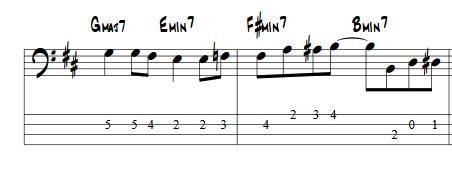
For this post we are going to analyze just 6 measures from single song to figure out how we can write better basslines. The song is Ain’t No Mountain High Enough by Marvin Gaye and Tammi Terrell. It is a Motown recording using their studio band, the Funk Brothers, with James Jamerson on bass. James Jamerson is one of the most influential bass players of all time so if you are unfamiliar with him, go do your homework and then come back.

Listen to the song if you don’t already know it. This version has the bass turned up and has a visual for the bassline. The sheet music below is from www.thebassment.info.

So this is just 75% of the chorus and you have a fairly a straight forward 4 chord progression.

G… E… F#… B…

If you are used to 4 chord power songs then you already know a dozen different fills to connect these chords. This is slightly different as it is in the key of Bm with you ending on the root. Thus you have a traditional 6 – 4 – 5 – 1 line. Otherwise, nothing really note worthy here, and most bass players would have played some simple licks to connect the parts and moved on.

But not Jamerson… and lines like this are why he is a legend.

Take just a second to think of a more traditional bassline under this song using some of the riffs you already have in your arsenal. You make it sound a bit funky, you put a bit of groove in it, and I’m sure you execute on it well. Listen back to it in your head I sure it sounds good. But does it have that rolling roar of a Jamerson line? So let’s break it down.

Using Octaves Asymmetrically

So we have our line of 6 – 4 – 5 – 1 in the key of Bm, but what octave do we play it on? For many the answer is often either what has the tone we want or if we specifically want to play the root higher or lower then the rest. On lines that end on the root, we often play it lower than everything else to give it extra oomph and create a feeling of resolve with in the line.

So what does Jamerson do with the root notes of the chords in terms of octaves?

Low – Low – Low – Low
High – High – High – Low
High – High – High – High

Each line is different. We start low, go to a mix, and end high. That is 3 different basslines just in terms of the where we place our root notes. Let’s look at the transitions between roots.

Low (go up to walk down) Low (walk up) Low (walk up) Low (walk up)
High (bounce around) High (walk up) High (go down to walk up) Low (walk up)
High (walk down) High (walk up) High (walk up) High (go down to walk up)

Every transition is different from line to line with one exception. The transition from Em7 to F#m7. This one part is the same every time. Notice he also walks up 7 of the 12 times, walks down 3 times, and bounces around only once. This is mostly an ascending line with intentional movement to make dramatic moves down so he can chromatically walk back up.

Using Rhythm Asymmetrically

Jamerson is a bit less dramatic here (not so with the verses, but that is for another time). The first and third pass through the chord progression we see the same rhythm. Note that by holding out on the & of 2 in the second (and sixth) measure it breaks the 1 and 3 flow from the first (and fifth) measure.

1 – 2 & 3 – 4 & | 1 & 2 & – & 4 & |
1 & 2 & 3 – 4 & | 1 & 2 & 3 & 4 & |
1 – 2 & 3 – 4 & | 1 & 2 & – & 4 & |

The second line reflects the first and third pass through the chords, in fact is one note busier in each measure, which is every other chord. This means it still feels very close… but isn’t quite the same.

Bring the Asymmetrical Element Together

So what is the big picture of these 6 measures?

Low Octave – Rhythm 1
High/Low Octave Mix – Rhythm 1 with slight variations
High Octave – Rhythm 1

He uses similar chromatic walk up throughout. He keeps the relationship between the Em7 and F#m7 the same at all stages. He never radically changes the style or tonality. That said, go listen to the song again. That chorus has a this rolling roar that brings you in and is constantly shifting below your feet.

In an earlier blog post I ranted against musician’s obsession with tone, and I concluded with the idea that if you feel like your tone is lacking, maybe the problem is with the bassline you are playing. In an earlier post I also talked about the role of a bass player as selecting between great lines, not just being good enough to play one good line. The exercises needed to seek out those better basslines are the same kinds of approaches that can be applied across a verse or chorus to create a dynamic asymmetric bassline. Notice that we are ignoring our preferred tone across octaves to write a line that moves across octaves.

And that is part of the barrier to asymmetric basslines. You must put the technician aside and lean hard, hard, into the musician side for being a bass player. A bias for specific tones or specific riffs will actually stand in your way as you try to write broader lines.

Election 2020 Predictions

So I created this blog to talk about policy. Yes, from time to time that also means talking about politics as a necessary evil. For the last four years, we have had only politics and very little actual policy happening. That is also why this blog went silent for a few years. I am publishing this on 10/31, the Saturday before the election.

So let’s talk about 2016. There are two way you can view the outcome in that election: Trump won or Clinton lost with the truth somewhere between those two. That election was more of a Clinton loss then a Trump win. Fundamentally, this is because Clinton was and always has been a weak candidate. First, Clinton has only won a single election which was for the New York Senate Seat in 2000 and while she won that it was by a smaller margin then other Democrats had won a New York Senate Seat. This was with the advantages of coming out of a popular Clinton presidency from her husband, high name recognition, a wealth of support from other liberal groups, and the proven Clinton election team supporting her. On the New York ballot in 2000 she got 55% of the vote for her senate run while Gore got 60% for his presidential run. Second, the Democrats got it right in 2008 in selecting Obama over Clinton. Third, Bernie Sanders was always a strange political outsider but went toe to toe with her in the primaries for fairly deep in the nomination process. When given a chance to vote for Clinton or someone else, people consistently look for someone else.

And this is without taking into account poor campaign management and marketing decisions that were made again and again during her 2016 campaign. They regularly spent time/resources in solid blue states, running up the score in the popular vote, while ignoring battleground states or shoring up the light blue rust belt. When your opponent directly and exclusively targets a specific group in your base, you have to go defend that group. Trump talked immigration, trade, and little else in terms of policy. That hits the union vote head-on and Clinton ignored it. Clinton deserved to lose that election, and god bless Trump he did his best to hand her a win but he was unable to make that many scandals that quickly.

A note on the polls in 2016. First, go listen/read/watch 538 and their various content. The polls where right in 2016, people were not reading them correctly. Clinton never really had the lead because there was a larger than normal amount of undecided voters. Traditionally those voters split evenly, this time they splint massively in favor of Trump. Once again, when given a chance to vote for Clinton or someone else, people consistently look for someone else. The media was taking polls like “Clinton 46%, Trump 40%” and calling that for Clinton without trying to figure out what was happening with the other 14%. On a normal election year undecided voters would have been closer to 4% they would split evenly at the election. Thus pundits would evenly split the 14% of undecided voters evenly and thus the projected results would be “Clinton 53%, Trump 47%” within a specific state. On the actual election those turned into “Clinton 49%, Trump 51%” which is within the projected results. Also note that while Trump’s win was a surprise to a lot of people, it was not a blowout. If Clinton would have done 2% better across the board she would have won.

Here is my view on 2020 in a nutshell. Clinton was awful, Trump is bad, and Biden is meh. My money is on the meh. Both Trump and Biden are known quantities and there are very few undecided voters this year. Biden is at or above the 50% mark in polls in enough states to win. And yes, that 50% is an actual 50% without any assumptions about how undecided voters will turn. There are many paths for a Biden victory if you map out all the possible routes. There are very few, and frankly odd looking, paths for a Trump victory. Things can go bad for Biden on election day and he still wins. Things must go near perfect for Trump for him to pull out a victory.

So that means we have a liberal government again right? Well…

Let’s talk about the Senate. With the presidency and house firmly in democratic hands, it is up to the Senate to slow things down. Senators have a long history of being independent and bucking their party on very specific issues, so expect moderate democrats to act as the brakes on anything too liberal. Most moderate democrats have specific issues with local resonance that they go conservative on. The real question here is how many democrats get senate seats. A 55-45 split is far more likely to push heavily liberal bills through since they can lose a few democrats along a the way while a 51-49 senate will pass the more pragmatic things without an issue but force the democrats to pick their battles on a number of policy fronts. Expect the Supreme Court to act on the most extremely liberal bills… but with a side note. Of course the republicans still have a chance of holding on to the Senate outright, specifically multiple routes to 48-52 favoring republicans, making the Senate an outright blocking body. While the democrats have the edge at the moment, it is a much smaller lead than seen elsewhere and many of these races are legitimately too close to call.

This difference between the 55 senators vs. 51 senators vs. 48 senators does a better job explaining Democratic spending and efforts right now then just Biden trying to run up the score or being extra careful in swing states. Yes, Biden is targeting swing states, but swing states are also where the senate is in play.

Side note on the court, I actually think people have over stated the importance of the new 6-3 conservative court. Roberts believes in voting to preserve the institution and other conservative justices have their own unique pet issues. That creates a quick path from a 6-3 court to a 4-5 court on controversial issues. Much of their conservative legal agenda is specifically pitted against legislating from the bench. While rights issues can and will come into question, broader tax and spend style policy choices seem to be clear of their aims.

So that is where I think we stand heading into the election. Congrats to Biden for the Presidency. Congrats to Pelosi for staying Speaker of the House. Congrats to Mitch McConnell and Republicans for locking down the Supreme Court. Now let’s all watch the Senate races to learn what kind of government we are actually going to get.

Stars Without Numbers – A streamlined guild to making a character

With Covid-19 being an issue, I have been using roll20 as a way to socialize with people other than family. As part of that I wanted to try something different so I looked into a few Sci-fi games. Most of this genre is dominated by setting specific systems, i.e. people who want to do Star Wars or Star Trek and happen to be doing via a table top game. In the end I settled on a system called “Stars Without Numbers” which I was informed is a simple system and gave DM’s a lot setting control so hopefully I could find a group with a unique setting and some of the bigger ideas that makes sci-fi great.

The system seems super flexible and simple when you read through it, but as you sit down to make a character it become very clear that you actually don’t have a clear guideline on how to make a character. This system gives you flexibility by burying your in exceptions, alternative rules, and unclear paths. So I have written this break down. Mostly, this is just me figuring out how to make my own character, but I’m putting it forward to helps others that are hitting the same confusion. Note: these are rough guild lines, exceptions are listed below.

Skills foci level up hit points attack bonus
Expert 3 from Background, 1 bonus 1, 1 NCNP 3 skills, +1 NCNP 1d6 half your level
Warrior 3 from Background, 1 bonus 1, 1 Combat 3 skills, +1 to combat focus 1d6+2 your level
Psychic 3 from Background, 2 psychic, 1 bonus 1 3 skills 1d6 half your level
Adventurer: E+P 3 from Background, 1 psychic, 1 bonus 1, 1 NCNP 3 skills, +1 NCNP 1d6 half your level
Adventurer: E+W 3 from Background, 1 bonus 1, 1 NCNP 3 skills, +1 NCNP 1d6+2 half your level with a +1 at level 1 and 5
Adventurer: P+W 3 from Background, 1 psychic, 1 bonus 1 3 skills 1d6+2 half your level with a +1 at level 1 and 5

*NCNP: non-combat, non-psychic

This is not a 100% correct guide. This system has lots of exceptions that allow you to switch out different mixes of skills or trade skills  attributes or other bonuses.

  • Most foci give you a skill
  • If you roll on background options you may improve your stats instead
  • Con is added to health and gain each level
  • level also effect saving throws

The result of all of this is the following big point. At level 1, a warrior will most likely start with 6 skills (3 from background, 1 from bonus, 1 from warrior combat, and 1 from foci) while an expert will most likely start with 6 (3 from background, 1 from bonus, 2 from foci) The other things not listed here are the big bonuses to the 3 non-hybrid options. Both Experts and Warriors get a very strong reroll ability and full Psychic get a twice the range of skills.