Classes in Blackmoor, or, how to run a class system and abandon it at the same time 

So in Blackmoor, the pre-D&D attempt at a role playing game, we run into what I think is the best attitude to how to run a campaign and why I dislike so many modern RPGs. So with nothing to turn to, because he was doing something entirely new, Arneson grabbed a copy of the war game “Chainmail” and gave the three most interesting military units in the game to his players: the Hero, the Seer, and the Elf. 

The Hero is a basic ground unit that ranges from Light Footmen to Heavy Horse (all units in the Chainmail game) depending on the gear they can buy. Really, it is 6 different units that all follow similar rules. Basically, they can make themselves a higher point value unit by finding gear or looting dungeons to buy gear. They have 4 unique features: 

  • No morale checks (a war game mechanic) 
  • Gain +1 to all melee attacks 
  • The biggest and most powerful bonus of all: 4hp!… which in a game where everything has 1hp is actually a really big deal. All 4 points of damage had to be dealt in the same round. 
  • If a Dragon is flying overhead and you have a bow, instantly kill the Dragon on a hit of 10 on 2d6 assuming you are a “Ranger” and you are using enchanter arrows. 

There is also an upgraded unit called a Superhero. 

  • Force a morale check when you charge at an enemy formation
  • Upgrade that health to 8hp
  • Dragon killing with a bow on a 7. 

The Seer is the lowest form of Wizard. They had a strong default spell list right out of the gate. 

  • Invisibility on Self. This is a turn to turn ability so it is actively using their magic. 
  • Fireball… which used the math of a Catapult 
  • Lightning Bolt… which used the math of a Heavy Field Gun (i.e. a Cannon) 
  • Immune to normal arrows and they got a saving throw to prevent fireball or lightning bolt against them. Think of this as the shield spell and an automatic Counter Spell against spells they know. 

In addition to these things they also got a single spell of their choice. As they improved, they learned more spells and increased their odds with Counter Spell and Shield. They had two health and the defensive stats of heavy infantry which is solid. 

Arneson also made a few Elves. These elves were less Tolkien and more Kibbler or Santa style and are always talked about in the same breath as fairies. These were upgraded archers from chainmail with some bonus features like the Dragon-kill archery, invisibility, and bonus dice when rolling against Orc or Goblins (similar to 5e’s advantage system). They also got to ignore some of the rules about combining movement with archery as well as splitting movement. So they aren’t faster in a run, just less restrictions on movement overall. 

Now while Arneson was happy with a bunch of Heroes running around in his world, he still wanted Seers and Elves to be somewhat rare in his world… so he just did not make that many character sheets for them. Later on DMs and game designers would try to control for this rarity with stat requirements as a way to control access… but if you are the DM, yea, you can just control for that directly. 

As people started to play the campaign… things started to change based on what his players did, what players wanted, and what challenges they faced. 

First, built into Chainmail is a trade-off between protection and movement speed. Higher protection, slower movement (from 12” to 9” to 6”). Movement paired with a charge mechanic from the base chainmail game. 

The obvious way to play was to buy nicer armor and weapons as you looted the dungeon, so most players moved along this default “Peasant to Knight” style of play. Most players did this while hiring soldiers and building castles along the way. 

However a few mechanics stopped this from being universal. If in melee, you can give up your movement to attack a second time. Charge was also a solid tactic the people wanted to use whenever possible. Both of these made some players favor movement over armor. Thus, some Heroes preferred the speedy, so a more “Barbarian” style of play developed, ignoring the armor aspect of character development for the speed. 

Other players liked to have ranged weapons. Ranged weapons only fired once per turn and had specific movement limitations added. From here you can see the emerging mix of heavily armored knights with swords, lightly armored archers who quickly redeploy as far away as they could, and speedy barbarians who mix it up with both sword, bow, and charging into combat. This is NOT a Knight Class, Ranger Class, and Barbarian Class since it is all within the same system… but they did use those terms to describe who their characters were, not what their character was. And of course which of these options was the best also depended on if you had picked up a magic sword, enchanted arrows, or magical set of armor. This was all the default Hero and the root of the multifaceted Fighter we have today. 

One of the first big enemies in the campaign was a Vampire named “Sir Fang”. He was actually not played by Arneson, but instead played by another player and played by correspondence since they could not be at the table often. Some of the players were talking about how they could defeat him. They started to research vampires at the local church and discovered that yes, the vampire was weak to all traditional anti-vampire things. Then one of the players pitched an idea “Hey, can my Hero join the priesthood so I can make holy water?” Arneson loved this idea but wanted to keep the game balanced. So he gave the best answer any DM can give “Yes, but at a cost.” Two of the Heroes now class changed to Clerics. All of the magic weapons in the game were bows or swords, so they gave up bows and swords, thus limiting themselves to hammer, but they gained holy water and Turn Undead. They were now Van Helsing like characters.

As the campaign moved on, Sir Fang started to try to turn people into vampires. “The Wounds” was an euphemism for the pair of neck holes when a vampire had bitten into your neck. Wounded people had a chance to “turn” periodically, thus creating a moment like in a zombie movie when someone is bitten and the others have to decide to save their friend or kill them. One of the Clerics started to research how to cure people of vampyrism while the other Cleric went on a quest to find that knowledge. In the end, they put what they learned together and gained the origin of “Cure Wounds”. In modern D&D this would be a restoration spell with a percentage chance of failure, not a heal. This is a war game at its heart, you are either fully alive or fully dead, so there is no healing. 

The next set of upgrades were to the game’s Seers/Wizards. Those players were just a bit underpowered. Arneson did not change the class, he just patched each character in a different way. One of them got a temperamental baby dragon. Most of the time, it was a bonus but not always. … and yes, this right here, this is the best way to patch a character. Not a +1 or +2 or weak to X damage type, but a temperamental baby dragon. 

Another of these patches was the “Super Berries”. These were limited, grew on only one tree, and would rot after a while. The Wizard could eat them to cast a more powerful version of their spells. Basically, this is the 5e Sorcerer’s Empowered Spell or upcasting a spell but with a limited number of usages. That is right, Sorcery Points are actually older in D&D than spell slots. Blackmoor was played on Arenson’s ping-pong table and they used brightly colored ping-pong balls to track the Super Berries. Using a Super Berry also gave the player the chance to chuck the ping pong ball at the DM’s head, an underutilized mechanic in modern D&D to be sure. 

And finally we have… the unique ones. There are two characters that are often brought up as classes. They were never classes, just the result of one-off things in the game. The first is the Sage… which may be one of the most unlucky characters in the history of the game. They were a Hero and had built up a bit of an army. They studied tactical and siege weapons. They were meant to be a great and powerful warlord… until they were turned into a basilisk. One of the other magic users tried to develop spells to reverse the effects… but instead just kept polymorphing them into other random things. Every few sessions he would get transformed into something else odd, everyone would laugh about it, and then move on with the player using a set of monster stats for just a session or two. Finally in one session he got polymorphed into a female elf seer and he said “good enough” and that character became “The Sage.” Basically Arenson agreed to another “Yes, but at a cost” deal similar as he did with the Clerics. The Sage kept all his weapons, soldiers, and siege knowledge but would physically play those as a Seer. He-now-she, would give up damaging spells like Fireball and Lightning Bolt but keep spells like Shield, Invisibility, and Counterspell. She then gained some curses to cast on others. This odd character was a mix of war scholar and support caster is a class total unique to their story in game, with many of the curses match his previous forms. 

The second was “The Merchant” who was actually a bad guy like Sir Fang. No, this was not a player running a shop like a NPC. It was a mafia don and it was one of the players doing it. They were forming a cabal to raise pricing at all the shops and the tavern with the difference in price going to “The Merchant” who soon became the richest player until the other players were tired of being taxed and figured out who was doing it. That required the players to break up the mafia in game and thus defeat the Merchant. So, at the start PvP was enabled but it was done via economics. 

Much in the same way we got the Blue Rider, the Flying Bishop, and the Paladin. The Blue Rider had a blue-flame sword (nice), a mechanical horse named bill which ran on lamp oil (neat), and a set of blue platemail which was really strong (and he was clearly trapped in it, causing him great pain and slowly killing him, oh God!). The Flying Bishop was one of the two clerics but with a magic cloak that let him fly some-what, really it was more like jumping really well. So he dropped the hammer, got a pair of metal boots, and started to do kung-fu kicks. The Paladin was just one of the more honorable Heroes who had done some quests for the King, had a nice sword, and always answered the call to patrol the roads. 

So let’s review: 

Start of Campaign 

  1. Hero 
  2. Seer (limited number)  
  3. Elves (limited number) 

End of Campaign 

  1. Heroes with a side of Knight 
  2. Heroes with a side of Ragner 
  3. Heroes with a side of Barbarian 
  4. Seer but with Baby Dragon 
  5. Seer but with Super Berries
  6. Elves  
  7. Hero into Cleric 
  8. Hero into Cleric into Monk 
  9. Sage 
  10. The Merchant 
  11. The Blue Rider 
  12. The Paladin 

… and to me, this is the way to run a campaign. Give players the minimum they need to get started. Players should get their powers from the world, not the Handbook, so the more you give them upfront the less choices they have as they play. This makes large lists of starting character options a bad thing. Those ideas are great, but they belong in the world and not a starting character’s sheet. At the same time, the DM should not limit how a player wants to develop their character. They should allow for a “Yes, but at a cost” style of character development in game. How your character changes and improves should be a response to what happens in the game, not a build you got off of Reddit.

This is part of my beef with many tabletop games. We have moved character development from the story to the prologue. Let’s put the character back into the story.

Will the Democrats learn this time or repeat their 2016 mindset?

So to fully understand this article you will need to first read this: https://www.natesilver.net/p/24-reasons-that-trump-could-win. Nate Silver is still the best pollster America has. He is a liberal. These are his words on why his party may lose. Published 2½ weeks before they did lose. I would roughly divide these 24 reasons into 3 groups:

  1. Situational issues specific to this election or Harris in particular
  2. Running as an incumbent and people’s reflection on the result on the current administration
  3. Fundamental party issues

So before we dive into this, let’s start with point 0. If you are on the Left and this result is “unbelievable” or “I just can’t understand it” then you do not have any of the problems listed by Nate. You have a reality problem. That is not a take down nor is it an insult, it is a technically correct analysis on the range of information you are allowing in. Trump and Harris have been tied for 3½ months in the polls. If two people are tied, then it is not a surprise when either one of them wins. You should have seen this coming, or at least admitted that there was a notable possibility of it. Feeling bad for a loss, that is human and you have my sympathy. Doubly so for those who have worked hard on campaigns only to lose. Not being able to contemplate how a loss is possible even when it is widely reported on and has been widely reported on for months? That is an unwillingness to accept information you don’t like.

It is ok to be wrong. Use it to get stronger. 

So Nate’s 24 points break down into 3 big blocks of ideas: 

  1. 10 points specific to this election or Harris

  2. 7 points specific to how the Biden Administration ran things, or more precisely how well some of their policies worked

  3. 7 points about the Democratic party at large and where they fit in and aligns with the general US population

The first 10 we get to ignore. Those will not be an issue for Democrats in the next election cycle. If you want to scapegoat while refusing to get better, that is your list. Please don’t do that.

The next 7 are policy lessons that should be reviewed. CNN calls out Harris (https://www.cnn.com/2024/11/06/politics/harris-campaign-went-wrong/index.html) for struggling to answer the question “What would you do differently?”. That is a scapegoat. The problem is not how she answered her question but that many choices made collectively by Democrats over the last few years did not end up well. That means the party needs to reflect on those and make actual policy changes. A political party losing an election because they made bad decisions is the sign of a healthy democracy. Given the role of inflation in this election and the way Democrats treated Joe Manchin and economists who warned them on over spending, this black eye is earned.

Look, policy is hard. The history of public policy is filled with stories of unintended consequences. Some ideas are “broadly good ideas” but don’t work at a specific time or in a specific situation. That is a nuance that policy makers need to understand and always strive to get better at. Their desires for an idea do not outweigh the realities on the ground. Some level of moderation, timing, or situational adjustment are needed. Yes, still do the idea most of the time, just not all of the time if the situation does not match. Polarization makes this worse because what was a “broadly good idea” now gets turned into a political litmus test as if an edict from God. If you want to make minor modifications to it instead of bowing to it as an immutable truth then you are “not a real Democrat”. And that is the problem. When ideals and reality don’t agree, the side that votes against reality will quickly find reality voting against them in the next election. And that is the sign of a healthy democracy.

The final 7 issues are about the party at large… and almost all of them were said in 2016. Part of what happened here and has been happening is the Democrats were so busy hating Trump at the start of 2017, they just never reflected on their weaknesses and they elevated their most unlikable voices. You know, the exact same trick Karl Rove pulled during the Bush Administration. This is not hard to figure out. Open up the Democratic platform on one screen. Open up the Gallup poll on the other screen. Compare them and when 60%+ of the country disagrees with your position, that is where you need to moderate, not dig in.

Previously, the Democrats were slowly and steadily losing both the Labor vote and the minority vote. With the new male/female split among those in their 20’s, they may be losing the youth vote too. Now let me be clear: when I say “losing” what I mean is losing their advantage, i.e. they are now splitting the vote with Republicans instead of it being a source of surplus votes, i.e. part of their “Big Tent”. Latinos and the Asian voter were already becoming more diverse in their political views. We will have to wait and see the final polling numbers, but the number I am most curious to see is the ratio on how black men voted.

Either way, all of this adds up to the fact that the Democratic party is no longer the “Big Tent” party it once was. It is a medium tent party at best, and a medium tent party is just not good enough to win an election, not even against candidates as flawed as Donald Trump. For Democrats to win, they need to enlarge their tent again. That will take compromise on some issues, reprioritization on other issues, and flat out recanting some very unpopular ones. Those are going to be hard conversations for the party, but they are hard conversations that are long overdue. It is time for the Democrats to trade some tiny voting blocks in deep blue states to regain a footing in some much larger voting blocks in swing states.

… and you don’t have time to spare. As I am writing this the Senate is clearly going red and while the House is still in play… it is steadily filling up red as well. The Left needs to get strong if they want to divide power and block the worst of Trump in the second half. And that is the line. It is not “do I like this new policy position”, no the line is “does this position help win in the next election?”. That is the question that should have been asked in 2016 when Hilary lost. It should have been asked in 2020 when Biden won but with the thinnest of margins. The quality of character between Biden and Trump is massive, the margins should not have been that small. And now in 2024 the Democratic Party has once again being given the chance to take a fearless moral inventory of itself in the light of popular opinion.

I hope the Left learns. America needs it to.

Characters, Classes, and World Context

As I am working on my next campaign, I thought I would take a few minutes to write some of the context that goes into that. For this post we will have two parts: 1) elements of play and 2) trade-off between combat systems.

Element of play or What the heck is this game going to actually be? 

The early Blackmoor campaign, from which D&D was derived, was an odd mix of mostly crawling a single large mega dungeon with characters being units from a war game, raising an army for the big end battle, and then a smaller mix of one-off adventures in the land. 1st and 2nd editions of D&D, or OSR if you prefer, are also focused on a mix of smaller dungeons and hex crawling. In the early game, getting a burst of power to work through a dungeon works. For a mega dungeon… not so much. Raising an army for large battles was important in Early D&D but only in late game. Modern D&D is mostly split between DM’s doing small dungeons with a specific theme and then lots and lots of characters and one-off adventures matching them. 

The reason why this matters is because we have to call out what a character needs to do if we are making something like a class or character creation process. Given the previous ideas: 

While every campaign is different, between the editions there has been a shift in focus on what D&D games are and are not. On what kind of content they do and do not tackle. One of the reasons why more recent versions of D&D have struggled with designing Fighters is because in the early version the two most important things about Fighters is their ability to raise armies and their use of magic swords. Now everyone gets magic items and they are not raising armies, i.e. everyone is now part-fighter and half of the Fighters job is no longer a core part of the game. No wonder they are bland. 

There is also this core idea of player feedback in response to the content. Originally there was no thief class. Players created the thief class and suggested it to TSR, not TSR offering it to the player. And the original thief class is a completely logical response to a dungeon filled with traps and trickery. As the published modules started to lean on hex crawls more and more, the Ranger class went from a specialty within the fighter to its own stand alone thing. The Ranger class and its themes only really make sense in a game that is leaning into that niche of content. Rangers in 5e struggle… because they are best Hex Crawlers in a game that does not hex crawl. 

So if you ask me “How do I make a good Ranger class?” my answer to that will vary wildly based on which edition of the game you are playing or what kind of campaign you are running. In a Dark Sun like setting where you have to scavenge for water, Rangers are totally overpowered. In a generic superheroes in high-fantasy setting, Rangers have lackluster DPS. 

So in this next campaign, what are the marquee ideas I am pinning the campaign on?

  • Mega-Dungeons… or at least much larger dungeons with interactive elements between sections. 
  • Hunting down great beasts… with a focus on turning their hides into armor and weapons 
  • Faction Play… with a focus on building an army, raising a castle, and improving the realm with infrastructure 
  • A Real Time game, so one day in the real world is one day in the game. Time is a resource you use for self healing, regaining magic, crafting, self training, and training others. 

So how do these ideas affect the game? The biggest is how the real time game interacts with magic. There is always a cost to regaining magic so there is always an incentive to not cast a spell. At the same time, there is a meta level of play where magic users can stack up a large pool of spells in their magical arsenal. It is best to look at magic users not in terms of long rest but instead in terms of their total magic over their career.

Tools, which are throwaway items in 5e, are actually super critical to helping you and your allies to power up. Crafting will be more powerful and reliable than enchantment magic. It also means that many players will be dependent on other players for their “level up”. I double down on this idea with a team being needed to hunt down large monsters to make better weapons and armor but that creature only giving a limited amount of crafting material. 

And finally, given the faction play element, it is important to look beyond your character and instead look at your role in the world. Gaining +1 soldiers is more powerful than gaining +1 to your sword hand when fighting in a big battle. This creates a very different leveling experience because you are facing a trade off between different elements of play.

This goes back to the classic failure of modern D&D players to read only the class section of the older player handbooks and declare that Fighters are linear. They are not, they keep gaining extra attacks and more health via adding more minions to the battlefield. Neither the Beastmasters Ranger nor conjuring Wizards are the best pet class in D&D. The 1st Edition Fighting-Man is the best pet class in D&D. That is why Fighters use basic mechanics. You’re basic because you will be playing 4 Fighters at once. 

Of these three examples, note how they interact with each other. Crafting, regaining magic, training others, and resting to recover from tanking a dungeon all share the same resource: Time. Something like an Eldridge Knight or a Bladesinger becomes challenging in this system because they would want to drop all their Time into resting and regaining magic, but doing that ;eaves them with nothing left for Faction Play or leveling up their character with training and crafting. Those kinds of apex dungeon crawlers can be a thing… just know that sustaining those is hard and comes at a cost to other parts of the game. 

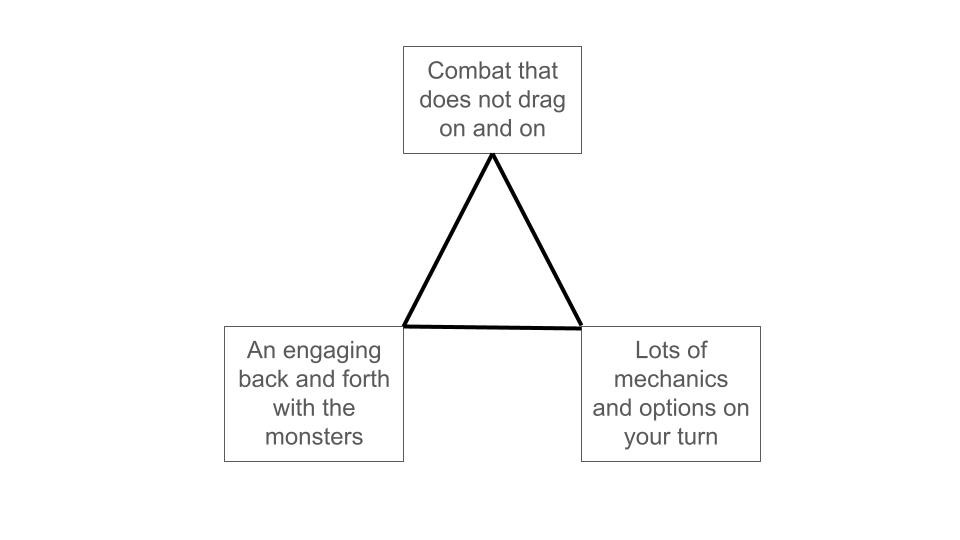
The Iron Triangle of Combat Systems 

This is the iron triangle of tabletop RPG systems. You can pick any two options for your RPG, but you can never get all three. 

Now all of these three ideas are good insights and fun ideas. There are plenty of reasons to support any of these and any combination of these. However, as a designer I have to accept that I will always sacrifice the third option is I prioritize the other two. 

For 5e D&D, the vast majority of combat ends in 2-3 rounds. That is the game working as intended. But as a DM and storyteller, I hated this. It removes any chance for the party to have to regroup and find a new approach to re-engage the enemy. That engaging back and forth matters. I find this hilarious because this is actually something the D&D movie gets right but that game gets wrong. From the first few scenes of the movie you know that Chris Pine’s bard is going to have to outwit the final boss. And he does in an entertaining way. But it is only entertaining because one the first attempt it failed. More rounds were needed for the regroup and second try. That is just the basics of good storytelling.

The problem is if you want those fights with lots of player options and power as well as the back and forth, that is just a really long fight. Great for the climax of a film, too many hours at the table. This is part of the mistake 4th edition D&D made. Combat took way too long and was way too complex. 5e was largely built on 4e’s math and 3.5e character sheets but with things gutted down to a 2e level of simplicity, or at least as close to that level of simplicity as they could get. The key with 5e being that they designed the characters and monsters to be 2-3 fights because they were actively avoiding longer fights. 

And that is the choice here: 1) the 5e approach of lots per round but only 2-3 rounds or 2) what I just did in Star Chaser with 6-10 rounds but less options per round. Both systems preserve the top of the triangle. I think that part of the Triangle is the most mandatory just due to the practicality of running games regularly. 

Now in Star Chaser I did sneak around that a bit. Most sessions were the red line while one or twice a year we had a series of green line sessions. Those green line options were large scope battles that lasted multiple sessions. I did this not by giving each character more options, but instead just gave everyone many simple characters to play all at once. I think that worked well in the campaign, fits right in with what the Blackmoor campaign did, and is actually what the D&D movie did as well. I think this mostly red line to sometimes green line but never blue line design is what the OSR community has backed into. The problem being that as time goes on, the obvious addition is adding in more things to classes which pushes you from the red line to either the blue line (with weaker monsters) or the green line (with stronger monsters). 

Combining these two frameworks 

Traditionally a character class is define as “here is the list of cool powers you get” 

So what is a character class in a system with a focus on: 

  • Faction level play 
  • Combat with lots of rounds but minimal per round 
  • A focus on very large dungeons with real resource limitations 
  • And character growth limitation governed by Time, not selecting between bonuses 

That is the challenge I am working through. This is not about balancing the DPS of different classes. This is about larger structural questions on how a class would interact in a much larger world and seeking more long term goals.

And that says nothing of things like characters aging, creating a lineage of characters, or the details of Kingdom management and technological development or magical development. This is not really a class system but a whole series of class system applied to different aspects of the game.