
So for my next campaign I am working on something both more in the west marches style and something in the Sword and Sorcery vein. The issue with the latter is most RPGs are written with high fantasy in mind. So I have been working on a simple system that best matches the Sword and Sorcery style and also leans into the west marches ideas.
I have a few overarching goals
- Warrior types should have a risk and reward play style. Brave heroes require brave players.
- Warrior types should be given bonuses for cunning plays. Cunning heroes require players with good ideas and who have figured out the enemies.
- This should feel gritty but require minimal paperwork and complexity
- Ways to handle the flavor character types: the trickster, the hunter, the beastmaster, etc. but require minimal paperwork and complexity. These are flavors of warriors, not fully their own thing.
- Capture the parallel duality of magic and civilization
- Magic should feel chaotic and corrupting but also powerful and strategic; spells should have an effect and a possible cost that reflects that effect; there is an element of corruption to magics, an element of darkness
- Civilization should feel chaotic and corrupting but also powerful and strategic, i.e. an Army; being in a civilization should have advantages and also drawbacks, risks, or complications; there is an element of corruption to civilization, an element of darkness
- Each character should have lots of small upgrade options within each class. I don’t want big leveling moments or lots of heavily delineated classes but instead lots of small bonuses. I would rather have a spectrum of Barbarians than multiple warrior classes. I would rather have a spectrum of Sorcerers than multiple magic classes.
Here is my attempt to answer those goals
Core mechanics
You will pick 1 of 4 classes: Barbarian, Sorcerer, Elf, and Dwarf. You start with 3 “downtimes” to spend how you like.
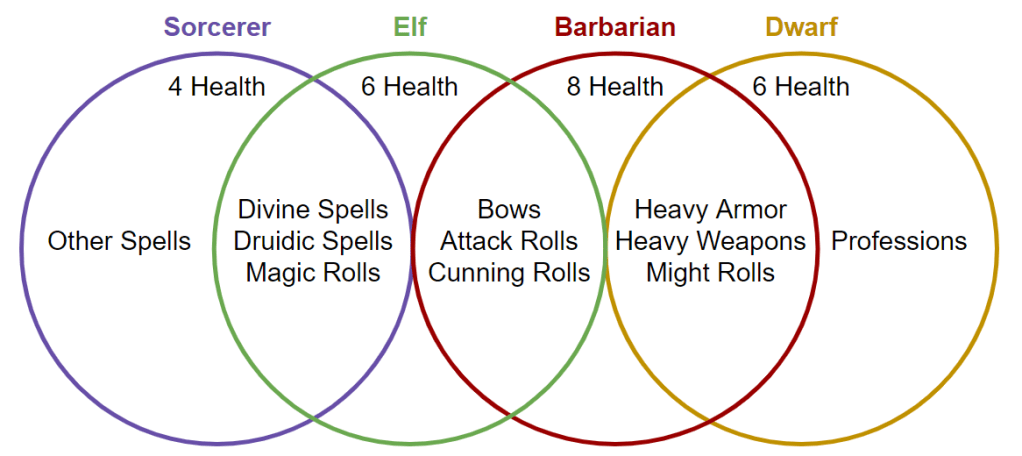
- Characters gain upgrades from “downtime” which happens every 4 sessions. Spending downtime is how people upgrade their character from a pool of options specific to their class. They can also spend loot to buy helpful things.
- Everything in this game is a d20, sometimes with advantage, and rarely with disadvantage
- The action economy is generally one movement and one action.
- Reactions: this allows you to take an action even if it is not on your turn. This is reserved for some spells, blocking with a shield, and specific maneuvers. If you use a reaction then you have to give up either your action or movement on your next turn.
The 3 part combat system
- This game does NOT use modifiers added to a d20 roll. Instead, you will gain charges of advantage in places where you would normally gain +1 bonuses in other systems. You can use multiple charges in a single action if you like.
- Pushing the action economy: You can take extra movements or actions on your turn but for each additional action/movement you make increases the DC. While pushing, failure to succeed any part ends your turn and you fall prone, giving others advantage against you. This allows for a blaze of glory or falling on your face right out of the door. DC starts at 11 and increases by +3 for each additional task.
- Attack vs. Called Shot: Attack is generally the more powerful option, but Called Shot allows players to engage a more roleplay style choice by trying to engage enemies in their weak spots. It is riskier but offers more rewards if you read the situation correctly. This is NOT a universal set of trip/blind/grapple mechanics driven by the players but a set of enemy specific weaknesses driven by the narrative.
Note that all three of these ideas flow together. You can use multiple charges of advantage on your turn to increase your odds of successfully pulling off multiple called shots in a single turn with a whirlwind of attacks. Of course doing all of that will blow through a lot of resources and put you at risk. Or you can use charges sparingly and be that fighter that is steadily ripping through enemies.
Magic
- Spells Casting: each spell has a DC, generally a DC 11. If you roll over, the spell happens as written. If you roll under then nothing happens and you forget the spell temporarily. The divine/druidic spells have no negative consequence. All other spells can have a negative consequence on a low roll, normally just a 1.
- Not all spells are equal. More powerful spells will have a higher DC and greater negative consequences but also are way more powerful.
- Note: spells work just like attacks and you can use them within the “3 part combat system” with magic rolls replacing weapon rolls.
- spells are less in the vein of magic missile and lean more to rituals or riskier combat abilities. Think less tactical and more strategic.
- Spells are… odd. Some have extra features that are discoverable. So as an example: you may have two copies of Cure Wounds and then two more copies that can be reversed into Inflict Wounds and a fifth copy which is Curing Words that works at range. Inflict Wounds and Curing Words heal like Cure Wounds but have a second option and higher DC.
Where to spend your down time
- There are 4 stats: Might, Magic, Cunning, and Weapons. A bonus in each is just another charge of advantage.
- Might: athletics, strength, endurance, movement (including pushing)
- Magic: casting spells and understanding magical effects
- Cunning: stealth, thievery, traps, lying, wilderness survival, and general trickery
- Weapons: melee and bow
- Those with magic can copy a spell they already know, learn a spell from a scroll, make a scroll of a spell they know, or combine magic fragments to create a random spell
- Dwarves gain a bonus down time which can only be used on professions. This allows dwarves to craft stuff or access new professions.
- This is not a complete list. As you play the game and discover things, more options will become available. As you build up the town and additional outposts, more options will become available. Some in game events may also open up additional options as well.
Recovery while adventuring
- In town, regain any mix of 10 from charges of advantage to spells to health. Most of the time you will not be in town.
- In the field, regain any 3 from charges of advantage to spells to health. Some spells or dwarven crafts may increase this.
 Sean Witherspoon's Blog